

A source-backed roundup of Google I/O 2026 announcements from official Google, Android, YouTube and X channels, including Gemini 3.5 Flash, Gemini Omni, Search agents, Antigravity, Android XR glasses, Workspace and Universal Cart.
Last checked: May 19, 2026. This roundup uses official Google, Android, YouTube and X sources first. Availability can vary by country, language, subscription tier and device, so confirm the live product pages before making buying or workflow decisions.
Quick answer
Google I/O 2026 was less about one isolated product launch and more about Google turning Gemini into an action layer across Search, Android, Workspace, YouTube, Shopping and developer tools.
The biggest announcements were Gemini 3.5 Flash, the new model Google says is built for coding and long-running agentic work; Gemini Omni, a multimodal creation model that starts with video; AI-powered Search updates with information agents, generative UI and a redesigned Search box; Antigravity 2.0 for developers; intelligent eyewear on Android XR; and consumer-facing agents such as Gemini Spark, Daily Brief and Universal Cart.
Google's official I/O site listed the Google keynote for May 19 at 10:00 am PT, and the official X event page framed the livestream as the place to watch Google's biggest news, updates and innovations for the year ahead.
Google framed I/O 2026 as the agentic Gemini era
Sundar Pichai's opening keynote set the tone clearly: Google wants Gemini to move from answering questions to helping users complete tasks across the products they already use. The official Google I/O collection summarizes this shift as moving beyond AI tools that help people write toward agents that help people act.
Google also used the keynote to give scale numbers. The company said AI usage across its surfaces has grown to more than 3.2 quadrillion tokens per month, up 7x year over year. It also said more than 8.5 million developers are building monthly with its models, its model APIs process roughly 19 billion tokens per minute, and the Gemini app has passed 900 million monthly users across 230 countries and more than 70 languages.
That scale matters because most I/O announcements depend on the same idea: AI gets more useful when it can understand context, use tools, interact with apps and keep working in the background under user direction.
Gemini 3.5 Flash is the main model story
Gemini 3.5 Flash is the first model in Google's new Gemini 3.5 family. Google says it combines frontier intelligence with action and is generally available now through the Gemini app, AI Mode in Search, Google Antigravity, the Gemini API in Google AI Studio and Android Studio, Gemini Enterprise Agent Platform and Gemini Enterprise.
Google is positioning 3.5 Flash around speed, coding and agents. In its official model post, Google says 3.5 Flash outperforms Gemini 3.1 Pro on many coding and agentic benchmarks, including Terminal-Bench 2.1, GDPval-AA and MCP Atlas, while being four times faster than other frontier models when measured by output tokens per second.
For normal users, the practical takeaway is simple: the same model layer is now powering the Gemini app, Search's AI Mode and agent features. For developers, it is the model behind Antigravity 2.0 and managed agents. For businesses, Google is pitching it as a way to automate long workflows that used to require repeated manual review.
Gemini Omni brings video creation and editing into the Gemini family
Gemini Omni is Google's new multimodal creation model. It starts with video and is designed to take text, images, audio and video as inputs, then generate or edit videos through conversation.
Google says Gemini Omni Flash is rolling out globally to Google AI Plus, Pro and Ultra subscribers through the Gemini app and Google Flow. It is also rolling out at no cost to users in YouTube Shorts and the YouTube Create app starting this week, with developer and enterprise API access planned in the coming weeks.
The most important safety detail is provenance. Google says videos created with Omni include SynthID digital watermarking and can be verified through the Gemini app, Gemini in Chrome and Google Search. In a separate I/O trust and safety post, Google also said it is expanding SynthID and C2PA Content Credentials across Search, Gemini, Chrome, Pixel and Cloud.
The Gemini app is becoming more proactive
The Gemini app update has three major layers.
First, Google announced Neural Expressive, a new Gemini design language with richer visual responses, fluid animations, typography and haptics. Google says this redesign is rolling out globally across web, Android and iOS.
Second, Gemini gets more creative through Omni and richer response formats. Google says Gemini can now shape answers into interactive timelines, narrated videos, imagery and dynamic graphics instead of returning only long text.
Third, Gemini becomes more agentic. Daily Brief is designed to prepare a personalized morning digest from information such as inbox, calendar and tasks. Gemini Spark is a 24/7 personal AI agent that can take action on the user's behalf under direction. Google says Spark is rolling out to trusted testers first, with a beta for Google AI Ultra subscribers in the U.S. planned next week.
This is useful, but it raises the privacy bar. Any AI assistant that connects to Gmail, Calendar, Drive, Photos or tasks should be treated like a powerful account integration. Turn on only the connections you actually need, review permissions and watch for prompts that ask to take high-impact actions.
Search is moving beyond answers into agents and mini apps
Search received one of the most consequential updates. Google says Gemini 3.5 Flash is now the default model in AI Mode globally, and it is rolling out a redesigned AI-powered Search box in places where AI Mode is available.
The new Search box can expand beyond short keyword queries and accept text, images, files, videos and Chrome tabs as inputs. Google also says users can ask follow-up questions from AI Overviews and move into AI Mode while keeping context.
The larger shift is Search agents. Information agents will monitor the web and fresh data sources such as finance, shopping and sports for a user's specific request, then send synthesized updates. These are planned first for Google AI Pro and Ultra subscribers this summer.
Google also announced expanded booking and calling capabilities in Search. In the U.S., Search will be able to help with tasks such as finding local services and, in select categories, calling businesses on the user's behalf. Generative UI is another major direction: Search will be able to build custom visual tools, simulations, dashboards and trackers for a question or ongoing task.
For readers, this is the part to watch closely. Search is no longer only a place to retrieve links; Google is pushing it toward a workspace where AI monitors, builds and acts. That can save time, but users should still check sources, compare options and avoid letting an agent make financial or account decisions without review.
Developers get Antigravity 2.0, managed agents and mobile AI Studio
Google's developer announcements were centered on turning prompts into production-ready work.
Antigravity 2.0 is now a standalone desktop application for orchestrating multiple agents in parallel. Google also announced Antigravity CLI for terminal workflows and Antigravity SDK for custom agent behavior. Managed Agents in the Gemini API let developers spin up an agent with a single API call in an isolated Linux environment.
Google AI Studio also gets a bigger role. Google announced a mobile app for capturing ideas on the go, Workspace integrations, export to Antigravity and native Android support so developers can build Android apps from prompts and publish to the Google Play Console test track.
The developer message is clear: Google wants Gemini to be used not only inside chat windows, but inside coding, testing, app-building, enterprise automation and scheduled background tasks.
Android XR glasses and Googlebook bring Gemini to new hardware
Android was split across two moments: The Android Show: I/O Edition on May 12 and Google I/O on May 19.
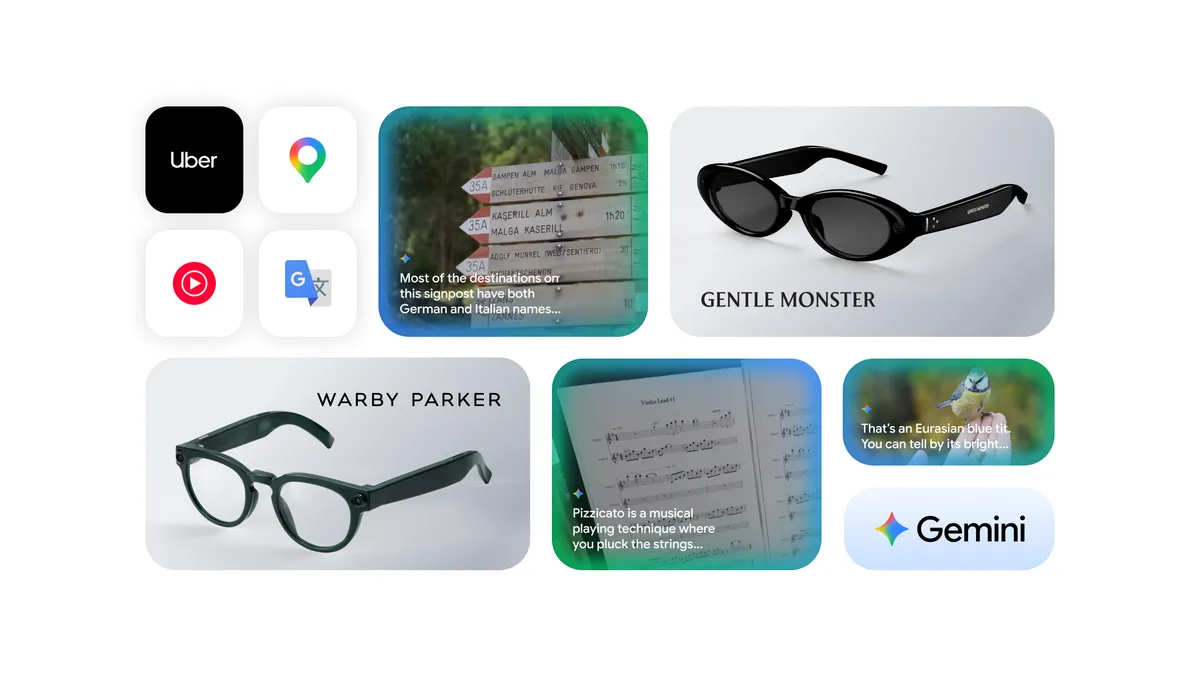
At I/O, Google shared more about intelligent eyewear for Android XR. There will be audio glasses and display glasses. Audio glasses launch first later this fall, with partners including Samsung, Gentle Monster and Warby Parker. Google says users will be able to ask Gemini about what they see, get turn-by-turn directions, manage calls and texts, capture photos and videos, translate speech and text, and use apps such as Uber and Mondly through voice.
Googlebook was announced ahead of the main I/O keynote as a new laptop category built for Gemini Intelligence. Google says it brings together Android, ChromeOS strengths and premium hardware. Key ideas include Magic Pointer for cursor-based contextual suggestions, custom widgets built from prompts and Quick Access to phone files from the laptop file browser. Google says partners include Acer, ASUS, Dell, HP and Lenovo, with more details expected when devices become available this fall.
Android Halo is another small but important signal. It will show agent status at the top of the phone screen so users can see what an agent is doing without leaving their current app. Google says Android Halo arrives later this year and will work with Gemini Spark and other supported agents.
Workspace adds voice, Pics, AI Inbox and Spark
Google Workspace updates were practical and work-focused.
Gmail Live lets users ask voice questions about their inbox. Docs Live turns spoken thoughts into structured drafts and can pull relevant information from Gmail, Drive, Chat and the web with permission. Keep can turn spoken brain dumps into organized notes and lists. Google says these conversational features are rolling out this summer to Google AI Pro and Ultra subscribers and in preview to Workspace business customers.
Google Pics is a new image creation and editing tool built on Google's Nano Banana model. It supports object segmentation, in-image text editing and translation, Workspace integrations starting with Slides and Drive, and shareable canvases for collaboration. Google says Pics is launching first to trusted testers, then rolling out globally this summer to Google AI Pro and Ultra subscribers and in preview for Workspace business customers.
AI Inbox is expanding beyond Ultra. It adds personalized draft replies, instant file access and task management improvements. Google says it is starting to roll out to Google AI Plus and Pro subscribers in the U.S., with Workspace Enterprise Plus preview availability.
YouTube gets Ask YouTube and Gemini Omni remixing
YouTube's I/O announcements focused on search and creation.
Ask YouTube is a conversational search experience that can answer complex video-finding questions, compile relevant videos across long-form YouTube and Shorts, and support follow-up questions. YouTube says Ask YouTube is currently available for Premium members aged 18 and older in the U.S. through youtube.com/new, with broader rollout planned.
For creators, Gemini Omni is coming to YouTube Shorts Remix and the YouTube Create app. Users can remix eligible Shorts with prompts and images while keeping the context of the original video. YouTube says Omni remixes include digital watermarks, identifying metadata and links back to the original video. Creators can opt out of visual remix in Shorts, and likeness detection is expanding to all creators aged 18 and older.
This is one of the better examples of I/O's broader theme: creative AI gets more powerful, but platforms need provenance, opt-outs and likeness controls to keep it usable.
Shopping gets Universal Cart and agentic payments groundwork
Google Shopping's biggest announcement was Universal Cart. It is an intelligent cart that works across Google services, including Search and Gemini first, then YouTube and Gmail later.
Google says users can add products while browsing Search, chatting with Gemini, watching YouTube or reading Gmail. The cart can look for deals and price drops, provide price history, flag stock updates and reason about compatibility. For example, if a shopper adds PC parts from different retailers, Universal Cart can warn about incompatibilities and suggest alternatives.
Google also discussed Universal Commerce Protocol and Agent Payments Protocol. UCP is meant to make checkout smoother across merchants, while AP2 gives agents strict guardrails for purchases, including brand, product and budget limits. Google says AP2 will start coming to Google products in the coming months, beginning with Gemini Spark.
The safety advice is direct: never let an agent spend money without clear boundaries. Use spending limits, review merchant details and keep confirmation steps turned on.
What users should do next
For everyday users, the best approach is to separate curiosity from account access. Try Gemini, Search AI Mode or YouTube's new features with public information first. Connect Gmail, Photos, Drive, Calendar or payment data only when a feature is genuinely useful and you understand what it can read or change.
For developers, the practical next step is to test Gemini 3.5 Flash in a narrow workflow before replacing existing tools. Antigravity 2.0, Managed Agents and AI Studio Android support could speed up prototypes, but agent output still needs review, tests and security checks.
For creators and publishers, Gemini Omni and YouTube remixing are worth watching closely. Watermarks, metadata, source links and likeness controls should become part of the publishing checklist, not an afterthought.
For buyers, wait for device-specific details before making hardware decisions. Android XR glasses and Googlebook both sound important, but pricing, regional availability, app compatibility and battery life will matter more than keynote demos.
Official X and video channels to follow
Use these official channels for the live conversation, media and follow-up posts:
- Google I/O 2026 event on X: x.com/i/events/2053241348807864323
- Google on X: x.com/Google
- Google for Developers on X: x.com/googledevs
- Android on X: x.com/Android
- YouTube on X: x.com/YouTube
- Google AI on X: x.com/GoogleAI
- Google I/O official site: io.google/2026
- Google keynote page: io.google/2026/explore/google-keynote-1
- Android Show I/O Edition recap and videos: android.com/new-features-on-android/io-2026
Sources
- Google I/O 2026 official collection: blog.google
- Sundar Pichai keynote remarks: blog.google
- Gemini 3.5 announcement: blog.google
- Gemini Omni announcement: blog.google
- Gemini app updates: blog.google
- Google Search I/O updates: blog.google
- Developer highlights: blog.google
- Android XR eyewear: blog.google
- Googlebook: blog.google
- Android Halo: blog.google
- Workspace updates: blog.google
- YouTube I/O updates: blog.youtube
- Universal Cart and shopping updates: blog.google
- Content transparency, SynthID and C2PA updates: blog.google
Before you move on
Global AI workflow guidance. Use this short checklist to turn the article into action.
- Check whether the tool can access private files or account data.
- Verify factual claims against primary sources before publishing.
- Keep a human review step for work that affects money, school, or customers.
This guide is written for practical user safety. For account, platform, or legal decisions, confirm critical steps with the official help center or your service provider.