

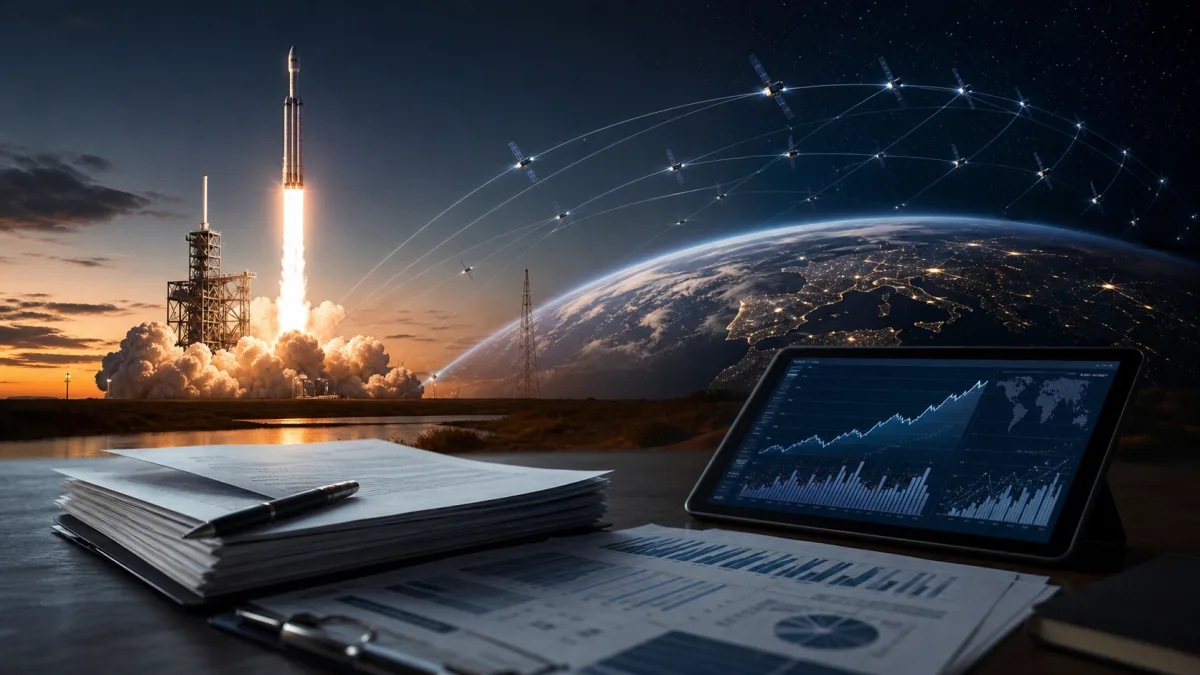
SpaceX is reportedly preparing for a record IPO. Here is what is known about the possible June timing, Goldman Sachs role, valuation debate, Starlink, Starship and investor risks.
Last checked: May 21, 2026. SpaceX had not released a public S-1 prospectus at the time of this update. Reported timing, valuation, ticker and offering size should be treated as preliminary until confirmed in official filings.
SpaceX is moving toward what could become one of the largest initial public offerings in market history, according to a series of reports that say Elon Musk's rocket and satellite company has begun the IPO process and is preparing for a possible June listing.
The reported offering would put one of the world's most valuable private companies in front of public investors for the first time. It would also test the market's appetite for a business that combines reusable rockets, satellite internet, government space contracts, defense connectivity, Starship development and long-term plans for space-based infrastructure.
AP reported in April that SpaceX had filed preliminary paperwork to sell shares to the public, citing people familiar with a confidential filing. Reuters later reported that Goldman Sachs is expected to secure the lead-left role in the IPO. Axios has reported that SpaceX has told investors it is planning for a 2026 public offering and that the deal could value the company as high as $2 trillion.
Those reports do not replace an official filing. The public S-1 prospectus will be the document that confirms the financials, share structure, risk factors, offering size and final path to market. Until then, the SpaceX IPO is an advanced reported plan, not a completed listing.
What has been reported
The latest reporting points to a fast-moving IPO process. AP said SpaceX had filed preliminary paperwork and that the offering could come as soon as June. Reuters, in coverage carried by Investing.com, reported that SpaceX's pre-IPO materials describe ambitions that go well beyond launch services and satellite internet. Reuters also reported that Goldman Sachs is expected to take the most prominent underwriting role, known as lead left.
Axios reported that the potential listing could value SpaceX at as much as $2 trillion and that market infrastructure providers have been considering how a company of that scale could enter major indexes quickly. Those details underscore the size of the event. This would not be a normal technology IPO. It could immediately become a market-moving mega-cap listing.
The most important missing piece is the public S-1. Investors still need audited financial statements, revenue breakdowns, margin data, debt and capital commitments, customer concentration, legal disclosures, voting rights and risk factors. A famous founder and a famous brand do not replace those details.
Is there an official IPO date?
No official SpaceX IPO date has been confirmed publicly. Reports have pointed to June 2026 as a possible window, and some market coverage has discussed mid-June timing. That should be treated as reported timing rather than a final date.
IPO timelines can change quickly. A company may file confidentially, receive SEC comments, revise the draft, wait for market conditions, change pricing expectations or delay the offering. The process becomes much clearer only when a public prospectus appears on SEC EDGAR and the company begins formal marketing.
For a company as large and complex as SpaceX, the review process could be detailed. The filing will need to explain launch operations, Starlink, Starship, government contracts, capital spending, regulation, environmental risks, space-safety risks and governance. If any of those disclosures require more work, the timeline can shift.
The correct way to track the date is to watch for the public S-1, exchange notices, underwriter announcements and the final pricing release. Any unofficial ticker, guaranteed allocation pitch or pre-IPO offer should be treated with caution.
Why the deal could be historic
SpaceX has already changed the economics of space launch. Its reusable Falcon 9 rocket, Dragon spacecraft and Starlink satellite network have made the company a central part of commercial space activity and U.S. space policy. A public listing would turn that private-market story into a public-market test.
The scale alone could make the deal historic. AP reported that the offering could raise as much as $75 billion, though the exact amount has not been confirmed. Reuters and Axios reports have discussed valuation ranges from around $1.5 trillion to as much as $2 trillion. At those levels, SpaceX would enter public markets as one of the largest companies in the world.
That size matters because index funds, pension funds, mutual funds and global institutions would all have to decide how quickly to build exposure. If index providers fast-track the company into major benchmarks, passive funds could become significant buyers soon after listing. That possibility is one reason the IPO is drawing attention beyond normal growth investors.
It also matters because a large SpaceX valuation could influence other private technology companies. A successful listing might reopen the market for high-profile private firms. A weak response could make investors more cautious about mega-valuations built on long-term promises.
Goldman Sachs and the underwriting race
Reuters reported that Goldman Sachs is expected to receive the lead-left position on the SpaceX prospectus. In IPO language, the lead-left bank is the most visible underwriter and usually plays a central role in coordinating the offering, working with other banks, advising on pricing and managing institutional demand.
The reported role is significant because major banks compete intensely for landmark IPOs. A company of SpaceX's size would generate prestige, fees and long-term banking relationships. The underwriters would also help shape the investment narrative: whether public investors should view SpaceX primarily as a launch company, a broadband company, a defense and infrastructure contractor, an AI infrastructure platform or a long-duration space-industrial bet.
That narrative will be important. SpaceX is not easy to value using one peer group. Traditional aerospace companies, satellite operators, telecom providers, defense contractors, internet infrastructure companies and high-growth technology platforms all capture part of the story, but none is a clean comparison.
The S-1 and roadshow will need to turn that complicated business into a financial model investors can understand.
The business public investors would be buying
SpaceX has several major business lines. Launch services remain the foundation. Falcon 9 has become a workhorse for commercial, government and internal Starlink missions. NASA notes that Falcon 9 began delivering cargo to the International Space Station in 2012, making SpaceX the first commercial company to visit the station. Crew Dragon later became central to NASA's Commercial Crew program.
Starlink may be the most important public-market business line. It provides satellite broadband service to consumers, businesses, aircraft, ships, remote regions and government customers. Unlike launch revenue, Starlink can generate recurring subscription revenue. That makes it easier for investors to model if the company discloses subscriber growth, average revenue per user, churn, capital intensity and margins.
Starship is the highest-upside and highest-risk part of the story. The fully reusable vehicle is central to SpaceX's long-term ambitions, including larger Starlink deployments, lunar missions, Mars plans and potentially new space infrastructure businesses. It also remains a development program with technical, regulatory and operational risk.
Reports also say SpaceX's investor materials describe ambitions around orbital data centers and future off-Earth industry. That could connect the company to the AI infrastructure story, but public investors will need to separate current revenue from speculative long-term opportunities.
Starlink could drive the valuation debate
The most important question for many investors will be Starlink's economics. Satellite broadband is a large market, but it is capital-intensive. SpaceX must build and launch satellites, operate ground infrastructure, maintain user equipment, handle spectrum rights and continually refresh the network.
If Starlink is growing quickly with improving margins, it could justify a platform-like valuation. Recurring revenue, global coverage and government demand would support the idea that SpaceX has a durable broadband infrastructure business. Aviation, maritime, enterprise and defense customers could raise average revenue and improve the mix.
If Starlink margins are thin or capital spending is very high, valuation becomes harder. Investors may still pay for growth, but they will demand a clear path to cash generation. The public filing should show whether Starlink is a self-funding business or still dependent on large external capital.
Customer mix will also matter. Consumer broadband and defense connectivity are different businesses with different margins, contracts and regulatory risk. The more detail SpaceX provides, the easier it will be to judge the quality of revenue.
Starship is both catalyst and risk
Starship is central to the long-term SpaceX story because it promises a much larger, more reusable launch system. If it works at scale, it could lower launch costs, expand Starlink deployment capacity, support NASA lunar missions and make new space businesses possible.
The risk is that Starship is still a difficult engineering and regulatory program. Test failures, launch-site constraints, environmental reviews, FAA approvals, manufacturing challenges and mission complexity can all affect timing. Public investors will need to understand how much of the IPO valuation depends on Starship success.
The S-1 should disclose development costs, technical risks, regulatory dependencies and any material commitments tied to Starship. It should also explain how much revenue depends on Starship becoming operational at scale. A valuation built heavily on future Starship economics would carry different risk than a valuation supported mostly by existing launch and Starlink revenue.
SpaceX supporters may argue that the company has repeatedly solved problems once considered impossible. Skeptics will point out that public investors still need evidence, not only ambition.
Governance will be closely watched
Any SpaceX IPO would put Elon Musk's role under the microscope. Reuters reported that pre-IPO materials identify Musk as central to the company and describe governance risks tied to his role. Founder-led companies can create enormous value, but public investors need to understand control, succession and shareholder rights.
The public filing should show whether SpaceX uses multiple share classes, how much voting power Musk and insiders retain, how the board is structured, whether the company qualifies as controlled and what rights public shareholders receive. It should also disclose related-party transactions and potential conflicts involving other Musk-linked companies.
This will matter because Musk is involved with several major businesses. Investors will ask how much time he devotes to SpaceX, how key decisions are made and what happens if he becomes unavailable or focuses elsewhere.
Governance risk does not necessarily stop demand for the IPO. Many investors have accepted founder control at other technology companies. But governance can affect valuation, especially when the offering is expected to be one of the largest ever.
Financial questions the S-1 must answer
The public prospectus will determine whether SpaceX's reported valuation is defensible. Investors will focus on several areas.
Revenue breakdown: How much comes from launches, Starlink subscriptions, government contracts, defense services, commercial satellite customers and other activities?
Profitability: Is SpaceX profitable on a GAAP basis? If not, how large are losses, and which businesses consume the most cash?
Margins: What are the gross margins for launch services and Starlink? Are margins improving as reuse and scale increase?
Capital spending: How much cash is required for satellites, Starship, launch sites, factories, user terminals and network infrastructure?
Debt and obligations: What long-term liabilities, purchase commitments or customer obligations exist?
Customer concentration: How dependent is the company on NASA, the U.S. government, defense agencies or a few large customers?
Use of proceeds: Will IPO funds support Starship, Starlink expansion, orbital infrastructure, debt reduction or general corporate purposes?
These questions are especially important because some reports say SpaceX lost money last year and that several future projects rely on unproven technologies. The market can accept losses if the growth story is strong, but it needs clear disclosure.
Risks investors should not ignore
The SpaceX story is compelling, but the risk list is unusually broad.
Operational risk is high because rockets, spacecraft and satellites are complex systems. Launch failures, satellite defects, cybersecurity incidents or ground-infrastructure problems can be expensive and public.
Regulatory risk is significant. SpaceX operates in areas affected by aviation regulators, spectrum authorities, environmental reviews, defense rules, export controls and national-security concerns. Delays or restrictions can affect revenue and schedules.
Capital intensity is a major issue. Even successful space infrastructure businesses can require continuous investment. A large IPO can provide capital, but investors should watch whether future funding needs could dilute shareholders.
Competition is real. In satellite broadband, SpaceX faces existing telecom providers, regional broadband projects, satellite competitors and potential future constellations. In launch, SpaceX leads, but governments and private companies continue to fund alternatives.
Valuation is the final risk. A great company can be an expensive stock if the IPO price assumes too much future success. At a potential valuation above $1 trillion, the margin for disappointment may be narrow.
Retail investors should move carefully
SpaceX will attract intense retail interest because the brand is widely known and Musk has a large public following. That visibility creates opportunity but also risk.
Retail investors should wait for regulated broker access and official filings. Fake pre-IPO offers often appear around high-profile listings. Promises of guaranteed SpaceX shares, unofficial tokens, private allocation links or urgent payment requests should be treated as scams unless verified through a regulated platform and official documents.
Even in a real IPO, allocation can be limited. Institutions often receive most shares. Retail investors may receive a small allocation or may have to buy in the open market after trading begins. If the stock opens far above the IPO price, late buyers may face immediate volatility.
The right approach is to read the S-1, understand the valuation and compare the current business with the future promises included in the price.
What happens next
The next milestone is the public S-1 filing. That document will confirm the issuer structure, financial statements, use of proceeds, risk factors and offering details. After that, investors will watch for a price range, exchange, ticker, roadshow schedule, final pricing and first trading day.
The deal could still be delayed. Market conditions, regulatory comments, valuation negotiations or internal decisions can change the timeline. For now, the reports suggest SpaceX is preparing for a historic listing, but the final details remain pending.
If the IPO proceeds near the reported valuation, it will become one of the defining market events of 2026. It would also turn SpaceX from a private symbol of future space infrastructure into a public company judged every quarter by revenue, margins, cash flow and execution.
FAQ
Is SpaceX public now?
No. SpaceX remains private. Reports say it is preparing for an IPO, but shares are not yet publicly traded.
Has SpaceX confirmed an IPO date?
No official date has been confirmed publicly. Reports point to a possible June 2026 listing, but the date can change until the public filing and pricing process are complete.
What valuation is being discussed?
Reports have discussed valuations from around $1.5 trillion to as much as $2 trillion. The final valuation will depend on the prospectus, investor demand and pricing.
Why is Goldman Sachs important?
Reuters reported that Goldman Sachs is expected to take the lead-left role, making it the most prominent bank on the offering. That signals a major Wall Street process, but it does not finalize the deal.
What should investors read first?
The public S-1 prospectus. It should disclose revenue, losses or profits, cash flow, customer concentration, governance, risks and the use of IPO proceeds.
Sources
- AP report on SpaceX preliminary IPO paperwork and possible offering size: apnews.com
- Reuters coverage carried by Investing.com on SpaceX IPO plans and prospectus excerpts: investing.com
- Reuters report carried by MarketScreener on Goldman Sachs lead-left role: marketscreener.com
- Axios report on SpaceX IPO market impact and possible index-rule changes: axios.com
- Axios report that SpaceX told investors it was planning a 2026 IPO: axios.com
- Space.com report on SpaceX IPO plans and space infrastructure context: space.com
- SEC guidance on nonpublic draft registration statement review: sec.gov
- NASA background on Falcon 9, Dragon and Commercial Crew: nasa.gov
Before you move on
Global AI workflow guidance. Use this short checklist to turn the article into action.
- Check whether the tool can access private files or account data.
- Verify factual claims against primary sources before publishing.
- Keep a human review step for work that affects money, school, or customers.
This guide is written for practical user safety. For account, platform, or legal decisions, confirm critical steps with the official help center or your service provider.