
A practical SEM guide for business owners covering paid search strategy, AI bidding, keywords, landing pages, conversion tracking and budget control.
Last checked: May 31, 2026. Paid search platforms change frequently. This guide focuses on durable SEM principles and current Google Ads patterns such as conversion tracking, broad match, responsive search ads, Performance Max and AI-assisted bidding.
Quick answer
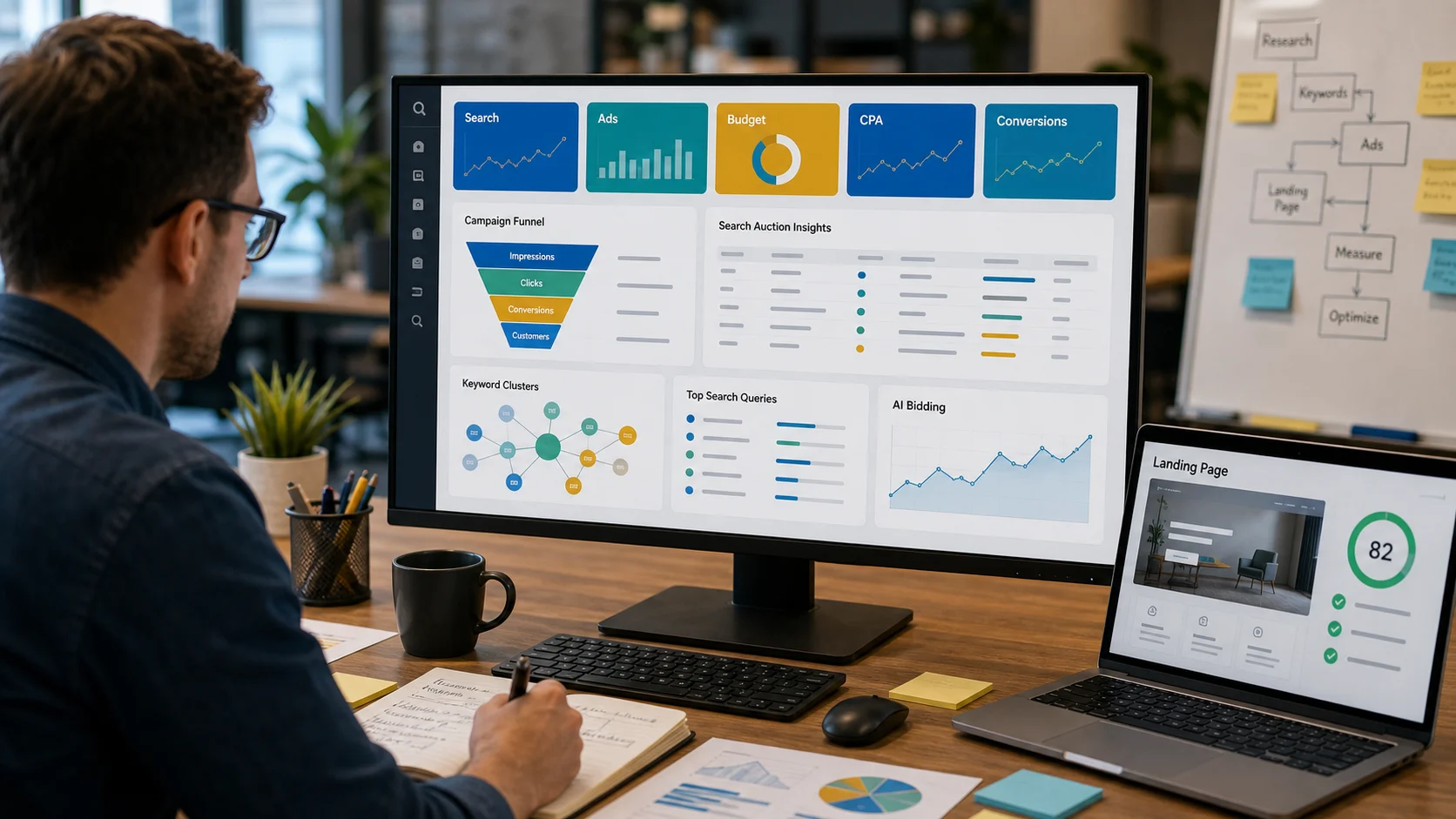
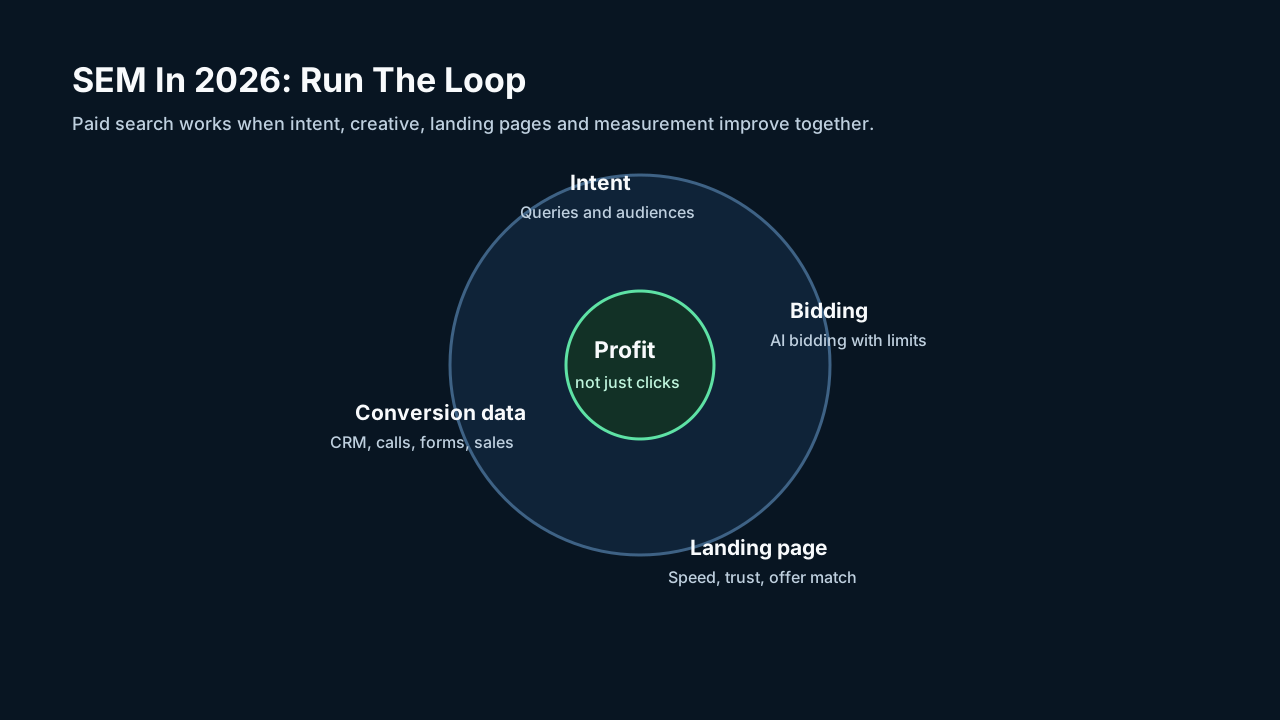
Search engine marketing still works in 2026, but only when it is managed around profit, not clicks. The modern SEM stack is search intent, conversion tracking, useful landing pages, AI bidding with guardrails, negative keywords, creative testing and CRM feedback.
If you run a business, do not start by spending money on every keyword. Start by knowing your best customers, your profitable services, your location or service area, your margin and your conversion path.
What SEM means in 2026
SEM usually means paid visibility on search engines. It includes traditional search campaigns, shopping ads, local ads, Performance Max, remarketing and AI-assisted campaign types.
The core promise is unchanged: appear when someone is actively searching for a product, service or solution.
The execution has changed:
- Matching is broader and more AI-driven.
- Creative assets are assembled dynamically.
- Bidding relies heavily on conversion data.
- Landing-page quality affects cost and conversion rate.
- First-party data matters more because privacy limits tracking.
- Brand trust affects both paid and organic performance.
Build the campaign around intent
Group keywords and audiences by intent:
| Intent | Example | Campaign priority |
|---|---|---|
| Emergency need | "24 hour plumber near me" | High |
| Commercial comparison | "best CRM for dental clinic" | Medium to high |
| Product search | "buy standing desk Dubai" | High if margin works |
| Research | "what is CRM software" | Lower unless you have nurture |
| Brand | Your business name | Defensive and measurable |
Do not treat every search as equal. A high-intent query can be worth 20 low-intent clicks.
The 2026 SEM checklist
Before spending serious budget:
- Set up conversion tracking for forms, calls, purchases and booked appointments.
- Import offline conversions from CRM where possible.
- Use enhanced conversions or privacy-safe first-party measurement where available.
- Build landing pages that match the exact offer.
- Add proof: reviews, guarantees, pricing clarity, photos, case studies and FAQs.
- Start with a limited geography or service set.
- Use negative keywords from day one.
- Review search terms regularly.
- Separate brand campaigns from non-brand campaigns.
- Track cost per qualified lead, not only cost per click.
How AI bidding should be controlled
AI bidding is powerful when it receives accurate conversion signals. It becomes wasteful when the conversion goal is too broad.
A bad setup optimizes for every form fill, including spam and low-quality leads. A better setup sends the ad platform stronger signals: booked call, qualified lead, quote request, first purchase, repeat purchase or closed revenue.
Use guardrails:
- Start with conservative budgets.
- Set realistic target CPA or ROAS after data exists.
- Exclude poor-fit locations.
- Exclude irrelevant search themes.
- Watch asset performance and landing-page mismatch.
- Use experiments before major budget changes.
Budget planning
For small businesses, a useful starting structure is:
- 60% on the highest-intent service or product.
- 20% on remarketing or Performance Max if tracking is reliable.
- 10% on brand defense.
- 10% on tests.
Shift budget only after enough conversion data exists. Do not judge a campaign from one day of clicks.
Common SEM mistakes
- Sending all traffic to the homepage.
- Measuring leads without checking lead quality.
- Using broad targeting before conversion tracking works.
- Ignoring negative keywords.
- Combining many unrelated services into one campaign.
- Letting AI optimize toward weak conversion events.
- Running ads without call tracking or CRM feedback.
Bottom line
SEM in 2026 is less about manually controlling every keyword and more about feeding ad platforms clean business signals. The business that tracks qualified demand, improves landing pages and reviews search terms will usually beat the business that only increases budget.
Sources
- Google Ads Help Center: support.google.com/google-ads
- Google Ads conversion tracking: support.google.com
- Google Ads enhanced conversions: support.google.com
- Google Ads broad match: support.google.com
- Google Ads Performance Max: support.google.com
Before you move on
Step-by-step recovery. Use this short checklist to turn the article into action.
- Start with the official app or account page, not a link from a message.
- Change exposed passwords and review active sessions.
- Save evidence if money, identity documents, or business accounts are involved.
This guide is written for practical user safety. For account, platform, or legal decisions, confirm critical steps with the official help center or your service provider.