


A practical news guide to AI in business, including adoption, use cases, AI agents, ROI, job impact, governance, risks, regulation and implementation steps.
Last checked: May 28, 2026. This article is based on Stanford HAI, McKinsey, Microsoft, PwC, NIST and European Commission sources. It is an independent business and technology explainer, not legal, financial or procurement advice.
Quick answer
AI in business now means much more than adding a chatbot to a website. In 2026, companies are using AI for customer service, sales, marketing, software development, finance, operations, supply chains, cybersecurity, HR, legal work, product development and executive decision support. The biggest shift is that AI is moving from experiments and individual productivity tools into core business workflows.
The current evidence points to three realities at the same time:
- Adoption is mainstream. Stanford's 2026 AI Index says organizational AI adoption reached 88 percent.
- Value is uneven. McKinsey's 2025 State of AI survey found that more than three-quarters of respondents said their organizations used AI in at least one business function, but more than 80 percent said gen AI was not yet producing a tangible enterprise-level EBIT impact.
- Governance is no longer optional. NIST frames AI risk management around governing, mapping, measuring and managing AI risks, while the EU AI Act is already applying some obligations and moving toward broader application.
For users, workers and business owners, the practical takeaway is simple: AI can improve productivity, decision quality and customer experience, but only when it is tied to real workflows, clean data, human accountability and measurable outcomes. Buying AI tools without changing the way work happens is usually where projects stall.
Why AI in business is in the news now
AI adoption has moved faster than normal enterprise software cycles. Stanford's 2026 AI Index says organizational adoption reached 88 percent and U.S. private AI investment reached $285.9 billion in 2025. That level of adoption does not mean every project is mature. It means AI is now part of normal business planning rather than a side experiment.
McKinsey's 2025 global survey gives a useful reality check. It found that 78 percent of respondents said their organizations used AI in at least one business function, up from 72 percent in early 2024 and 55 percent a year earlier. It also found that 71 percent said their organizations regularly used generative AI in at least one business function.
At the same time, scaling remains hard. McKinsey reported that only 21 percent of respondents whose organizations used gen AI said their organizations had fundamentally redesigned at least some workflows, and less than one in five said their organizations were tracking KPIs for gen AI solutions. That is the gap between using AI and getting durable business value from AI.
Microsoft's 2025 Work Trend Index framed the next phase around "Frontier Firms": organizations built around human-agent teams and intelligence on tap. Microsoft said 82 percent of leaders saw 2025 as a pivotal year to rethink strategy and operations, and 46 percent said their organization was using agents to fully automate workstreams or business processes.
The news is not simply "AI is popular." The news is that AI is becoming an operating model question.
What AI in business actually means
There is no single kind of business AI. Most organizations use a mix of several capabilities:
| AI type | What it does in business |
|---|---|
| Predictive AI | Forecasts demand, churn, fraud, risk, maintenance needs or inventory |
| Generative AI | Drafts text, code, images, summaries, proposals, emails and knowledge-base answers |
| AI assistants | Help employees search, summarize, write, analyze and prepare work faster |
| AI agents | Execute multi-step tasks across tools, often with approvals, memory and workflow triggers |
| Computer vision | Inspects products, documents, shelves, sites, medical images or physical assets |
| Speech AI | Transcribes calls, summarizes meetings, detects sentiment and supports voice interfaces |
| Optimization AI | Recommends prices, routes, staffing, resource allocation or schedules |
| Decision intelligence | Connects data, models and human judgment to operational decisions |
The most valuable business AI systems usually do not live alone. They sit inside a workflow: a support queue, sales pipeline, procurement process, code review, finance close, risk review, claims process, hiring workflow or supply-chain planning cycle.
Where businesses are using AI first
Most business AI value starts in areas where there is repeatable work, high information volume and a clear way to measure improvement.
Common use cases include:
- Customer service: AI can summarize tickets, suggest responses, route cases, detect escalation risk and support agents in real time.
- Sales: AI can research accounts, draft outreach, score leads, update CRM records and summarize calls.
- Marketing: AI can draft campaign copy, generate creative variants, analyze audience segments and localize content.
- Software development: AI can assist with code completion, tests, documentation, debugging and code review.
- Finance: AI can flag anomalies, summarize variance, support forecasting, detect fraud and speed up reporting.
- Operations: AI can forecast demand, optimize staffing, plan inventory and identify process bottlenecks.
- Supply chain: AI can model disruption risk, improve replenishment and recommend routing or supplier actions.
- HR: AI can draft job descriptions, analyze skills, support learning paths and answer employee questions.
- Legal and compliance: AI can summarize contracts, find clauses, compare policies and support review workflows.
- Cybersecurity: AI can triage alerts, summarize incidents, detect anomalies and support threat hunting.
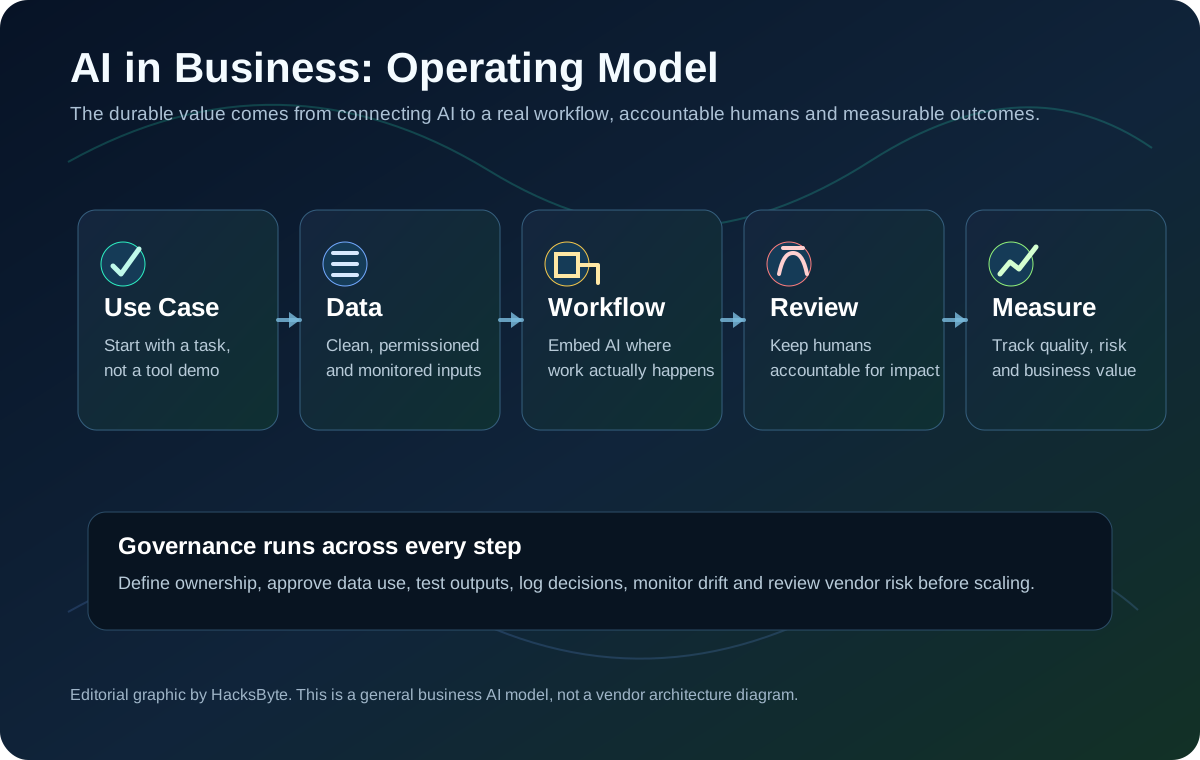
The right first use case is rarely the flashiest one. It is the one with a clear owner, available data, low enough risk to learn safely and a metric that shows whether the work got better.
The ROI question
AI return on investment is not measured only by time saved. A serious business case should track several categories:
| ROI area | What to measure |
|---|---|
| Productivity | Cycle time, tickets handled, reports produced, code shipped or hours saved |
| Quality | Error rate, rework, consistency, completeness, customer satisfaction or audit findings |
| Revenue | Conversion, retention, pricing uplift, faster launches or improved sales coverage |
| Cost | Lower manual handling, fewer escalations, lower support load or reduced waste |
| Risk | Fraud caught, incidents reduced, policy violations detected or controls improved |
| Workforce | Skills improved, employee satisfaction, training completion and adoption depth |
PwC's 2025 Global AI Jobs Barometer found that industries most exposed to AI saw three times higher growth in revenue per employee than the least exposed industries, and that AI-skilled workers saw an average 56 percent wage premium in 2024. That does not mean every company will get those results. It means the upside is real when AI exposure is paired with skills and operational change.
McKinsey's survey supports the same conclusion from another angle: tracking well-defined KPIs for gen AI solutions had one of the strongest links with reported bottom-line impact. If a company cannot say which KPI an AI system improves, it is probably not ready to scale that system.
AI agents: the next business shift
AI agents are systems that can plan and execute multi-step tasks, often by using tools, accessing data, calling APIs or coordinating with other agents. In business, an agent might create a draft proposal, pull account data, update CRM fields, schedule a follow-up and ask a human to approve the final email.
Useful agent workflows tend to share four properties:
- The task is repeatable.
- The required tools and data are known.
- Mistakes are reversible or catchable.
- The agent's actions are logged and reviewable.
Riskier agent workflows need more controls. Do not give an AI agent broad permission to move money, approve hiring decisions, change prices, delete data, send legal notices, alter customer records or commit production code without clear approval steps.
The best early agent deployments are narrow, observable and bounded. They save time because they handle routine work while humans keep responsibility for judgment, exceptions and consequences.
What workers need to know
AI in business does not affect every role the same way. Some tasks will be automated, some will be accelerated, and some will become more valuable because humans will supervise AI systems, interpret results and make higher-level decisions.
Workers should focus on five practical skills:
- Prompting and task design: knowing how to explain a task, constraints and desired output.
- Verification: checking sources, numbers, legal language, code and decisions before using AI output.
- Workflow literacy: understanding where AI fits into the real process, not just the chat window.
- Data judgment: knowing what information can and cannot be pasted into tools.
- Agent management: delegating routine work to AI while setting boundaries and reviewing results.
Microsoft's Work Trend Index said leaders expect teams to train and manage agents within five years. That is the direction of travel: employees will not only use AI, they will increasingly supervise AI-assisted work.
What leaders need to know
The biggest business mistake is treating AI as an IT installation instead of an operating change. A company does not become AI-enabled because it buys licenses. It becomes AI-enabled when teams redesign work around better information, automation, review and accountability.
Leaders should start with these questions:
- Which business outcome matters most?
- Which workflow blocks that outcome today?
- Which decision, document, prediction or action could AI improve?
- What data is required, and is it trustworthy?
- What risk does a wrong AI answer create?
- Who owns the process after launch?
- Which KPI proves that the workflow improved?
- Which employees need training before the tool is rolled out?
- How will errors, drift and misuse be detected?
- What will customers, employees or regulators need to know?
AI projects fail when responsibility is vague. The business owner, technology owner, data owner, security owner and legal or compliance owner should be clear before a pilot becomes a production workflow.
A practical implementation roadmap
Use this sequence before scaling AI across a business:
- Pick a real workflow, not a broad slogan like "use AI everywhere."
- Define the baseline: current time, cost, quality, error rate and customer or employee pain.
- Classify the risk: low, medium, high or regulated.
- Map the data: sources, permissions, retention, sensitivity and quality.
- Choose buy, build or partner based on strategic value and risk.
- Build a small pilot with a named owner and a measurable KPI.
- Add human review where mistakes could affect money, rights, safety, employment, credit, health or legal outcomes.
- Test for accuracy, bias, security, privacy leakage and failure modes.
- Train users on correct use, prohibited use and escalation.
- Scale only after the pilot improves the workflow and the control plan works.
This is slower than buying a tool and announcing transformation. It is also much more likely to survive contact with real work.
Governance and risk
Business AI creates familiar technology risks and some new ones:
- Inaccurate or fabricated outputs.
- Sensitive data leakage.
- Bias or unfair treatment.
- Copyright and intellectual property exposure.
- Cybersecurity vulnerabilities, prompt injection and data poisoning.
- Vendor lock-in and unclear data rights.
- Shadow AI tools used without approval.
- Poor audit trails for automated decisions.
- Model drift after launch.
- Employee or customer trust problems.
NIST's AI Risk Management Framework is a useful structure. It organizes AI risk management around four functions: govern, map, measure and manage. In business language, that means set ownership, understand the context, test and monitor the system, then manage risks across the lifecycle.
The EU AI Act adds legal urgency for businesses operating in or selling into Europe. The European Commission says the Act entered into force on August 1, 2024 and is broadly applicable from August 2, 2026, with some exceptions. Prohibited AI practices and AI literacy obligations have applied since February 2, 2025, and governance rules and obligations for general-purpose AI models became applicable on August 2, 2025. The Commission also notes ongoing timeline changes for some high-risk systems under the AI omnibus process.
The practical point is not that every AI tool is highly regulated. The point is that businesses need an inventory of AI systems, a way to classify risk and evidence that people are trained to use AI responsibly.
Buy, build or partner?
Most companies should buy commodity AI capabilities and build only where the workflow is strategically important.
Buy when:
- The process is common across many companies.
- The vendor already integrates with your systems.
- The risk is manageable with configuration and policies.
- Speed matters more than full customization.
Build when:
- The workflow is a competitive differentiator.
- Proprietary data gives you a real advantage.
- The system needs unusual controls or deep integration.
- You need ownership of models, logic, evaluation and audit trails.
Partner when:
- The use case is important but the internal team lacks AI engineering, data science, security or change-management depth.
- You need help with governance, evaluation, deployment or training.
- You are in a regulated sector and need outside assurance.
Avoid confusing "custom" with "better." A simple bought tool with strong governance can outperform a custom system that no one maintains.
Small business guidance
Small businesses do not need a giant AI transformation program. They need practical, controlled use cases.
Good starting points:
- Drafting customer emails and proposals.
- Summarizing calls and meetings.
- Turning FAQs into support drafts.
- Creating first drafts of social posts and product descriptions.
- Analyzing reviews and customer feedback.
- Building simple spreadsheet and reporting helpers.
- Creating internal checklists and standard operating procedures.
Small businesses should be especially careful with customer data, contracts, employee information and payment details. Use business-grade tools when sensitive data is involved, turn off unnecessary data sharing where settings allow it, and keep a human review step for anything sent to customers.
Red flags before buying an AI business tool
Be cautious if a vendor:
- Promises guaranteed revenue or cost savings without seeing your workflow.
- Refuses to explain data retention, training use or subprocessor access.
- Cannot provide security documentation.
- Does not support access controls, logs or admin oversight.
- Has no clear way to export data or outputs.
- Treats hallucinations as a user problem only.
- Cannot explain how the model is evaluated.
- Pushes full automation for high-stakes decisions without human review.
- Uses vague language like "fully autonomous" without boundaries.
- Does not explain pricing after pilot usage grows.
AI procurement should include the business owner, security, privacy, legal, finance and the employees who will actually use the system.
What customers and ordinary users should ask
If a company tells you AI is used in a product, service or decision, ask:
- Is AI generating content, recommending a decision or making a decision automatically?
- Was my personal data used?
- Can a human review the result?
- Can I correct inaccurate data?
- Can I appeal a decision?
- How does the company monitor errors and bias?
- Does the company disclose when users are interacting with AI?
For low-risk uses, a simple disclosure may be enough. For employment, credit, insurance, housing, education, health, legal or public-service contexts, users should expect more transparency and a meaningful human review path.
Media and related learning
This external video is a useful primer on the NIST AI Risk Management Framework. Use it as a companion to the official NIST material, not a replacement for it.
Useful official reading:
- Stanford HAI: 2026 AI Index Report
- McKinsey: The State of AI: How organizations are rewiring to capture value
- Microsoft: 2025 Annual Work Trend Index
- NIST: AI RMF Core
FAQ
What is AI in business?
AI in business means using artificial intelligence to improve work, decisions, automation, customer experience, products or operations. It includes predictive analytics, generative AI, AI assistants, agents, computer vision, speech AI and optimization systems.
Is AI in business only for large companies?
No. Large companies have more data and governance complexity, but small businesses can use AI for writing, support, research, operations and reporting. The key is to start with low-risk workflows and protect sensitive data.
Which business function gets the most value from AI?
It depends on the company. Common starting points are customer service, marketing, sales, software development, finance, operations and knowledge management. The best function is the one with a clear workflow, reliable data and measurable improvement.
Will AI replace workers?
AI will replace some tasks, change many jobs and create demand for new skills. The evidence is mixed by role and sector. PwC found wage premiums for AI-skilled workers, while Microsoft found many leaders considering both new AI roles and some headcount reductions. Workers should focus on verification, workflow design, data judgment and AI supervision.
What are AI agents in business?
AI agents are systems that can perform multi-step tasks using tools and data. They are useful for repeatable workflows but need strong boundaries, logging and human approval when actions affect money, customers, employees, legal obligations or safety.
How should a company measure AI ROI?
Measure the baseline first, then track productivity, quality, revenue, cost, risk reduction and workforce adoption. Do not rely only on hours saved. If AI output creates rework or risk, the apparent productivity gain can be misleading.
What is the biggest AI business risk?
The biggest practical risk is deploying AI without ownership. If no one owns the data, workflow, model behavior, user training, error handling and monitoring, the system can create privacy, security, accuracy and trust problems.
What should companies do first?
Create an AI inventory, choose one measurable use case, classify its risk, define data rules, run a controlled pilot and train users before scaling. Avoid launching broad AI access without policies and monitoring.
Sources
- Stanford HAI: The 2026 AI Index Report
- McKinsey: The State of AI: How organizations are rewiring to capture value
- Microsoft: The 2025 Annual Work Trend Index: The Frontier Firm is born
- PwC: 2025 Global AI Jobs Barometer
- NIST: AI RMF Core
- European Commission: AI Act
- European Commission: Navigating the AI Act
Before you move on
Global AI workflow guidance. Use this short checklist to turn the article into action.
- Check whether the tool can access private files or account data.
- Verify factual claims against primary sources before publishing.
- Keep a human review step for work that affects money, school, or customers.
This guide is written for practical user safety. For account, platform, or legal decisions, confirm critical steps with the official help center or your service provider.