

Anthropic has released Claude Science in beta for researchers on Pro, Max, Team and Enterprise plans. Here is what the AI workbench does, who can use it, what it changes for scientific workflows, and what researchers should verify before relying on it.
Last checked: July 4, 2026. Claude Science is available in beta, not as a finished general-release scientific platform. Anthropic lists macOS and Linux support, and Team or Enterprise users need an administrator to enable access.
Anthropic has launched Claude Science, a beta AI workbench designed to help scientists run literature reviews, data analysis, figure generation, manuscript drafting and computational workflows inside one research environment.
The company announced Claude Science on June 30, 2026, calling it an app that brings common scientific tools, packages, databases, agents and computing resources into a single workspace. The product is available now for Claude Pro, Max, Team and Enterprise users, with downloads listed for macOS and Linux.
This is not a new Claude model. Claude Science is a specialized app wrapped around Claude models, scientific skills, database connectors, local or remote compute, and an auditable artifact system. That distinction matters because the launch is less about a benchmark race and more about whether AI agents can make scientific work more reproducible, inspectable and practical.

Quick Facts
| Question | Answer |
|---|---|
| What launched? | Claude Science, an AI workbench for scientific research. |
| Who announced it? | Anthropic, on June 30, 2026. |
| Is it available now? | Yes, in beta. |
| Which plans can use it? | Claude Pro, Max, Team and Enterprise. |
| Which operating systems are listed? | macOS and Linux. Windows is not listed in the launch materials. |
| Is it a new model? | No. Anthropic describes it as an app using the Claude models included with a user's plan. |
| What domains are emphasized? | Genomics, single-cell analysis, proteomics, structural biology, cheminformatics, literature review and biomedical research. |
| What is the main promise? | Bring scientific tools, data, compute, artifacts and review into one traceable workflow. |
| What should users still verify? | Citations, calculations, methods, generated code, statistical choices, data handling, and any biomedical or clinical claims. |
What Claude Science Does
Claude Science is meant to reduce the tool-switching that defines much of modern computational research. Scientists often move between PubMed, preprint servers, Jupyter notebooks, R scripts, cluster terminals, genome browsers, chemical tools, protein viewers, internal lab pipelines and manuscript drafts. Anthropic's pitch is that Claude Science can coordinate those pieces from one conversational workspace.
The app includes a general coordinating agent, specialist agents, more than 60 curated skills and connectors, and pre-configured support for several life-science domains. Anthropic says the system can query scientific sources, run code, generate figures, draft manuscripts, inspect outputs and create a record of how each artifact was produced.
The biggest difference from a normal chatbot is provenance. When Claude Science generates a figure or manuscript artifact, Anthropic says it includes the code, environment, plain-language method description and conversation history behind the output. That is intended to make results easier to reproduce, audit and revise months later.
This is the right direction for scientific AI. A model that gives a fluent answer is useful; a system that can show the data, code and reasoning path behind a result is far more valuable.
Why Anthropic Is Targeting Scientific Workflows
AI companies are increasingly moving beyond general chat interfaces into specialized workbenches. Coding tools were the first clear example. Science is a logical next target because research is full of tedious but structured work: literature search, data cleaning, pipeline setup, figure iteration, citation checking and repeated computational experiments.
Anthropic has been building toward this market for months through life-science partnerships, scientific connectors and model capability work. TechCrunch framed Claude Science as a workflow bet rather than a new-model launch, noting that Anthropic is going broad with subscription access while other AI science products are more tightly gated or built around proprietary models.
That wider access could be important. If the product is reliable, researchers in smaller labs may get access to workflows that previously required a larger computational team. If it is unreliable, the risks also spread widely: bad citations, fragile pipelines, overconfident biological claims and hard-to-detect statistical mistakes.
That is why the beta label matters. Claude Science should be treated as a research assistant and workbench, not an autonomous scientist.
Reproducible Artifacts Are the Core Feature
Anthropic is placing heavy emphasis on artifacts that carry their history. In Claude Science, a generated figure is not supposed to be just a static image. It should be tied to the code, data inputs, software environment and conversation that created it.
That matters because scientific figures often change many times before publication. A researcher may need to remove gridlines, change a label, switch an axis to log scale, correct a legend, split a panel or revise colors for accessibility. Anthropic says users can ask for these edits in plain language and the agent will update the underlying code rather than manually repaint the image.
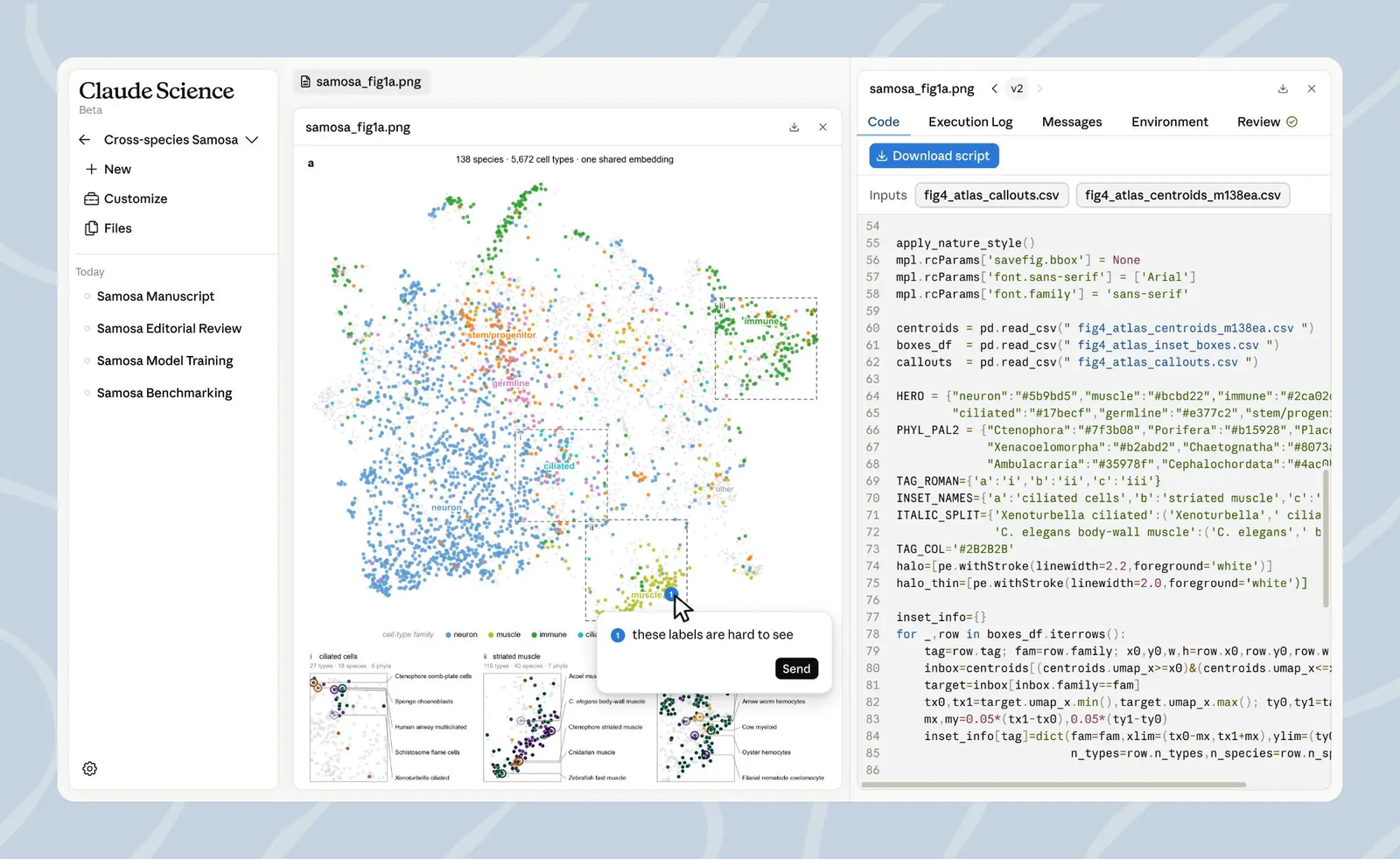
For labs, the value is not only speed. It is accountability. If a supervisor, reviewer or co-author asks how a figure was made, the answer should be visible. That could help reduce the gap between exploratory analysis and publication-ready work.
The risk is that provenance must be complete, not decorative. Researchers should still inspect the code, confirm the data subset, rerun the notebook, check statistical methods and verify that the plotted figure matches the described analysis.
Compute Management: Local, Cluster and Modal
Claude Science is designed to run where scientific data already lives. Anthropic says users can install it on a laptop, Linux box or HPC login node, and can connect to remote machines over SSH. The product page says jobs can run on local kernels, a Slurm cluster over SSH or through a Modal account.
The compute story is important because many scientific workflows are too large for a simple browser chatbot. Protein modeling, genomics pipelines and large single-cell analyses can require GPUs, cluster scheduling and long-running jobs. Anthropic says Claude Science can draft a plan, ask before reaching new resources, write or submit jobs, monitor outputs and let users revoke decisions.
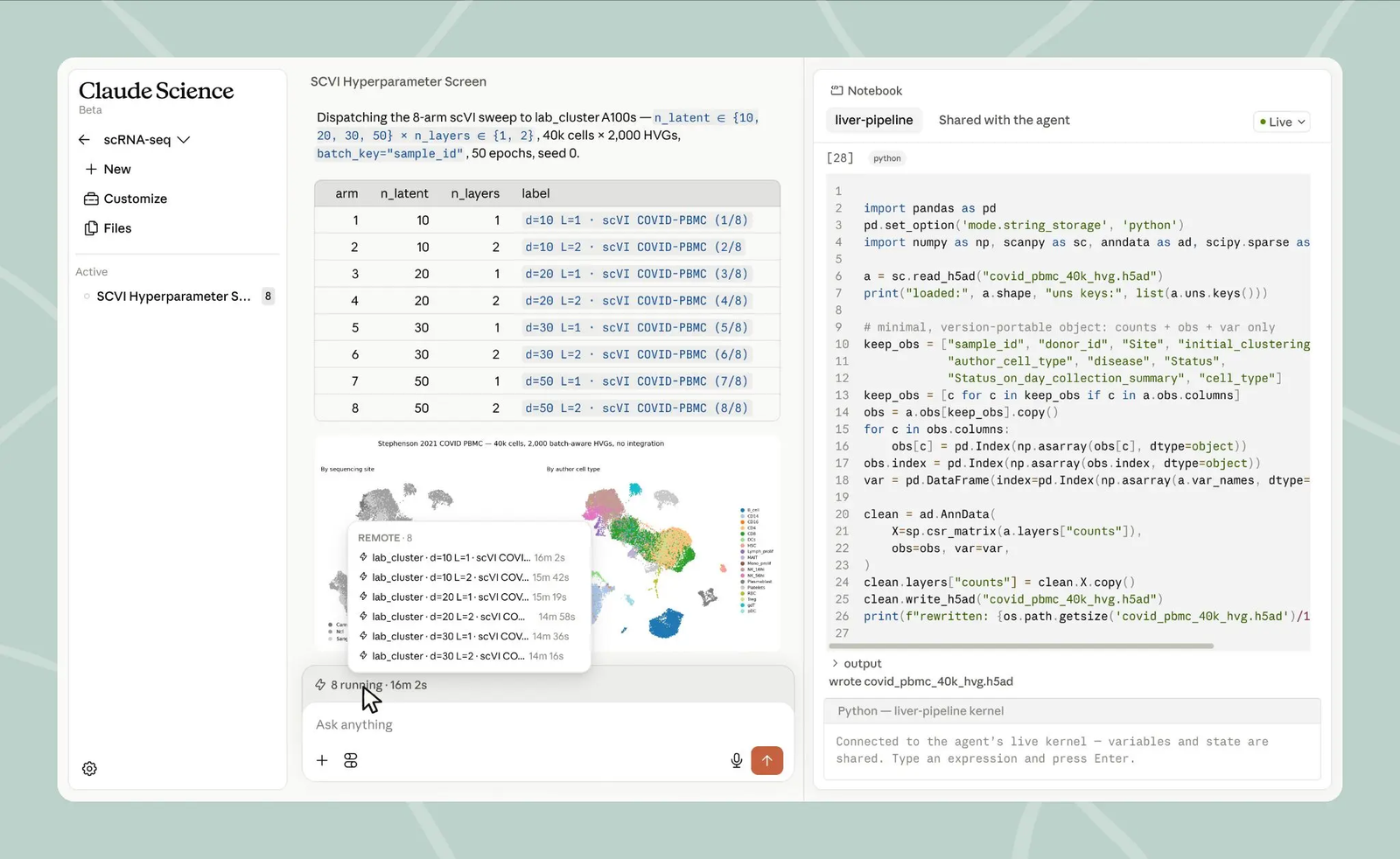
Anthropic also says raw datasets and compute can stay on the user's infrastructure, with only the needed context sent to Claude. That is a practical design choice for labs handling large or sensitive datasets. It does not remove the need for governance. Prompts and responses are still processed by Claude, so labs should review institutional rules, consent terms, protected health information policies, sponsor requirements and the data terms tied to their Claude plan before using the beta on sensitive data.
Built-In Review Is Useful, but Not Enough
Claude Science includes a reviewer agent that checks citations, calculations and whether figures match their underlying code. Anthropic says the reviewer can flag incorrect citations, untraceable numbers and mismatches between outputs and code, then self-correct as the workflow proceeds.
That is one of the more promising parts of the launch. Scientific AI needs built-in skepticism. A workbench that produces outputs without review would simply accelerate mistakes.
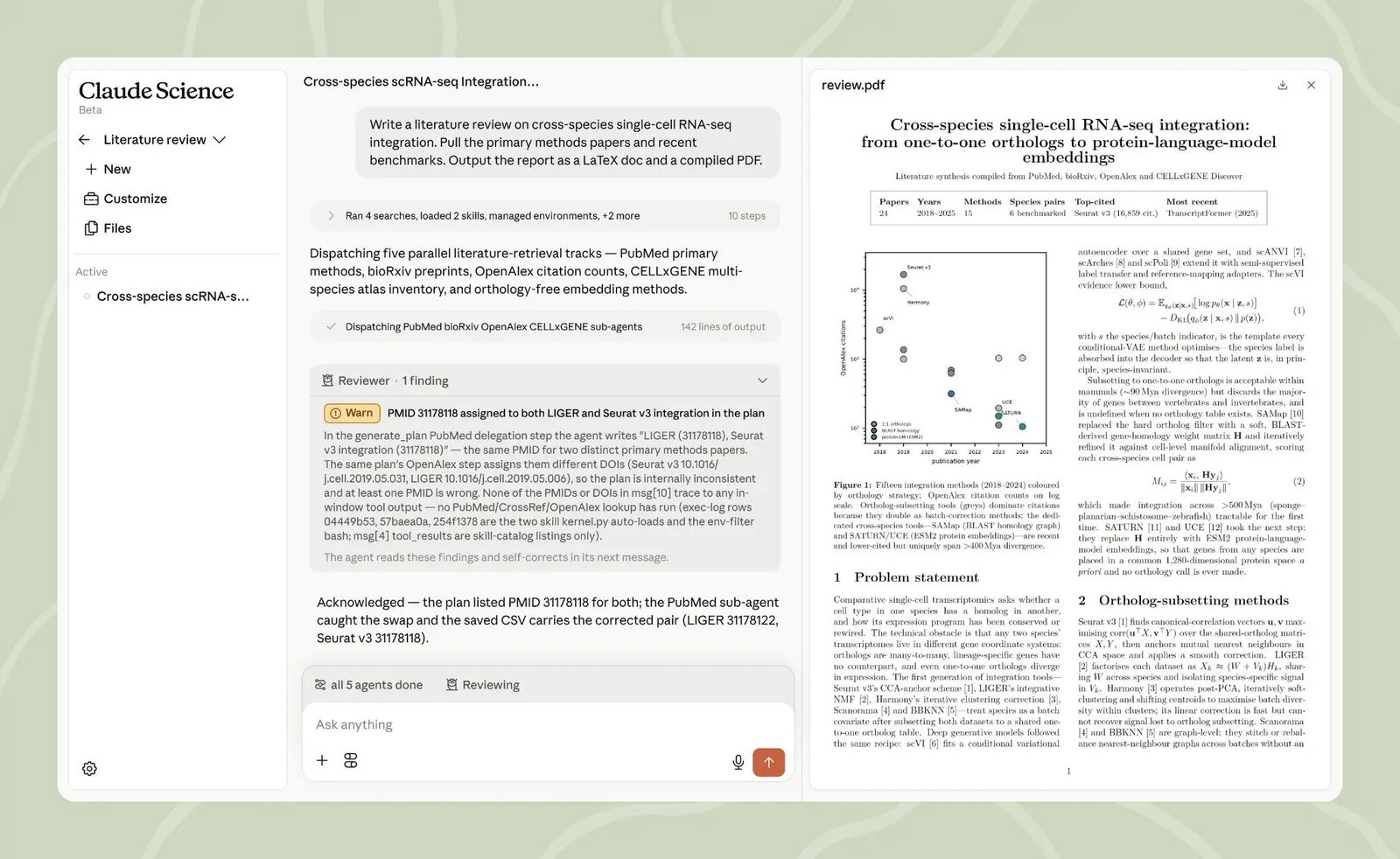
But built-in review should not be mistaken for peer review. It is still software checking software. Labs should maintain human review for literature claims, experimental design, statistical interpretation, clinical relevance, safety-sensitive biological claims and manuscript conclusions.
The safest workflow is layered: Claude drafts and runs; Claude reviewer checks; humans inspect; independent scripts or notebooks reproduce; domain experts approve.
Scientific Domains and Integrations
Anthropic says Claude Science is pre-configured for genomics, single-cell analysis, proteomics, structural biology, cheminformatics and other scientific domains. Its product page says the app can query more than 60 scientific databases and can inspect proteins, alignments, genomic tracks, chemical structures and PDFs in native form.
The NVIDIA integration is a major part of the launch. Anthropic says Claude Science uses skills from NVIDIA's BioNeMo Agent Toolkit to connect to life-science models and libraries in BioNeMo, including Evo 2, Boltz-2 and OpenFold3. NVIDIA says the toolkit packages accelerated life-science workflows as callable skills so agents can select tools, prepare inputs and execute workflows.
That pairing illustrates where AI science tools are heading. General-purpose models supply reasoning and orchestration. Specialized scientific systems supply domain tools, data structures, molecular models and compute acceleration. The workbench tries to make those pieces accessible without forcing every scientist to become an infrastructure engineer.
Early User Examples
Anthropic gave several examples of researchers using Claude Science during beta testing.
Manifold Bio used Claude Science to help nominate targets for experiments, ranking candidates using criteria informed by the company's internal data. The Allen Institute's Jerome Lecoq used it to build a multi-agent computational review workflow that reads thousands of papers, stores claims and quantitative findings in an evidence database, and drafts long-form reviews with reviewer agents checking accuracy and citation fidelity. UCSF epidemiologist Stephen Francis used it to accelerate molecular epidemiology work on glioma, with his group validating the results independently.
These are useful signals, but they are still vendor-provided examples. Teams should treat them as case studies to test against, not proof that Claude Science will work for every lab, disease area or dataset.
Grants, Credits and Academic Access
Anthropic is also trying to seed usage through research support. The company says it will support up to 50 Claude Science AI for Science projects with up to $30,000 in credits. Modal is also offering up to $2,000 in compute for select projects.
Applications are open through July 15, 2026, with award notifications planned by July 31. Selected projects are scheduled to run from September 1 to December 1, 2026.
Anthropic also says it has a discounted Team plan for active scientific labs at academic institutions and nonprofit research organizations. The Claude Science product page says eligibility is verified through the lab's principal investigator and that biomedical, basic-science and hard-science labs are prioritized.
What Makes This Different From General Claude
Claude can already summarize papers, write code and explain scientific concepts. Claude Science adds the operational layer around that capability.
| Normal AI assistant | Claude Science beta |
|---|---|
| Answers questions and writes code snippets. | Runs analyses inside a scientific workspace. |
| May summarize literature from provided text. | Can coordinate database and literature retrieval workflows. |
| Produces charts if given data and instructions. | Ties figures to code, environment and conversation history. |
| Relies on the user to manage compute. | Can work with local kernels, SSH, HPC and Modal compute. |
| Needs manual tool setup. | Ships with scientific skills, connectors and renderers. |
| Has limited workflow memory across tools. | Keeps running sessions, variables and context for iterative analysis. |
The best short description is this: Claude Science is not trying to replace every specialized scientific tool. It is trying to become the place where those tools are coordinated, inspected and turned into auditable outputs.
Competitive Context
Claude Science enters a crowded but still early market. Google DeepMind has AlphaFold and other science-focused AI systems. NVIDIA is turning life-science libraries and accelerated workflows into agent-callable tools. OpenAI, AWS, Google and others are pursuing life-science platforms, agents and drug-discovery partnerships. The Verge reported that Anthropic is also signaling a direct interest in developing drugs, while cautioning that AI-generated drug ideas still face years of lab work, clinical testing and regulatory review before reaching patients.
That caution applies to Claude Science as well. AI can speed up parts of discovery, but it does not make experiments unnecessary. Generated hypotheses still need wet-lab validation. Drug candidates still need safety, efficacy, toxicity, delivery and manufacturing work. Literature reviews still need domain experts. Statistical claims still need replication.
The real value of Claude Science will be measured less by demo videos and more by whether labs can reproduce results, reduce errors, shorten analysis cycles and publish or validate better work.
What Researchers Should Check Before Using It
Researchers should start with low-risk workflows: public datasets, literature mapping, figure recreation, exploratory notebooks and internal method comparisons. Before using Claude Science on sensitive or high-stakes work, labs should answer several questions.
Can the lab reproduce every output outside Claude Science? Are the inputs and transformations clearly logged? Does the environment capture package versions and random seeds? Are citations linked to the correct claims? Are generated statistical tests appropriate for the data? Does the tool ever substitute plausible-looking references or untraceable numbers? Are raw datasets staying on approved infrastructure? Do prompts or model responses include regulated health, genetic or proprietary data?
For biomedical labs, the threshold should be higher. Claude Science can help generate hypotheses and accelerate analysis, but medical, clinical or drug-development decisions still require human experts, validated protocols, institutional review, regulatory compliance and experimental confirmation.
What Happens Next
The next phase will be feedback from real labs. Anthropic says it is releasing Claude Science early so scientists can use it on real problems and tell the company how to refine it. The company is also asking the community for feedback on additional domain specialists and integrations.
Several practical questions will determine whether Claude Science becomes a serious research platform:
- Can it avoid citation and calculation errors at scale?
- Can it support reproducible workflows across messy institutional compute environments?
- Can it integrate with the tools labs already trust?
- Can admins control data movement, permissions and retention?
- Can it help non-computational scientists without creating false confidence?
- Can it survive peer-review-level scrutiny?
Claude Science is a meaningful launch because it brings AI agents closer to the actual workflow of science. Its success will depend on whether it can keep the benefits of speed while preserving the discipline of reproducibility.
FAQ
Is Claude Science available now?
Yes. Anthropic says Claude Science is available in beta for Claude Pro, Max, Team and Enterprise users.
Is Claude Science free?
No standalone free launch was announced. It is available through eligible paid Claude plans. Anthropic also announced credits for selected AI for Science projects and discounted Team access for eligible academic and nonprofit research labs.
Does Claude Science work on Windows?
Anthropic lists macOS and Linux downloads in the launch materials. Windows is not listed.
Is Claude Science a new Claude model?
No. Anthropic's product page says Claude Science is an app, not a model. It uses the Claude models included with a user's plan.
Can Claude Science replace peer review or lab validation?
No. It can help with analysis, literature synthesis, figures and workflow orchestration, but scientific claims still need human review, reproducibility checks and experimental validation.
Can Claude Science handle sensitive research data?
Anthropic says the app can run on a lab's own infrastructure so raw datasets and compute stay local, but prompts and responses are still processed by Claude. Labs should review data-governance rules before using it with sensitive data.
Sources
- Anthropic announcement: Claude Science, an AI workbench for scientists, is now available
- Claude Science product page and FAQ: claude.com/product/claude-science
- TechCrunch analysis of Anthropic's workflow strategy: techcrunch.com
- The Verge report on Anthropic's AI-for-science and drug-development ambitions: theverge.com
- NVIDIA blog on BioNeMo Agent Toolkit integration with Claude Science: blogs.nvidia.com
- NVIDIA BioNeMo Agent Toolkit announcement: nvidianews.nvidia.com
- AIwire launch summary: hpcwire.com
Before you move on
Global AI workflow guidance. Use this short checklist to turn the article into action.
- Check whether the tool can access private files or account data.
- Verify factual claims against primary sources before publishing.
- Keep a human review step for work that affects money, school, or customers.
This guide is written for practical user safety. For account, platform, or legal decisions, confirm critical steps with the official help center or your service provider.