


Google released Gemini 3.6 Flash and 3.5 Flash-Lite for faster, lower-cost agents, while keeping 3.5 Flash Cyber in a restricted defense pilot.
Last checked: July 23, 2026. This article uses the Google AI Studio announcement on X, Google's July 21 launch post, Google DeepMind model cards, Gemini API documentation and pricing, and Artificial Analysis testing. Benchmark results are attributed to the organization that produced them. Google has not released Flash Cyber through a public API, and several of its security results cannot be independently inspected because they use undisclosed vulnerabilities.
Quick answer
Google released Gemini 3.6 Flash and Gemini 3.5 Flash-Lite on July 21, 2026, while announcing a separate Gemini 3.5 Flash Cyber model for a limited-access defensive-security pilot.
The three models have different jobs:
- Gemini 3.6 Flash is the general-purpose “workhorse” for coding, multimodal knowledge work and tool-using agents. It costs $1.50 per million input tokens and $7.50 per million output tokens on the standard paid Gemini API.
- Gemini 3.5 Flash-Lite is the lower-cost, high-throughput option for extraction, routing, document processing and fleets of subagents. Standard paid pricing is $0.30 per million input tokens and $2.50 per million output tokens.
- Gemini 3.5 Flash Cyber is a specialized vulnerability-finding and patching model used with Google's CodeMender agent. It is not generally available and is due to enter a pilot for governments and trusted partners “soon.”
The most important change is not a single benchmark lead. Google is segmenting agent workloads by economics and risk. A stronger model can supervise complex work, a cheaper model can fan out across repetitive subtasks, and a security-specialized model can remain behind tighter access controls.
What Google announced
The official launch post describes the Flash family as infrastructure for production AI agents, where the cost of a job depends on more than the posted token rate. Reasoning length, tool calls, retries, latency and the number of subagents can all change the bill.
That is why the release emphasizes token efficiency and time per completed task:
| Model | Intended role | Public model ID | Standard paid API price | Context and output limits | Availability on July 23 |
|---|---|---|---|---|---|
| Gemini 3.6 Flash | Coding, knowledge work, multimodal analysis and complex agent loops | gemini-3.6-flash | $1.50 input / $7.50 output per 1M tokens | 1,048,576 input; 65,536 output | Available through Gemini API and AI Studio; also across multiple Google consumer and enterprise surfaces |
| Gemini 3.5 Flash-Lite | High-volume extraction, routing, document processing and subagents | gemini-3.5-flash-lite | $0.30 input / $2.50 output per 1M tokens | 1,048,576 input; 65,536 output | Available through Gemini API and AI Studio; rolling out in Google Search |
| Gemini 3.5 Flash Cyber | Vulnerability discovery, validation and patching through CodeMender | Not published | Not published | Not published | Limited pilot for governments and trusted partners planned “soon” |
*Prices are in US dollars and cover standard paid Gemini API text output, including thinking tokens. Google's pricing page lists lower Batch and Flex rates and higher Priority rates. Enterprise contracts and grounding charges may differ.*
Both public models accept text, images, video, audio and PDFs and return text. They support thinking, structured output, function calling, code execution, caching, file search, search grounding and URL context, according to Google's model pages.
Google says 3.6 Flash is based on 3.5 Flash, while Flash Cyber is a security-focused fine-tune of 3.5 Flash. The numbering therefore describes separate points in the product line rather than three models with identical release and access conditions.
Gemini 3.6 Flash: the upgrade is efficiency as much as quality
Google positions 3.6 Flash as a better production model than 3.5 Flash for coding, document analysis and computer-using agents. The Gemini 3.6 Flash model card reports a one-million-token input context window, a 64,000-token maximum output and a March 2026 knowledge cutoff.
On Google's selected evaluations, 3.6 Flash improved over 3.5 Flash in several agentic workloads:
| Google-reported benchmark | Gemini 3.5 Flash | Gemini 3.6 Flash | What it tests |
|---|---|---|---|
| DeepSWE v1.1 | 37% | 49% | Long-horizon software engineering |
| MLE-Bench | 49.7% | 63.9% | Machine-learning engineering |
| GDPval-AA v2 | 1,349 Elo | 1,421 Elo | Knowledge work |
| OSWorld-Verified | 78.4% | 83.0% | Computer use |
| GDM-MRCR v2 at 1M | 26.6% | 54.0% | Long-context retrieval and reasoning |
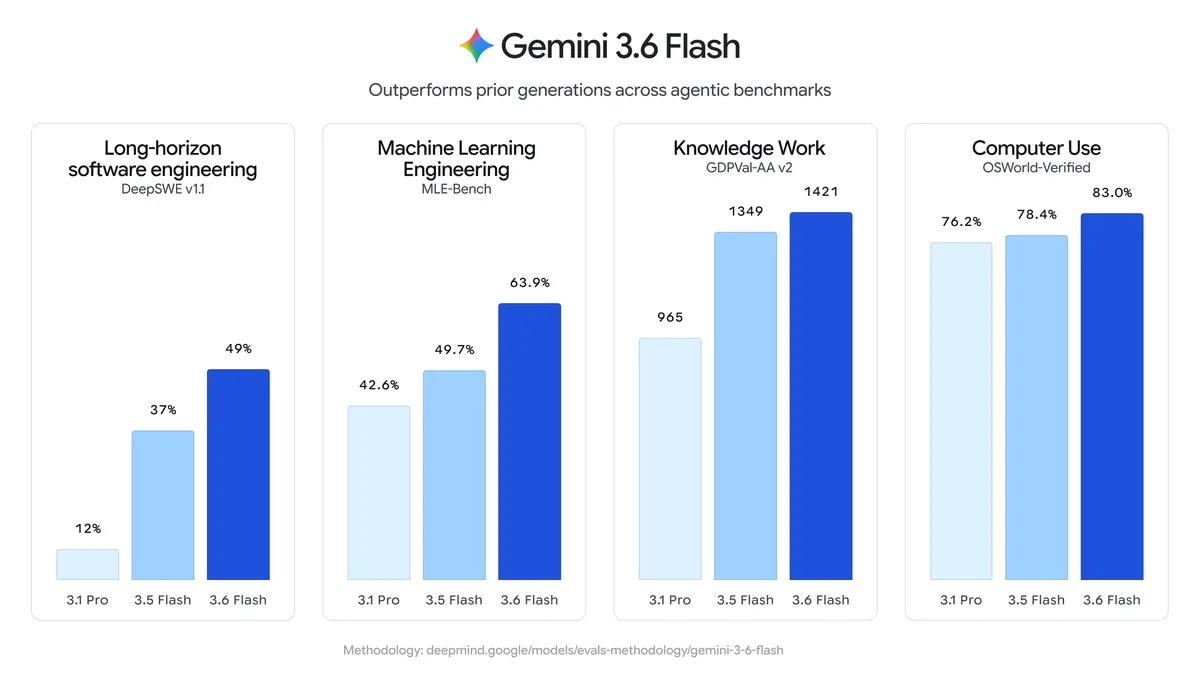
These numbers support Google's claim that 3.6 Flash is more capable on the tested tasks, but they are not a universal ranking. Benchmark harnesses, tool access and inference settings matter. The model card also shows rival systems leading some tests, including OpenAI's GPT-5.6 Luna on DeepSWE and Anthropic's Claude Sonnet 5 on MLE-Bench and GDPval-AA v2.
The stronger commercial argument may be output efficiency. Standard output pricing has fallen from $9 per million tokens for 3.5 Flash to $7.50 for 3.6 Flash, while input pricing remains $1.50. Google says 3.6 Flash used 17% fewer output tokens than 3.5 Flash on the Artificial Analysis Intelligence Index and roughly 65% fewer in its DeepSWE run.
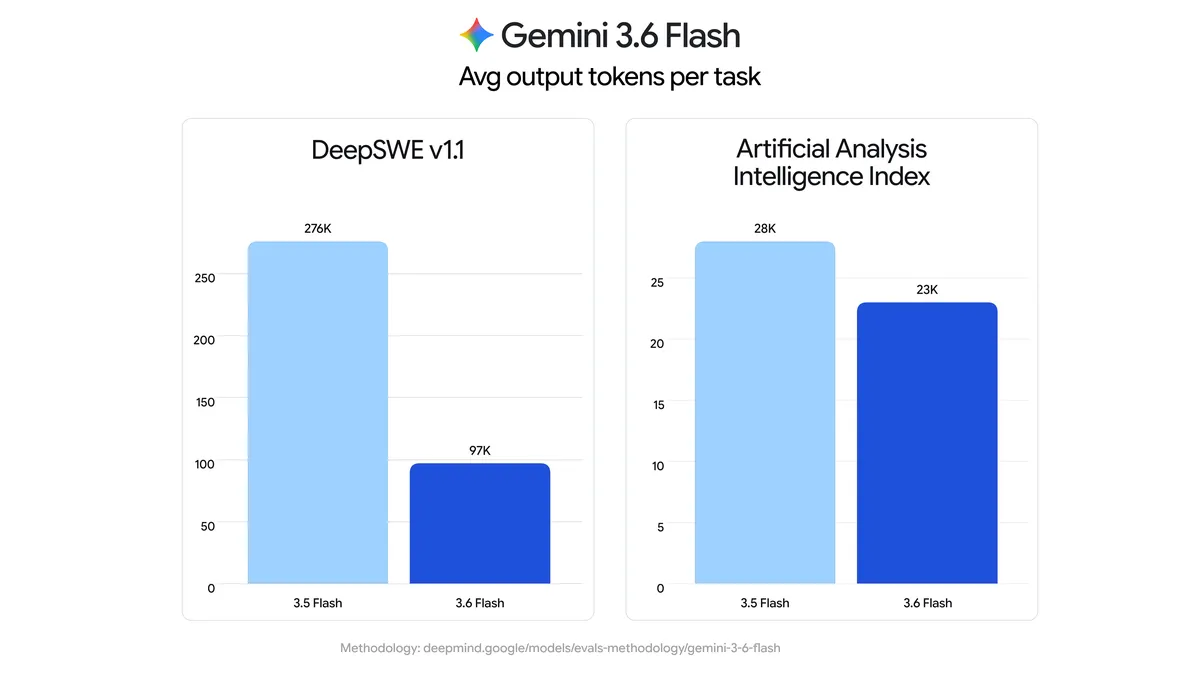
Independent pre-release testing by Artificial Analysis adds useful context. Its high-reasoning configuration gave 3.6 Flash the same Intelligence Index score as 3.5 Flash—50—rather than a broad intelligence gain. But average time per task fell from 2.7 minutes to 1.3 minutes, and estimated cost per task fell about 18%, from $0.59 to $0.50.
That difference matters. A model can become commercially better without moving a composite intelligence score if it completes similar work with fewer tokens and less time. For an agent that performs thousands of tool-assisted tasks, shorter loops can reduce compute expense, user wait time and the chance that a long workflow fails midway.
Gemini 3.5 Flash-Lite: cheaper than Flash, but not cheaper than its predecessor
Flash-Lite is designed for workloads where scale matters more than assigning every subtask to the strongest available model. Google's examples include document parsing, receipt extraction, translation, search, classification and parallel subagents.
Google cites a speed of 350 output tokens per second, measured by Artificial Analysis. The independent evaluator reported an Intelligence Index gain from 25 for 3.1 Flash-Lite to 36 for 3.5 Flash-Lite in high-reasoning mode. Its average task time fell from 1.0 minute to 0.6 minutes.
Google's own benchmark set shows substantial gains over 3.1 Flash-Lite:
- Terminal-Bench 2.1 rose from 31% to 54%.
- GDPval-AA v2 rose from 642 to 1,140 Elo.
- GDM-MRCR v2 rose from 60.1% to 72.2%.
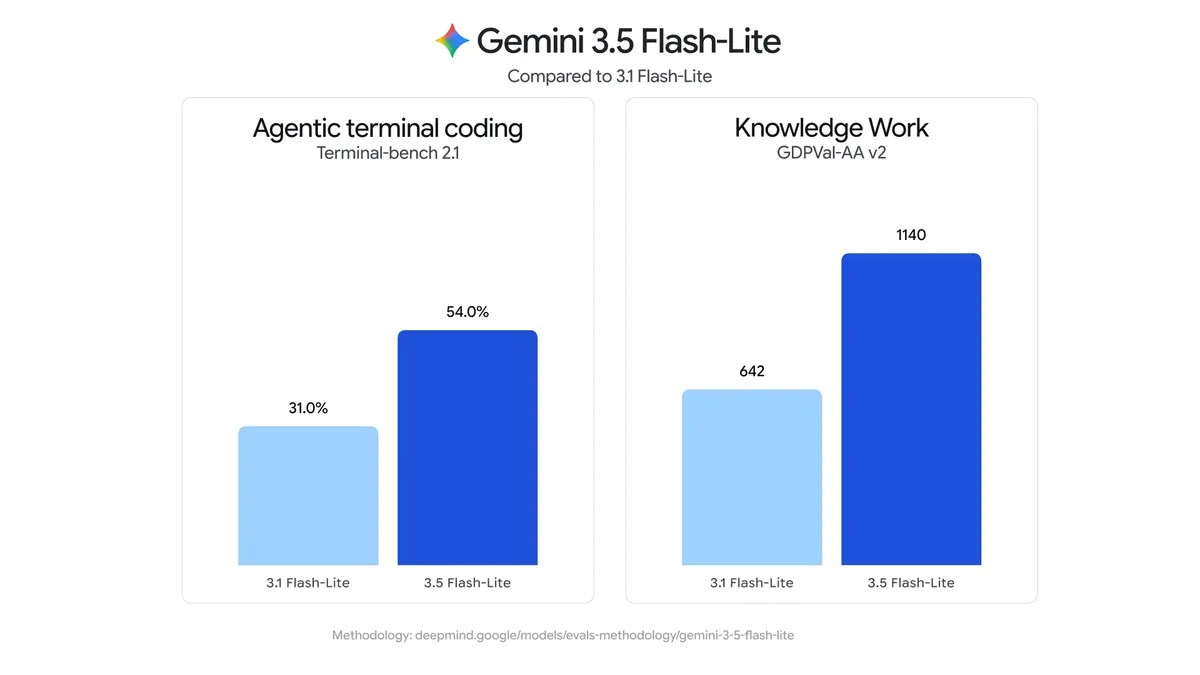
Google also reports that 3.5 Flash-Lite beats the older, non-Lite Gemini 3 Flash on SWE-Bench Pro and OSWorld-Verified. That is a notable generational shift: the budget tier can overtake a previous mainstream model on selected agentic tests.
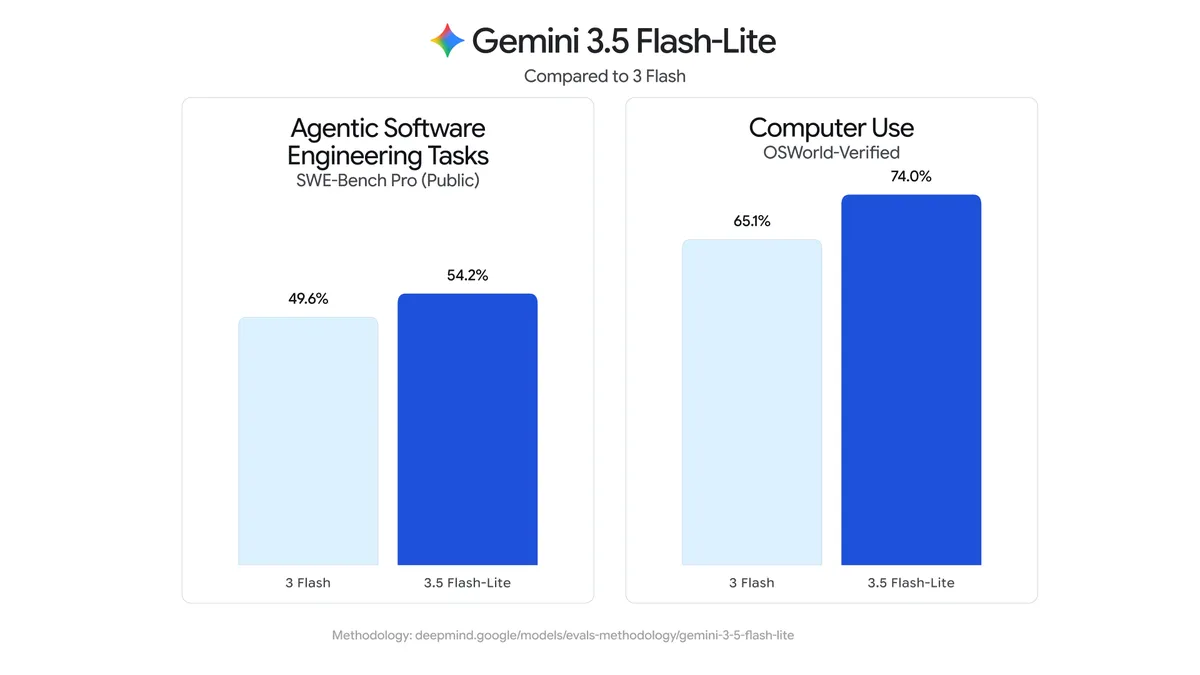
The “cost-effective” label needs qualification. Flash-Lite is much cheaper per token than 3.6 Flash, but 3.5 Flash-Lite costs more than 3.1 Flash-Lite:
| Standard paid API price | 3.1 Flash-Lite | 3.5 Flash-Lite | Change |
|---|---|---|---|
| Input, text/image/video | $0.25 / 1M | $0.30 / 1M | +20% |
| Output, including thinking | $1.50 / 1M | $2.50 / 1M | +66.7% |
Artificial Analysis found that fewer output tokens did not fully offset the higher rate in its evaluation suite: estimated average cost per task rose from $0.04 to $0.09. The model may still deliver better value when the quality gain prevents retries or replaces a more expensive model, but teams should benchmark their own task mix rather than assume the new Lite version lowers every bill.
Google's computer-use documentation conflicts
There is a launch-day documentation discrepancy that developers should watch.
Google's launch article says 3.5 Flash-Lite “now also has computer use as a built-in tool.” The company's latest-model migration page similarly says both new public models support the full suite of built-in tools, including computer use.
However, the dedicated 3.5 Flash-Lite model page marked computer use as “Not supported” when HacksByte checked on July 23. The dedicated 3.6 Flash page marked the capability supported in preview.
This could be a documentation lag, a surface-specific rollout or a distinction between the model and a higher-level Google product. Google had not reconciled the pages publicly when this article was checked. Developers should verify the capability in the API and region they plan to use before designing a production workflow around it.
Flash Cyber is a different kind of release
Gemini 3.5 Flash Cyber is not a third public endpoint beside the other two. Google DeepMind says the lightweight cyber model is fine-tuned to find, validate and patch vulnerabilities and will be offered exclusively to governments and trusted partners through CodeMender in a limited pilot.
The restricted release reflects a genuine dual-use problem. A system that can locate flaws across large codebases and validate them can help defenders shorten patch cycles. The same capability could help attackers identify exploitable weaknesses at scale.
CodeMender uses multiple Flash Cyber calls to explore different paths and merge the findings into one report. Google configured the system to call the model up to five times for its CyberGym result.
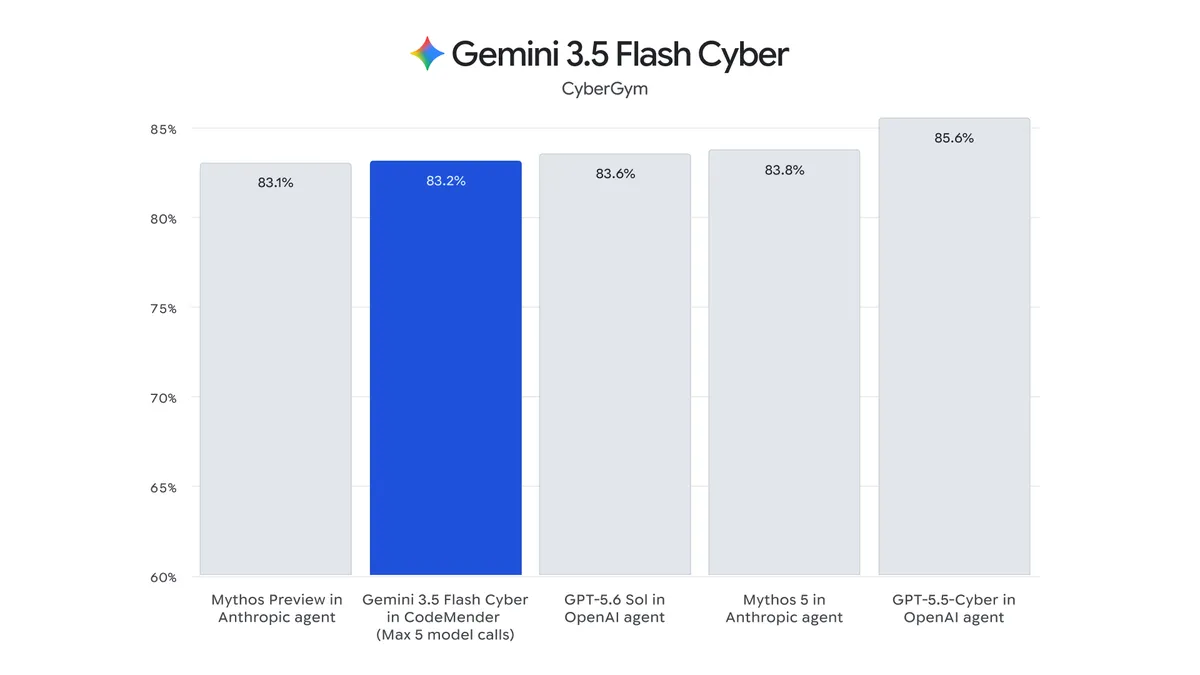
The chart requires careful reading. Flash Cyber in CodeMender scored 83.2%, close to the other plotted systems, which range from 83.1% to 85.6%. But this is a system comparison, not a clean one-model shootout:
- Google's entry can use up to five Flash Cyber calls for one final report.
- Competitor results come from the providers' own reported scores.
- Agent scaffolding differs between entries.
- Inference cost and latency are not shown.
The result supports Google's claim of competitive frontier performance, but it does not establish that Flash Cyber is the strongest cyber model.
Google's security claims are more consequential—and harder to audit
Google DeepMind reports that Flash Cyber outperformed mainline 3.5 Flash and 3.6 Flash on a separate Big Sleep evaluation focused on difficult vulnerabilities in major codebases. It also tested the model in Chrome's production commit-scanning pipeline.
On a fixed number of runs against the V8 JavaScript engine, Google says:
| Model | Unique confirmed issues found |
|---|---|
| Gemini 3.5 Flash Cyber | 55 |
| Gemini 3.5 Flash | 47 |
| Claude Opus 4.6 | 36 |
Google says Flash Cyber found 10 issues not caught by the other two models. It also says the system is being used internally across Chrome, Android, Cloud, Ads and YouTube.
The most serious claim comes from Google's Cloud Vulnerability Research team. According to the company, Flash Cyber found remote-code-execution vulnerabilities in public APIs and a memory-corruption flaw in a sensitive production service within two hours. Google says it also produced a reliable proof of exploitation that bypassed standard memory protections.
HacksByte is not reproducing offensive details. More importantly, these results remain Google-reported. The affected vulnerabilities were not disclosed, which Google says prevented benchmark contamination, but that also means outside researchers cannot inspect the findings, confirm severity, measure false positives or reproduce the comparison.
The limited-access decision is therefore part of the product story, not a footnote. Google is claiming a material increase in offensive-capable vulnerability research while withholding general access to reduce misuse.
What is confirmed
The following points are supported by Google's public launch materials and current documentation:
- Google announced all three models on July 21, 2026.
- Gemini 3.6 Flash and 3.5 Flash-Lite are available through the Gemini API and Google AI Studio.
- The stable API identifiers are
gemini-3.6-flashandgemini-3.5-flash-lite. - Both public models have one-million-token input limits and 65,536-token output limits.
- Standard paid pricing is $1.50/$7.50 per million input/output tokens for 3.6 Flash and $0.30/$2.50 for 3.5 Flash-Lite.
- Gemini 3.6 Flash is available in the Gemini app, Gemini Enterprise products and Google Antigravity, among other surfaces.
- Google says 3.5 Flash-Lite is rolling out in Google Search.
- Gemini 3.5 Flash Cyber is not generally available and is planned for a restricted CodeMender pilot.
- Google says Gemini 3.5 Pro is testing with partners and that it has begun a pre-training run for Gemini 4.
What remains unknown or unresolved
Google had not publicly answered several important questions as of July 23:
- The start date, eligibility criteria and geographic scope of the Flash Cyber pilot.
- Flash Cyber's model ID, token limits, pricing, rate limits and safety policy.
- Full reproducible data for the internal Big Sleep, Chrome and V8 security evaluations.
- False-positive rates and patch-acceptance rates for CodeMender in production.
- Comparable CyberGym cost and latency across the plotted agent systems.
- Why Google's Flash-Lite computer-use documentation contradicts its launch post.
- Real-world reliability across long-running agents, where retries, tool errors and accumulated context may differ from benchmark conditions.
- Whether partner-reported improvements generalize beyond each partner's internal evaluation.
What developers should do before switching
The two public models are available now, but a model-ID change should not be treated as a drop-in production upgrade.
1. Route by task value, not by model prestige
Use 3.6 Flash where coding quality, multimodal reasoning or fewer execution loops can justify its higher rate. Test Flash-Lite for extraction, classification, routing and parallel subagents. A mixed system may cost less than sending every request to one model.
2. Measure completed-task economics
Record input tokens, thinking and output tokens, tool calls, retries, latency, failure rate and human-review time. The lowest posted token price can lose if it needs more attempts; a more expensive model can win if it finishes in fewer loops.
3. Re-run regression and safety tests
Google's model card warns that 3.6 Flash can still hallucinate and may occasionally be slow or time out. Evaluate grounded accuracy, tool selection, structured-output validity, over-refusal and failure recovery on your own workload.
4. Follow the Gemini 3.x migration requirements
Google's migration guide tells developers to replace legacy sampling parameters with thinking_level, preserve thought signatures where required, validate function-call responses and use server-side interaction state for multi-turn workflows. Flash-Lite defaults to minimal thinking; 3.6 Flash defaults to medium.
5. Verify computer use before depending on it
Because Google's pages conflict, confirm that the exact model, API surface and region expose computer use. Keep sensitive actions behind deterministic policy checks and human approval regardless of model capability.
6. Keep cyber tooling defensive and isolated
Flash Cyber is not a public tool, and CodeMender's general capabilities are distinct from access to the specialized model. Organizations testing AI-assisted vulnerability discovery should use authorized targets, isolated environments, audit logs, strict data handling and coordinated disclosure.
What changes for Gemini users?
Google says 3.6 Flash and 3.5 Flash-Lite are available in the Gemini app, while Flash-Lite is also rolling out in Search. Consumer surfaces may choose models automatically, so users may experience faster responses or different behavior without selecting the API model ID themselves.
Flash Cyber is not a consumer Gemini mode. Google has not announced public access through the Gemini app or AI Studio.
For developers, the immediate choice is clearer: 3.6 Flash is the higher-capability production default, while Flash-Lite is an economic option for volume. For security teams, the announcement is a preview of a gated service rather than a model they can call today.
Bottom line
Gemini 3.6 Flash, 3.5 Flash-Lite and 3.5 Flash Cyber reveal Google's model strategy for the agentic era more clearly than any single benchmark chart.
The company is optimizing the mainstream Flash model around useful work per token, pushing the Lite tier toward large fleets of fast subagents, and separating powerful vulnerability research into a restricted channel. Independent testing supports the speed and efficiency story, while also showing that 3.6 Flash's value may come more from completing similar-quality work faster than from a broad jump in intelligence.
The open questions are equally important. Flash-Lite is not cheaper than its predecessor on every workload, Google's computer-use documentation is inconsistent, and the strongest Flash Cyber claims rely on private evaluations. Teams should treat the launch as an opportunity to test a new workload architecture—not as evidence that one model is automatically best for every agent.
Sources and editorial note
- Google AI Studio launch post on X
- Google: Introducing Gemini 3.6 Flash, 3.5 Flash-Lite and 3.5 Flash Cyber
- Google DeepMind: Gemini 3.6 Flash model card
- Google AI for Developers: Gemini 3.6 Flash
- Google AI for Developers: Gemini 3.5 Flash-Lite
- Google AI for Developers: Gemini API pricing
- Google DeepMind: Introducing Gemini 3.5 Flash Cyber
- Artificial Analysis: Gemini 3.6 Flash and 3.5 Flash-Lite testing
The featured image is original conceptual editorial artwork created for HacksByte; it does not depict real Google infrastructure or a product interface. The five benchmark graphics are official Google launch materials and are captioned as company-reported data. No local user-uploaded attachment was present in the workspace when this article was prepared. HacksByte will correct or update this report if Google reconciles the computer-use documentation or publishes material new evidence. See our Corrections Policy, Editorial Policy and Contact page.
Before you move on
Global AI workflow guidance. Use this short checklist to turn the article into action.
- Check whether the tool can access private files or account data.
- Verify factual claims against primary sources before publishing.
- Keep a human review step for work that affects money, school, or customers.
This guide is written for practical user safety. For account, platform, or legal decisions, confirm critical steps with the official help center or your service provider.