


OpenAI says enterprises should measure cost per accepted outcome, govern agent workflows before they scale, and match capacity to proven demand. Here is what the framework gets right, where buyers should be cautious, and a practical scorecard for AI investment decisions.
Last checked: July 15, 2026. This article uses OpenAI's July 14 guidance, "How to manage AI investments in the agentic era," as its primary source. It also reviews OpenAI's enterprise spend-control announcement and Codex economic research, the FinOps Foundation's unit-economics guidance, and the US National Institute of Standards and Technology's AI Risk Management Framework. Product-performance and adoption figures attributed to OpenAI are company-reported and have not been independently audited for this article.
Quick answer
OpenAI published a five-step framework on July 14, 2026 for enterprises trying to control AI spending as work moves from short chatbot exchanges to longer-running agents. Its central recommendation is that companies stop treating token price as the main measure of efficiency and instead track the full cost per accepted business outcome.
That means counting not only model usage, but also retries, tool calls, latency, human review, failed runs, integration work, security controls and the cost of correcting weak output. The denominator should be a result the business actually values: a support case resolved, a tested code change approved, a compliant document completed, a decision improved or a measurable risk avoided.
OpenAI's five steps are:
- Make usage and spend visible by workspace, team, user, product and model.
- Evaluate model efficiency against outcome-level return on investment.
- Put access, approval and spending controls around advanced workflows before they scale.
- Fund repeatable workflows and shared infrastructure that can compound in value.
- Buy capacity only after demand and business value are proven.
The framework is directionally sound and aligns with independent FinOps principles. It is also a vendor document. OpenAI recommends several of its own products and commercial options, including ChatGPT Work, Guaranteed Capacity, Scale Tier, Batch API, Flex processing, Prompt Caching, OpenAI Frontier and Deployment Company support. Buyers should therefore use the five steps as a decision framework, not as a reason to commit to one provider.
What OpenAI published
The new OpenAI guidance is aimed at enterprise leaders facing a new budgeting problem. Chatbots generally produce bounded, visible interactions. Agents may run for minutes or hours, call tools, retrieve large amounts of context, retry failed steps and operate across several business systems.
That makes the bill harder to interpret. Higher spend could indicate waste, a successful pilot attracting demand, or a workflow that is becoming essential. A single cost number cannot distinguish among those cases.
OpenAI argues that leaders need three views at once:
| View | Management question |
|---|---|
| Workspace | Are adoption, useful output and spend moving together? |
| Team and user | Where is demand growing, and who needs enablement or tighter controls? |
| Product and model | Where is more expensive intelligence being used, and does it improve outcomes? |
The company also says the price per million tokens fell 97% from GPT-4 to GPT-5.4. It reports that GPT-5.6 performed better on the Artificial Analysis Coding Agent Index while using 54% fewer output tokens and taking 57% less time per task. Those are OpenAI-reported comparisons, not independently reproduced results in the July 14 post.
The larger point is stronger than the benchmark claim: a lower list price does not guarantee a lower cost to finish useful work.
Why agentic AI changes the investment question
Traditional software budgeting often separates predictable seat licenses from infrastructure consumption. Agentic AI combines both patterns and adds uncertainty.
An agent can consume more when it:
- Reads a long conversation or large knowledge base repeatedly.
- Calls search, code execution, Computer Use or connected business systems.
- Runs several approaches in parallel.
- Retries after tool errors or unclear instructions.
- Escalates to a more capable model.
- Produces work that requires extensive human correction.
- Remains active in the background longer than expected.
OpenAI's June research on how agents are changing work helps explain why this is becoming urgent. The company's data showed a wide adoption gap: 97.9% of active OpenAI workers, 17.3% of active organizational users and 0.7% of active individual users had used Codex in the prior 28 days.
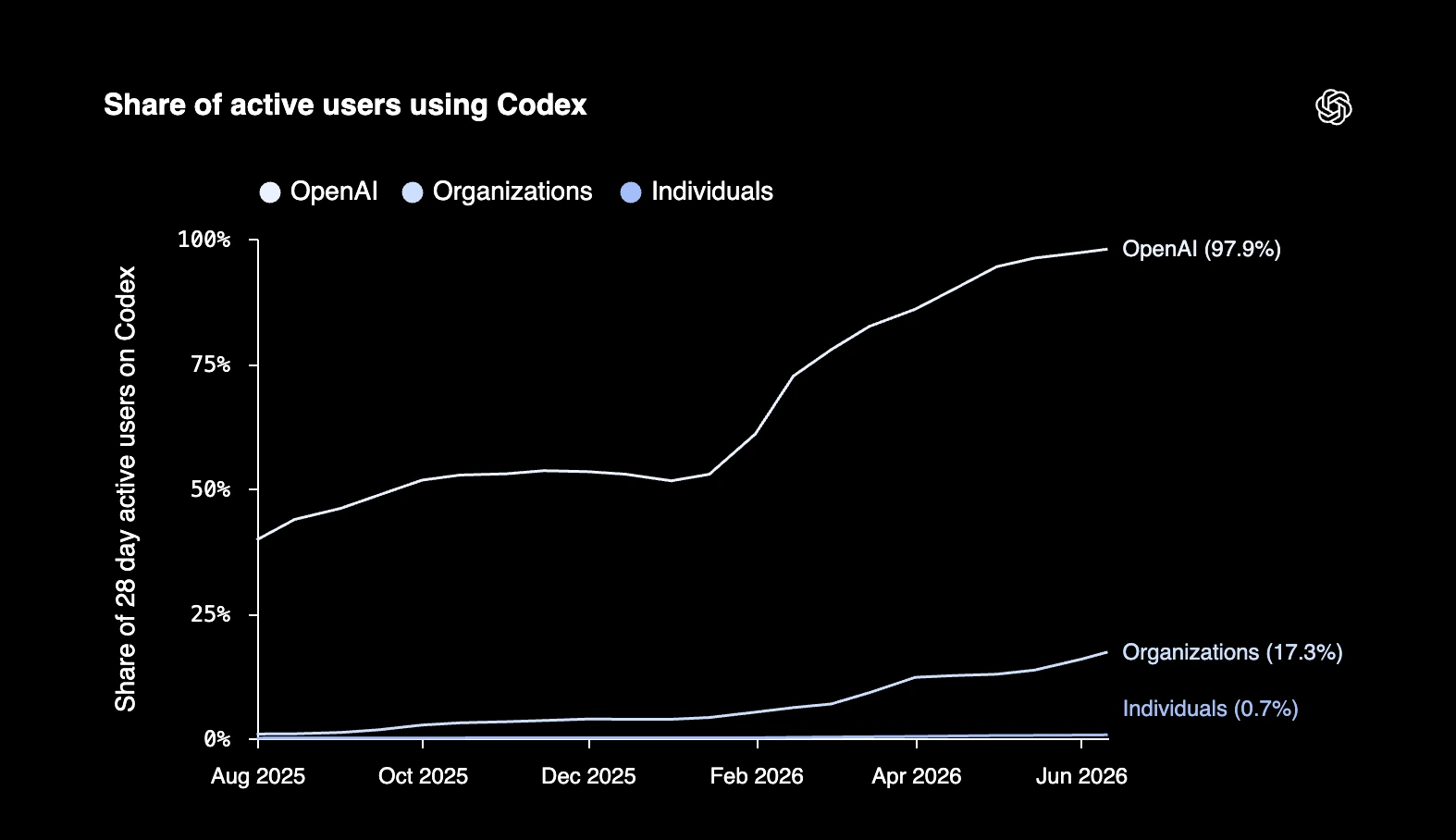
This should not be read as a market-wide adoption survey. OpenAI is an unusually favorable environment for its own tools, and the underlying research is company-reported. But it illustrates a planning challenge: agent adoption can be concentrated in a small number of teams before it becomes broad.
The intensity gap was even larger. OpenAI reported that Codex accounted for 99.8% of output tokens inside OpenAI, 63.3% among organizational users and 16.5% among individual users across Codex and ChatGPT.
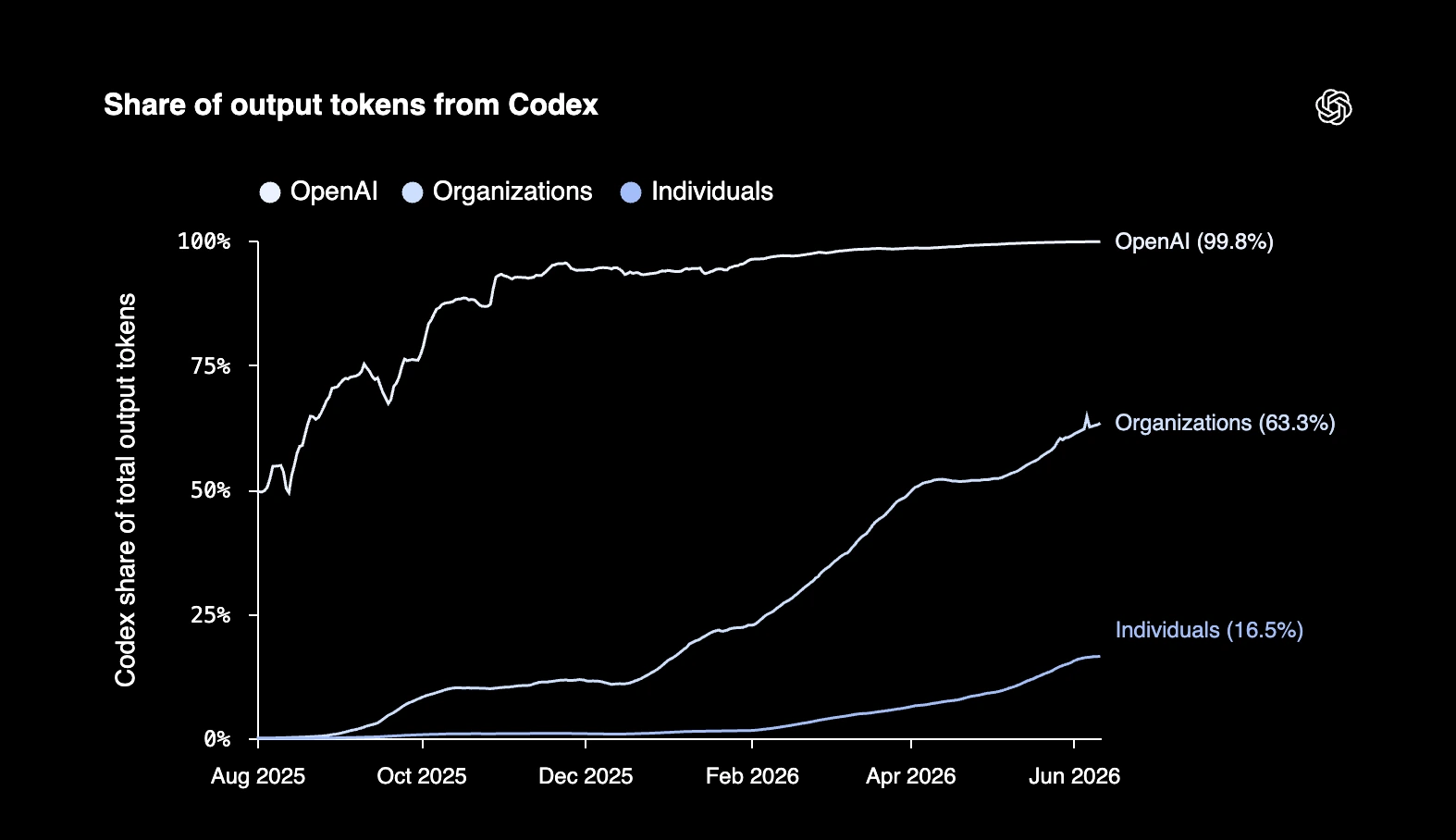
For finance teams, this means active-user counts alone can miss the real cost driver. A small group of power users can produce a large share of agent consumption. The correct response is not automatically to cut them off. It is to determine whether that usage creates accepted, valuable work.
Step 1: Sharpen visibility into usage and spend
OpenAI's first recommendation is basic but essential: establish a shared view of who is using AI, which product and model they use, how much capacity they consume and what work the consumption supports.
The company introduced new ChatGPT Enterprise usage analytics and spend controls on June 18. OpenAI says its Global Admin Console can now break down ChatGPT and Codex credit consumption by user, product and model, identify top users and trends, and expose the same data through a unified Cost API. Admins can set workspace defaults, group limits and individual overrides, while users can request more credits with project context.
That is a useful control surface, but visibility should not stop at the vendor console. A defensible enterprise ledger should connect:
| Cost and activity data | Business context |
|---|---|
| Model, token and credit use | Workflow or use case |
| Tool calls and agent run time | Business owner |
| Retry and failure rates | Accepted outcome |
| Human review minutes | Quality threshold |
| Connector and infrastructure cost | Data sensitivity and risk tier |
| Integration and support effort | Revenue, time, capacity or risk value |
The FinOps Foundation's unit-economics guidance makes the same distinction. Cost per token is a resource-efficiency metric. Cost per case resolved, agent action or accepted deliverable is closer to a business metric.
Leaders should also watch the shape of demand. A fast-growing user may be wasting credits, but may also have found a workflow worth standardizing. Conversely, flat spend can conceal a low-value pilot that no one is willing to retire.
Step 2: Evaluate model efficiency by outcome ROI
OpenAI's strongest recommendation is to compare models and workflows on the cost of reaching an acceptable result, not the price of an isolated token.
A cheaper model can become the expensive choice if it fails more often, loops, sends work to human reviewers or creates defects. A frontier model may cost more per request but finish the job in fewer attempts. The only reliable way to know is to test both against representative work.
For each priority workflow, define the quality bar before comparing models:
- What counts as accepted?
- Which errors are tolerable?
- Which failures are severe even if rare?
- How much human review is required?
- What is the maximum acceptable delay?
- What actions must always require approval?
OpenAI's separate business guide to evaluations recommends a specify, measure and improve loop using real-world cases, costly edge cases, domain experts and continuing post-launch measurement.
The investment metric can then be written as:
| Metric | Practical calculation |
|---|---|
| Cost per accepted outcome | Total model, tool, infrastructure and review cost divided by accepted outcomes |
| First-pass acceptance | Outputs accepted without rework divided by completed outputs |
| Review burden | Human review minutes divided by accepted outcomes |
| Failure-adjusted cycle time | Total elapsed time, including retries and corrections, divided by accepted outcomes |
| Outcome ROI | Business value minus fully loaded cost, divided by fully loaded cost |
Consider a support agent. Model A costs half as much per run as Model B, but resolves only 55% of cases without escalation. Model B resolves 80%, uses fewer retries and needs less review. Model B may deliver the lower cost per resolved case even though its token price is higher.
The same logic applies to coding agents. The business outcome is not "tokens generated" or even "pull request opened." It is a tested change that meets requirements and passes review without introducing unacceptable risk.
Longer tasks make raw usage metrics less reliable
OpenAI's Codex research estimated that by May 2026, 80.6% of sampled individual users had made at least one request representing more than 30 minutes of human work, 70.2% had made one above an hour and 25.6% had made one above eight hours.
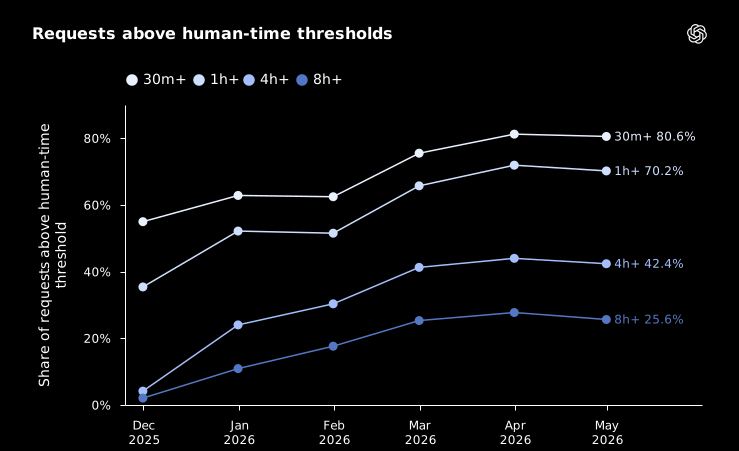
These durations were estimated by a model from a 0.1% sample of individual-user queries. They are directional, not stopwatch measurements of labor saved. A task estimated at eight human hours does not prove eight hours of productive work was delivered.
The internal OpenAI data also showed that users at the 99th percentile were generating more than 60 hours of Codex agent turns per day by June 2026, often through parallel agents.
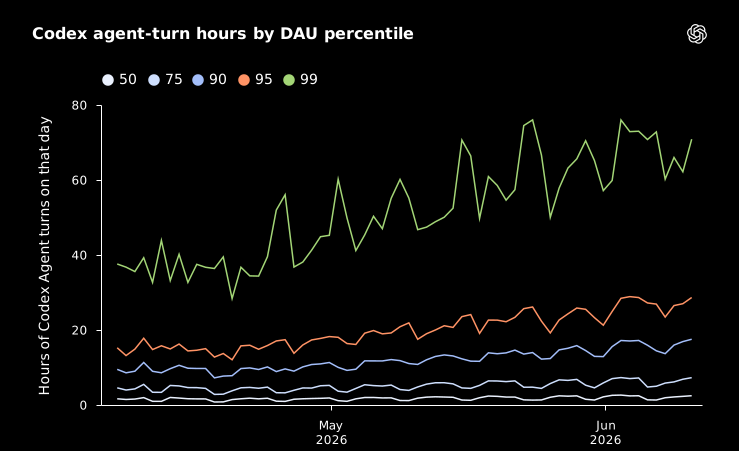
That is a measure of agents running on a person's behalf, not a claim that one employee performed 60 hours of verified work. It highlights why agent run time must be paired with acceptance, review and impact metrics.
Step 3: Govern advanced workflows before they scale
OpenAI says governance should define the context an agent can use, the tools it can access, the actions it can take, who approves high-risk steps and how more capacity is granted.
That matters because the downside grows with autonomy. A drafting assistant and an agent with access to email, customer records, code repositories and Computer Use do not belong in the same risk tier.
The NIST AI Risk Management Framework offers a useful independent structure: govern, map, measure and manage risk across the AI lifecycle. It is broader than cost control, but it reinforces a crucial point—spend governance and risk governance should be designed together.
A practical control matrix looks like this:
| Workflow tier | Example | Required controls |
|---|---|---|
| Low | Drafting an internal summary from approved material | Data boundary, logging, sampled quality review |
| Moderate | Updating a non-production dashboard or internal knowledge base | Scoped access, test environment, named owner, rollback |
| High | Sending customer messages, editing financial logic or changing production code | Explicit approval, strong identity controls, complete audit trail, pre-deployment evals |
| Prohibited or exceptional | Autonomous payments, destructive data actions or legal commitments | Block by default; senior exception process if allowed at all |
Before increasing limits, require the workflow owner to provide:
- A named business outcome and owner.
- A representative evaluation set.
- A documented failure and escalation path.
- Least-privilege access boundaries.
- A human-approval policy.
- A budget and cost-per-outcome target.
- Logging, incident and rollback plans.
This turns a credit increase from an informal request into an investment decision.
Step 4: Fund workflows that can compound
OpenAI recommends treating enterprise AI as a portfolio with three layers:
- Broad access for everyday productivity.
- Function-specific workflows that improve repeatable work.
- A smaller set of strategic bets built around proprietary company context.
The editorially important qualifier is repeatable. A polished one-off demonstration may be impressive but is often a weak investment candidate. A less glamorous workflow that happens 50,000 times a month, has a clear quality bar and produces auditable savings may be much more valuable.
Funding should change with maturity:
| Stage | Question | Appropriate funding |
|---|---|---|
| Exploration | Can the model perform the task at all? | Small, time-boxed pilot budget |
| Validation | Does it meet a quality bar on representative cases? | Evaluation, security review and instrumentation |
| Production | Does it remain reliable, governed and economical at scale? | Integration, observability, support and change management |
| Expansion | Does marginal value remain above marginal cost? | More capacity and broader rollout |
OpenAI also argues that identity, trusted connectors, curated knowledge, evaluations, observability, model routing and reusable agent patterns should be funded centrally. That can prevent every department from rebuilding the same controls, although central platforms should not become an unaccountable blank cheque.
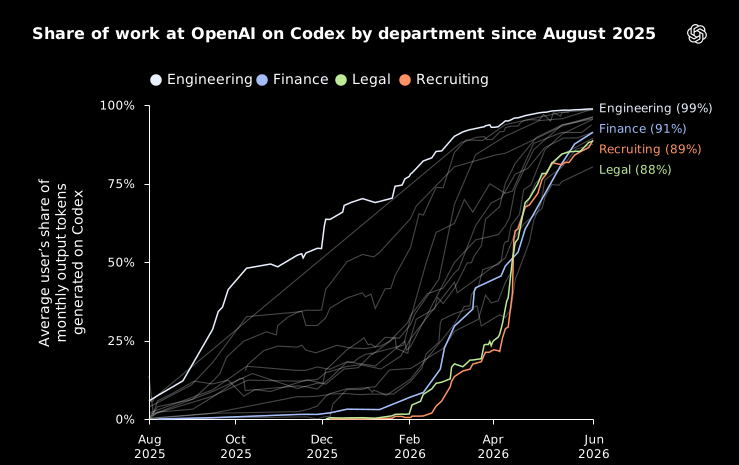
The need for shared infrastructure becomes clearer in OpenAI's own department data. The company reported that Codex became the dominant source of AI output across engineering and non-engineering teams.
OpenAI also reported sharp increases in combined ChatGPT and Codex output tokens between November 2025 and June 2026, including 56 times for Research, 32 times for Customer Support, 27 times for Engineering and 13 times for Legal.
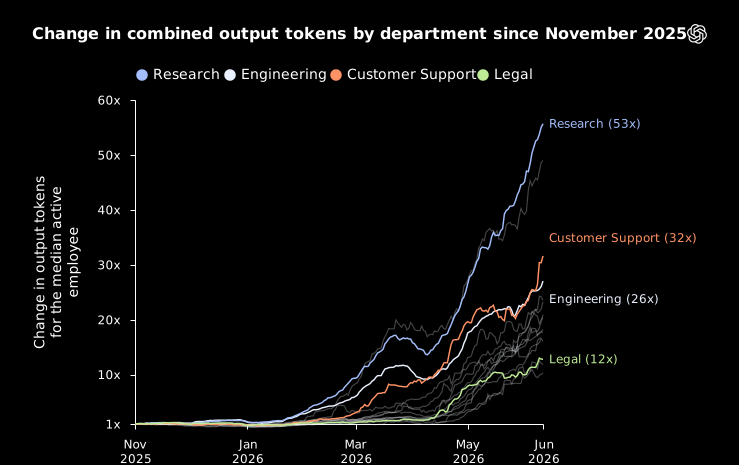
More output is not the same as more productivity. It could include useful work, failed experiments, parallel drafts or noise. The figures make a case for instrumentation, not for assuming a return.
Non-developer growth expands both opportunity and control needs
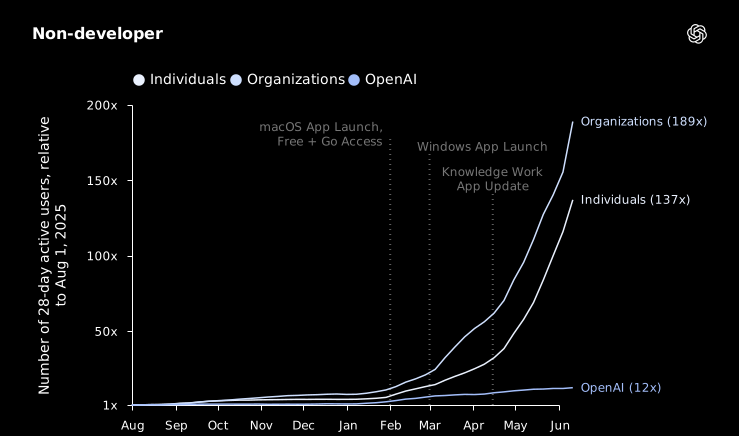
OpenAI says non-developer Codex users grew 137 times among individuals, 189 times among organizational users and 12 times inside OpenAI from August 2025 to June 2026.
Developer adoption also increased, but at a different rate.
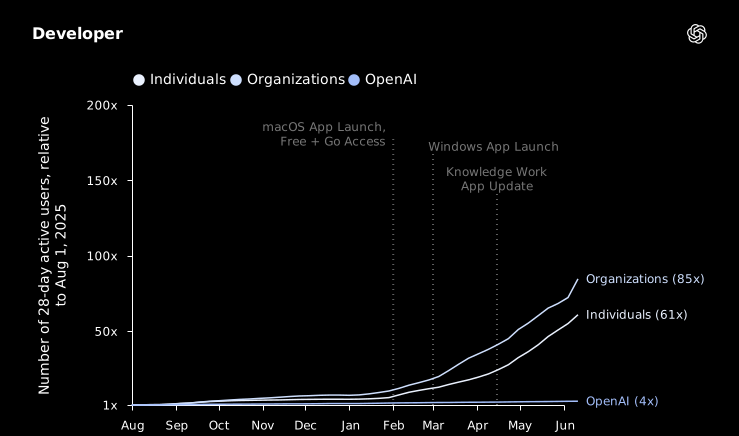
These two charts matter for investment planning because the next budget surge may not come from engineering. Legal, finance, recruiting, support, operations and marketing teams can now delegate data work, automation and internal-tool tasks that previously required technical help.
That can unlock valuable local innovation. It can also create shadow automation: scripts, dashboards and agents without clear owners, tests, maintenance plans or security review. Central enablement should therefore make safe experimentation easy while making high-impact deployment deliberately harder.
Step 5: Match capacity to proven demand
OpenAI's final step is to match the commercial and technical capacity model to a workload only after its value is demonstrated.
The company names several options:
- Guaranteed Capacity for production systems that need access certainty. OpenAI says customers can make one- to three-year commitments, with discounts increasing by annual commitment.
- Scale Tier for predictable, high-volume API workloads.
- Batch API for asynchronous work.
- Flex processing for lower-priority workloads that can tolerate slower or less predictable service.
- Prompt Caching for repeated context.
These can improve cost or reliability in the right workload. They can also create commitment risk. A long-term capacity deal signed before demand stabilizes may convert experimentation uncertainty into contractual overcapacity.
Before committing, procurement teams should ask:
- How much of forecast demand is proven production use rather than pilot enthusiasm?
- What is peak demand, and what is steady demand?
- Can the workload tolerate batching, caching or flexible latency?
- How portable are prompts, tools, evaluations and data connectors?
- What happens if a smaller or competing model reaches the quality bar?
- Are unused commitments transferable across products, models or cloud providers?
- Which prices, service levels, data terms and exit rights are contractually fixed?
Capacity should follow evidence. It should not be used to manufacture confidence that the evidence does not support.
What the framework gets right
OpenAI's guidance is most useful in four places.
First, it rejects token price as a complete efficiency measure. That aligns with the FinOps Foundation's recommendation to move from cost per token toward use-case economics.
Second, it treats evaluations as an investment tool, not only a model-quality tool. A good eval makes it possible to compare models, prompts and workflow designs against the same acceptance bar.
Third, it connects budget controls with workflow context. A power user who has found a high-value process may deserve more capacity; a broad limit increase may not.
Fourth, it separates exploration, validation and production funding. Too many AI programs either starve promising pilots or scale demonstrations before they are operationally ready.
Where buyers should be cautious
The July 14 post is written by OpenAI and directs readers toward OpenAI products and services. That does not make the recommendations wrong, but it creates an obvious commercial interest.
Several cautions follow:
- Vendor-reported efficiency is not workflow ROI. Model benchmarks and token reductions do not show the result inside a specific company's process.
- A vendor console is not a complete cost ledger. It may omit internal labor, downstream cloud costs, data preparation, security work and review time.
- Capacity certainty can create lock-in. Long commitments need demand evidence, portability analysis and exit terms.
- Output growth is not value growth. OpenAI's internal token charts show activity, not causal productivity or financial return.
- Governance features do not replace governance decisions. The customer remains responsible for choosing permissions, approvals, risk tolerances and accountability.
- OpenAI is not a representative workplace. Its employees have unusually strong access, familiarity, incentives and support for OpenAI tools.
Companies should use the framework across providers. Run the same accepted-outcome evals, fully loaded cost model and risk criteria against every model or platform under consideration.
A practical AI investment scorecard
An executive review can be kept to one page if the right questions are used.
| Dimension | Evidence required | Stop or redesign signal |
|---|---|---|
| Outcome | Named result and baseline | No agreed definition of success |
| Quality | Representative eval and acceptance rate | Demo works, real cases fail |
| Economics | Fully loaded cost per accepted outcome | Cost rises faster than accepted value |
| Demand | Sustained use by a defined group | Usage depends on a single champion |
| Risk | Data, action and failure classification | High-impact actions lack approval |
| Operations | Owner, logs, incident and rollback plan | No one owns failures after launch |
| Portability | Exportable data, evals and workflow logic | Core process cannot move or be tested elsewhere |
| Capacity | Forecast tied to proven volume | Commitment depends on speculative adoption |
A workflow should advance only when the evidence improves. If quality stalls, review time climbs or users stop returning, more credits will not fix the investment case.
A 90-day operating plan
Days 1-30: establish the ledger
- Inventory AI products, API keys, agent workflows, connectors and owners.
- Tag spend to a use case, department and environment.
- Select three to five recurring workflows with measurable outcomes.
- Establish current human cost, cycle time, defect rate and throughput.
- Assign a risk tier and prohibited actions to each workflow.
Days 31-60: run outcome-based evaluations
- Build representative test sets with domain experts.
- Compare at least two model or workflow configurations.
- Capture model, tool, infrastructure and review cost.
- Measure first-pass acceptance, failure types and time to approved result.
- Tighten instructions, context, tool access and stopping conditions.
Days 61-90: fund, pause or retire
- Expand workflows that beat their baseline and meet the risk bar.
- Redesign workflows with promising value but weak reliability.
- Retire pilots that lack a repeatable outcome or accountable owner.
- Fund reusable controls and evaluation infrastructure centrally.
- Negotiate capacity only for sustained, measured production demand.
What changes today?
OpenAI's July 14 post is guidance, not a mandatory pricing change or a new regulation. There is no immediate action required for individual ChatGPT users.
For ChatGPT Enterprise customers, the advice builds on spend and analytics features OpenAI announced in June. Admins should verify which controls and data exports are available in their own workspace and contract rather than assuming every capability applies to every plan or region.
For CFOs, CIOs and business-unit leaders, the immediate action is to change the monthly AI review. Replace "How many tokens did we buy?" with four questions:
- Which accepted outcomes did the spend produce?
- What was the fully loaded cost of each outcome?
- Which risks and review burdens grew with usage?
- Which workflows have earned more capacity?
Bottom line
OpenAI's five-step framework captures the central investment challenge of the agentic era: consumption is easy to measure, but value is not.
The right unit of management is neither the user seat nor the token. It is the accepted, governed business outcome. Companies need enough visibility to attribute spend, enough evaluation discipline to compare alternatives, enough governance to contain agent authority, and enough procurement patience to buy capacity only after demand is real.
OpenAI has a commercial reason to help enterprises scale AI usage. Buyers have a different obligation: prove that each additional dollar produces useful work without creating disproportionate risk or lock-in. The best investment process can hold both truths at once.
FAQ
What did OpenAI announce on July 14, 2026?
OpenAI published a five-step management framework for enterprise AI investment. It recommends better usage visibility, outcome-based model evaluation, governance before scale, portfolio funding for repeatable workflows and capacity commitments tied to proven demand.
What is the best metric for agentic AI cost?
For priority workflows, use cost per accepted outcome. Include model and tool charges, retries, infrastructure, integration, human review and correction. Define the outcome in business terms, such as a resolved case or an approved code change.
Is the cheapest model always the most economical?
No. A cheaper model can cost more overall if it fails more often, loops, creates rework or requires more review. Compare models against the same representative evaluation and quality threshold.
Should every AI workflow get a fixed budget?
No. Exploration should receive small, time-boxed funding. Validation needs evaluation and risk controls. Production funding should follow evidence of quality, demand and value. Limits can then vary by workflow and user rather than rising for everyone.
When should a company buy guaranteed AI capacity?
After a production workflow has sustained, measurable demand and needs access certainty. Buyers should compare the commitment with flexible alternatives and examine portability, unused capacity, service levels and exit terms.
Does more agent output prove higher productivity?
No. More tokens, run time or generated artifacts show activity. Productivity requires accepted outputs, lower cycle time, reduced human effort, better decisions, revenue impact or risk reduction after quality and review are considered.
Sources and methodology
- OpenAI: How to manage AI investments in the agentic era, published July 14, 2026. Primary source for the five-step framework and OpenAI product claims.
- OpenAI: New usage analytics and updated spend controls for enterprises, published June 18, 2026. Source for Global Admin Console and credit-control details.
- OpenAI: How agents are transforming work, published June 25, 2026. Source for Codex adoption, task-horizon and department-level charts. These are company-reported findings.
- OpenAI: How evals drive the next chapter in AI for businesses, published November 19, 2025. Source for evaluation methodology context.
- FinOps Foundation: Unit Economics. Independent framework for connecting technology cost with business value.
- NIST: AI Risk Management Framework Core. Independent governance, mapping, measurement and risk-management framework.
HacksByte selected the primary and supporting sources, compared their claims, added the investment scorecard and 90-day operating plan, and labeled vendor-reported evidence. No source paid for or reviewed this article before publication. See our Editorial Policy and Corrections Policy.
Before you move on
Global AI workflow guidance. Use this short checklist to turn the article into action.
- Check whether the tool can access private files or account data.
- Verify factual claims against primary sources before publishing.
- Keep a human review step for work that affects money, school, or customers.
This guide is written for practical user safety. For account, platform, or legal decisions, confirm critical steps with the official help center or your service provider.