


Airbnb CEO Brian Chesky reportedly plans to back a new AI lab focused on AI models, user interaction and design. Here is what is known, what remains unclear, and why the move matters for travel, hosts, guests and AI competition.
Last checked: June 5, 2026. This article uses TechCrunch's June 4 report as the primary source, with Bloomberg credited as the outlet that first reported the plan. It also checks Airbnb's own 2026 shareholder letter, Airbnb's 2026 Summer Release and Airbnb's official CTO announcement for context on the company's broader AI strategy. Airbnb and Brian Chesky declined to comment to TechCrunch, so details about the lab's structure, funding, leadership and launch timeline should be treated as unconfirmed until publicly announced.
Quick answer
Airbnb CEO Brian Chesky reportedly plans to back a new AI lab, according to reporting first broken by Bloomberg and later confirmed to TechCrunch by a person familiar with the situation.
The lab has not been formally announced by Airbnb or Chesky. TechCrunch reported that Airbnb and Chesky declined to comment. The clearest available detail is that the new AI effort may focus on AI models, user interaction and design, areas that fit Chesky's public emphasis on product experience and Airbnb's recent AI push.
TechCrunch also reported that Chesky is expected to remain Airbnb's CEO and will not personally lead the new operation. That distinction matters: this appears, based on current reporting, to be a Chesky-backed AI venture rather than an Airbnb product launch.
For Airbnb users, hosts and investors, there is no immediate product change to act on. But the move would be strategically important because Airbnb is already using AI across engineering, customer support, reviews, comparison tools and trip planning. A separate lab could help Chesky explore AI interfaces for travel and commerce outside the constraints of Airbnb's main platform.
What happened
TechCrunch reported on June 4, 2026 that Brian Chesky plans to launch a new AI lab. The article said Bloomberg first reported the news and that a person familiar with the matter confirmed the plan to TechCrunch.
The article did not identify the lab's name, founding team, funding amount, legal structure or launch date. It also said the focus is not yet clear, while noting Bloomberg's report referenced user interaction and design.
That uncertainty is important. The most accurate way to describe the story today is:
| Question | Current status |
|---|---|
| Is Chesky reportedly backing a new AI lab? | Yes, according to Bloomberg and TechCrunch reporting. |
| Has Airbnb officially announced the lab? | No public Airbnb announcement reviewed by HacksByte confirms it. |
| Will Chesky leave Airbnb to run it? | TechCrunch reports he will remain Airbnb CEO and will not lead the lab himself. |
| What will the lab build? | Unclear; reporting points to AI models, user interaction and design as possible focus areas. |
| Is this an Airbnb product? | Not confirmed. Current reporting frames it as a new AI operation associated with Chesky. |
| Did Airbnb comment? | TechCrunch says Airbnb and Chesky declined to comment. |
The story matters because it moves Chesky from being an adviser and major AI customer to potentially becoming a backer of model or interface research.
Why the lab could matter
Most AI labs focus on one of three things: frontier models, specialized applications or new interfaces. Chesky's reported interest points most strongly to the third category.
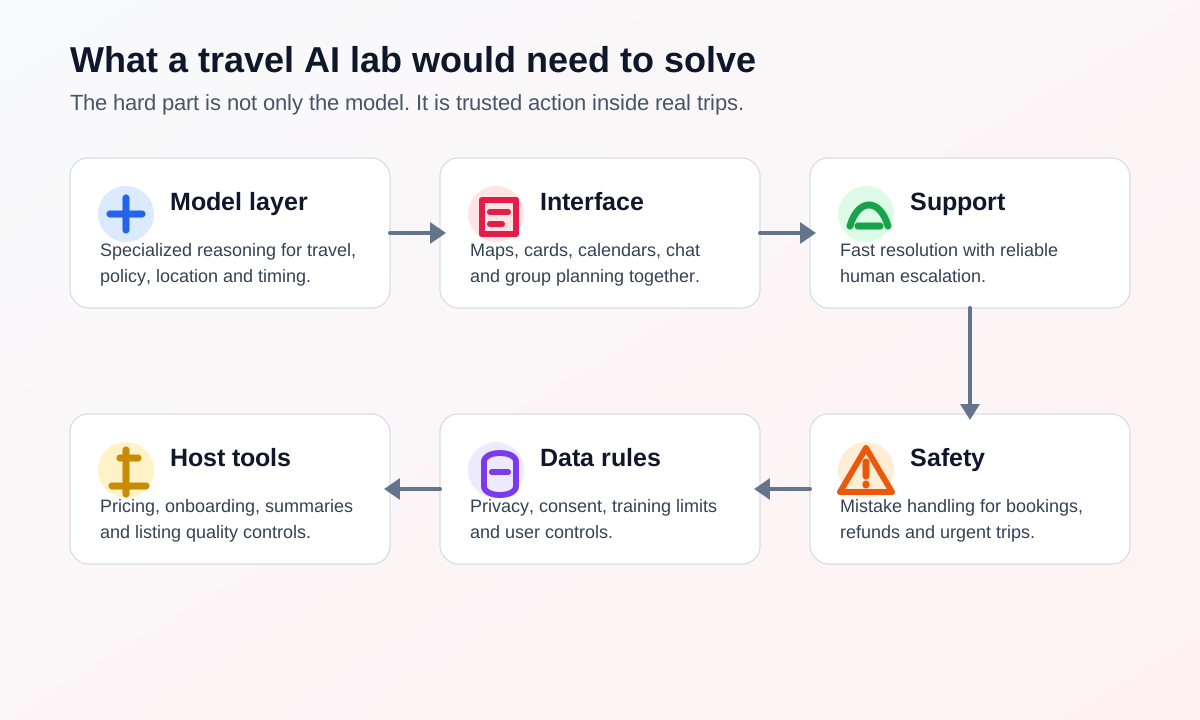
Travel is a hard interface problem. Booking a trip is not one question and one answer. It involves comparing neighborhoods, dates, budgets, safety, group preferences, cancellation policies, accessibility needs, transportation, activities, host rules and last-minute support.
That is why a generic chatbot is often not enough. A travel AI product needs:
- Memory of user preferences.
- Visual comparison of options.
- Trust and safety controls.
- Payments and policy awareness.
- Group planning support.
- Local context.
- Transparent recommendations.
- Reliable handoff to humans when needed.
Chesky is a design-led founder. Airbnb's core product has always depended on turning messy real-world decisions into a usable interface. If the reported lab is focused on interaction and design, it could be an attempt to answer a question many AI companies are still struggling with: what should the AI-native app actually look like?
How this fits Airbnb's AI strategy
The reported lab arrives after several months in which Airbnb has been unusually explicit about AI.
In January 2026, Airbnb named Ahmad Al-Dahle as chief technology officer. Airbnb's official announcement said Al-Dahle previously led Meta's Generative AI group and the team behind the Llama family of models. Chesky's internal note framed the hire as part of a human-centered technology push.
In Airbnb's Q1 2026 shareholder letter, the company said AI is already changing how it builds. Airbnb said nearly 60% of code produced by its engineers is coauthored with AI. It also said more than 40% of support issues from guests using its AI Assistant are resolved without a human agent, up from roughly one-third in Q4 2025.
In Airbnb's May 2026 Summer Release, the company announced AI review highlights, an AI-powered comparison feature for wishlists, and AI-powered customer support available worldwide in 11 languages. Airbnb also said it plans to extend the AI assistant to voice later in 2026.
Put together, those moves show Airbnb is not treating AI as a side feature. AI is touching engineering productivity, support economics, discovery, planning and the way guests compare places to stay.
Timeline
| Date | Event | Why it matters |
|---|---|---|
| January 14, 2026 | Airbnb announced Ahmad Al-Dahle as CTO. | The company hired a former Meta generative AI leader to oversee engineering and data science. |
| Q1 2026 | Airbnb said nearly 60% of engineer-produced code was coauthored with AI. | AI became part of Airbnb's internal software-development workflow. |
| Q1 2026 | Airbnb said its AI Assistant resolved more than 40% of support issues without a human agent. | AI support moved from experiment to operating metric. |
| May 20, 2026 | Airbnb's Summer Release introduced AI review highlights, AI comparison and expanded AI support. | AI became more visible inside the guest product. |
| June 4, 2026 | Bloomberg and TechCrunch reported Chesky plans a new AI lab. | The reported lab could extend Chesky's AI ambitions beyond Airbnb's current product roadmap. |
What Airbnb is already building with AI
Airbnb's public materials show four current AI lanes.
| AI lane | What Airbnb has said publicly | Why it matters |
|---|---|---|
| Engineering productivity | Nearly 60% of engineer-produced code is coauthored with AI, according to the Q1 2026 shareholder letter. | Faster software delivery can help Airbnb ship more experiments and operational tools. |
| Customer support | More than 40% of AI Assistant issues are resolved without a human agent, according to the shareholder letter. | Support automation can lower costs and speed up common fixes, but users still need reliable escalation. |
| Discovery and comparison | Summer Release features include AI review highlights and AI-generated comparison summaries. | AI can reduce the work of scanning many listings, reviews and amenities. |
| Trip assistance | Airbnb says its AI assistant knows trip details, supports interactive cards and will expand to voice. | This points toward a more active travel companion, not just a search box. |
The reported AI lab would be different if it works on underlying models or novel interfaces rather than only Airbnb-specific product features.
Why Chesky may want a separate AI lab
There are several plausible reasons a consumer-tech CEO might back an external AI lab. These are inferences from the reporting and from Airbnb's public strategy, not confirmed details about Chesky's plans.
1. Interface research needs room to experiment
Airbnb's main app handles real bookings, money, identity, safety and guest-host disputes. That makes radical experimentation difficult. A separate lab could explore new AI interfaces without immediately exposing Airbnb users to unfinished product ideas.
2. Travel and commerce need more than chat
Chesky has publicly emphasized design and user experience. Travel planning often requires maps, cards, calendars, saved lists, group decisions and policy-aware actions. A lab could work on interaction models that combine conversation with visual and transactional interfaces.
3. Model providers may not solve Airbnb's exact problem
General-purpose AI labs optimize for broad capabilities. Airbnb needs AI that understands travel, trust, marketplaces, hospitality, policies and multi-party coordination. A specialized lab could focus on consumer decision-making rather than generic assistant behavior.
4. AI talent wants ambitious missions
Top AI researchers and product builders often want to work on model architecture, product interaction and new markets. A standalone lab may be easier to position as a high-upside research company than an internal corporate team.
5. Strategic optionality
If the lab succeeds, it could supply technology to Airbnb, operate independently, partner with other companies, or become a broader consumer AI company. None of those outcomes is confirmed, but each would explain why a founder might back the idea outside the main company.
The OpenAI connection
TechCrunch highlighted Chesky's relationship with OpenAI CEO Sam Altman. Chesky and Altman both have Y Combinator roots, and TechCrunch reported that Chesky became an adviser to Altman during OpenAI's growth and helped support him during the 2023 leadership crisis.
That context is relevant, but it should not be overread. The current story does not prove a direct OpenAI rivalry, and TechCrunch does not report that the new lab has a specific product competing with ChatGPT, OpenAI's API or any named model.
What it does show is a broader pattern: major consumer-company founders increasingly want more control over the AI layer that will shape their products. Companies such as Airbnb do not only need access to large language models. They need the interface, reliability and business logic that make AI useful in real transactions.
What hosts should watch
For Airbnb hosts, a Chesky-backed AI lab does not change listings today. The more relevant issue is how Airbnb's existing AI roadmap affects visibility, support and operations.
Hosts should watch:
- Whether AI review highlights summarize their listings fairly.
- Whether comparison tools emphasize the right amenities and tradeoffs.
- Whether AI support can resolve host issues or creates new escalation friction.
- Whether pricing, onboarding and property-management tools become more automated.
- Whether AI-generated recommendations favor certain listing types, cancellation policies or locations.
- Whether hosts get visibility into why their listing is or is not recommended.
The biggest host concern is transparency. If AI becomes a major layer between guests and listings, hosts will need to understand what signals matter and how to correct inaccurate summaries.
What travelers should watch
For guests, Airbnb's AI direction could be useful. Reading dozens of reviews, comparing homes and planning logistics can be exhausting. AI can make that easier.
But travelers should remain careful with AI-generated booking help:
- Verify cancellation rules, fees and house rules before booking.
- Check exact location, accessibility and transportation details.
- Read a sample of recent reviews, not only the AI summary.
- Confirm whether AI support can actually complete the task you need.
- Escalate to a human for safety, payment, refund or emergency issues.
- Be cautious when AI suggests add-on services or comparisons that may involve commercial incentives.
AI can shorten the planning process, but the booking contract, host rules and local laws still matter.
What investors should watch
For investors, the key question is whether the reported lab is a distraction, a hedge or a strategic asset.
The positive case is that Chesky understands consumer interfaces and travel better than most AI model labs. A lab focused on AI-native user experience could produce technology that strengthens Airbnb or becomes valuable beyond travel.
The skeptical case is that AI labs are expensive, talent markets are overheated, and competing with frontier labs requires massive capital unless the lab is narrowly focused. If the project has unclear governance or overlaps with Airbnb's strategy, investors may also ask whether management attention is being split.
Important unanswered investor questions include:
- Who will fund the lab?
- Will Airbnb invest directly?
- Will Airbnb own any IP or commercial rights?
- Will Chesky serve as founder, chair, investor or adviser?
- How much time will he spend on it?
- Could the lab create conflicts with Airbnb shareholders?
- Will it use Airbnb data or only public/synthetic data?
- Will it sell technology to Airbnb or third parties?
Until those questions are answered, the market should treat the report as strategically interesting but incomplete.
Governance and privacy questions
If a travel-focused AI lab eventually touches Airbnb data, privacy becomes a major issue. Travel data can reveal where people sleep, who they travel with, their budget, family structure, medical or accessibility needs, work trips, religious events and private routines.
There is no public evidence that the reported lab has access to Airbnb user data. But any future partnership should answer clear governance questions:
| Question | Why it matters |
|---|---|
| Will Airbnb user data train models? | Users and regulators will want explicit disclosure and controls. |
| Will hosts and guests be able to opt out? | Marketplace participants may object to their data powering external AI products. |
| How will safety incidents escalate? | Travel support can involve urgent, real-world risks. |
| Who is liable for bad AI advice? | Booking, refund, safety and accessibility mistakes can have real consequences. |
| Will recommendations be explainable? | Hosts and guests need to understand why listings are surfaced or downgraded. |
AI in travel is not the same as AI for casual search. It affects real-world movement, payments and trust.
What remains unclear
The main open questions are basic but important:
- What is the lab's name?
- Is it a new company, research group, incubator or investment vehicle?
- Who will lead it?
- How much capital has been committed?
- Will Airbnb have an ownership stake?
- Will the lab build foundation models, specialized travel models, interface systems or agent tools?
- Will it hire researchers, designers, product engineers or all three?
- Will it work exclusively with Airbnb or serve other customers?
- How will Chesky manage governance, time commitment and potential conflicts?
The story will become clearer only when Chesky, Airbnb, the lab's eventual leader or investors provide more detail.
Bottom line
Brian Chesky's reported plan to back a new AI lab is not yet an official Airbnb announcement. But it fits a visible pattern: Airbnb is pushing AI deeper into its product, operations and support, while Chesky has argued that AI needs better consumer interfaces and better design.
The most interesting part is not simply that another tech executive may start an AI lab. It is that this lab may focus on the product layer where many AI tools still feel weak: how people actually compare choices, plan with others, trust recommendations and take action.
For now, users and hosts do not need to change anything. Watch Airbnb's AI features inside the app, verify AI-generated summaries before making decisions, and look for future disclosures about the lab's leadership, funding, data access and relationship to Airbnb.
Sources
- TechCrunch: Airbnb's Brian Chesky plans to launch a new AI lab, June 4, 2026.
- Bloomberg: Airbnb CEO Brian Chesky Plans to Start a New AI Company, June 4, 2026.
- Airbnb: Q1 2026 shareholder letter, May 2026.
- Airbnb Newsroom: 2026 Summer Release, May 20, 2026.
- Airbnb Newsroom: Airbnb announces Ahmad Al-Dahle as Chief Technology Officer, January 14, 2026.
Before you move on
Global AI workflow guidance. Use this short checklist to turn the article into action.
- Check whether the tool can access private files or account data.
- Verify factual claims against primary sources before publishing.
- Keep a human review step for work that affects money, school, or customers.
This guide is written for practical user safety. For account, platform, or legal decisions, confirm critical steps with the official help center or your service provider.