


Alphabet, Google's parent company, says it expects to raise $80 billion through public stock offerings, an ATM program and a Berkshire Hathaway private placement as AI data-center spending accelerates.
Last checked: June 3, 2026. This article uses Alphabet's June 1, 2026 equity capital raise announcement as the main factual anchor, with the Guardian as the primary news report and AP, Alphabet's SEC filing and Alphabet's Q1 2026 earnings release for additional context. This is a news explainer, not investment advice.
Quick answer
Alphabet, the parent company of Google, announced on June 1, 2026 that it expects to raise $80 billion through a mix of stock offerings, a planned at-the-market share program and a private placement with Berkshire Hathaway.
The stated reason is the cost of AI expansion. Alphabet says demand for Google Cloud, Gemini, AI infrastructure and data-center capacity is stretching compute needs. The company now expects 2026 capital expenditure of $180 billion to $190 billion, with spending expected to rise again in 2027.
The planned financing has three main parts:
| Funding piece | Alphabet's stated amount |
|---|---|
| Underwritten public offerings | $30 billion |
| At-the-market stock sale program | $40 billion |
| Berkshire Hathaway private placement | $10 billion |
For users, the immediate effect is not a change to Search, Gmail, YouTube or Gemini pricing. The bigger signal is that AI services are becoming capital-intensive infrastructure businesses. Google is raising new equity even while it remains highly profitable, because the AI race now requires enormous spending on chips, servers, power, networking and data centers.
For investors, the core tradeoff is dilution versus AI growth. New shares can reduce existing shareholders' ownership percentage, but Alphabet is arguing that more capital is needed to defend and expand its AI position.
What happened
The Guardian reported on June 2, 2026 that Alphabet plans to sell $80 billion in stock to fund its AI spending spree. The report pointed to Alphabet's official June 1 announcement and described the move as a sign of how aggressively major technology companies are spending to keep up with AI infrastructure demand.
Alphabet's announcement says the company expects to raise $80 billion in aggregate through:
- $30 billion in concurrent underwritten public offerings.
- $40 billion through a planned at-the-market, or ATM, offering program.
- $10 billion through a private placement to Berkshire Hathaway.
The public offerings include $15 billion of depositary shares representing mandatory convertible preferred stock and $15 billion of Class A and Class C capital stock. Alphabet says the ATM program is expected to begin in the third quarter of 2026 and may be used to sell Class A and Class C shares over time.
Berkshire Hathaway agreed to buy $5 billion of Class A stock and $5 billion of Class C stock, according to Alphabet's announcement. AP reported that Berkshire had already held nearly 58 million Alphabet shares as of the end of March 2026.
Why Alphabet says it needs the money
Alphabet says AI demand is changing the scale of its capital needs. In its announcement, the company said it needs additional capital to "advance AI infrastructure, enhance global compute capacity and meet growing customer demand."
The company also disclosed several financial context points:
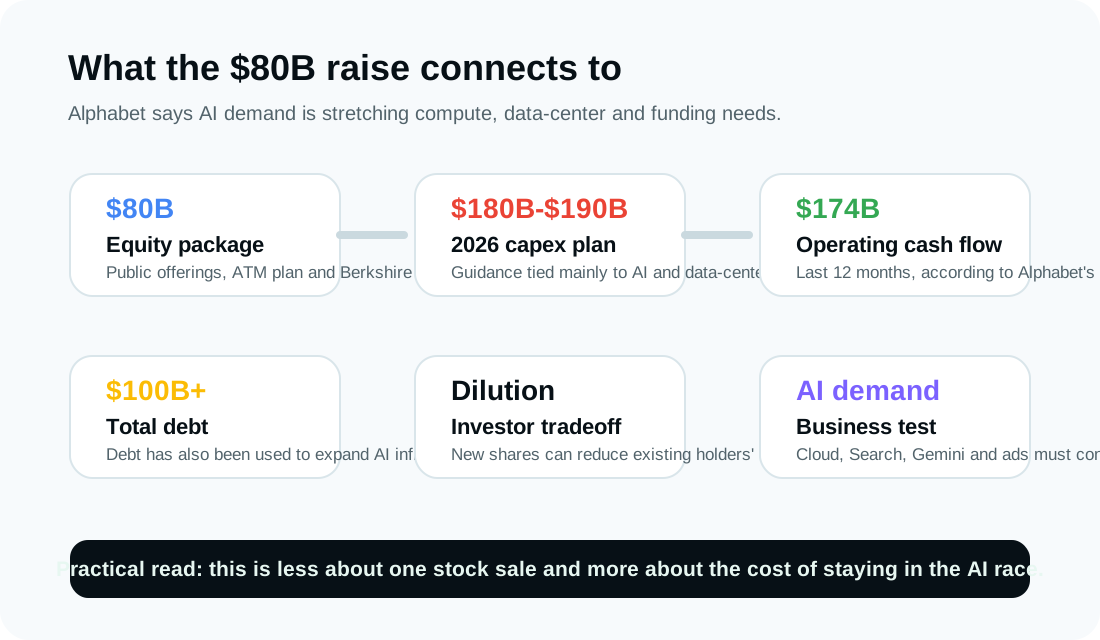
- It expects 2026 capital expenditure of $180 billion to $190 billion.
- It expects capital expenditure to increase again in 2027.
- It generated $174 billion in operating cash flow during the 12 months ended March 31, 2026.
- It raised more than $85 billion in debt during the past 12 months.
- Its total debt now exceeds $100 billion.
That combination matters. Alphabet is still generating huge cash flow, but AI infrastructure spending has become so large that the company is using a broader funding mix: cash flow, debt and now equity.
The spending is not only about training frontier models. It also covers the physical and software stack that lets AI products run at scale:
- Data centers.
- AI chips and accelerators.
- Servers and storage.
- Networking.
- Power contracts and energy infrastructure.
- Cooling systems.
- Google Cloud capacity.
- Gemini model training and inference.
- AI features in Search, Workspace, Android, YouTube and ads.
What the $80B package actually means
The phrase "sell $80 billion in stock" can sound like one simple transaction. Alphabet's plan is more layered.
1. The $30B underwritten offerings
Alphabet says the $30 billion public offering package includes:
- $15 billion of depositary shares representing mandatory convertible preferred stock.
- $15 billion of Class A and Class C capital stock.
Mandatory convertible preferred stock is a security that generally pays a preferred dividend and later converts into common stock under specified terms. For existing shareholders, the key issue is eventual dilution. For Alphabet, it can provide capital now while spreading the common-share impact through the conversion structure.
2. The $40B ATM program
An at-the-market offering lets a company sell shares into the market over time instead of selling the entire amount in one block.
Alphabet says the ATM program is expected to launch in the third quarter of 2026. The company also says it expects about $30 billion of the ATM proceeds in 2026 to fund withholding tax obligations tied to equity awards that vest for employees. Any additional 2026 ATM proceeds are expected to be used for general corporate purposes.
That detail is important because it means not every dollar is a direct "new data center" dollar. Some proceeds are linked to employee stock compensation tax mechanics, while the broader financing plan supports the AI infrastructure buildout.
3. The $10B Berkshire Hathaway placement
Alphabet says Berkshire Hathaway agreed to buy:
- $5 billion of Class A stock at $351.81 per share.
- $5 billion of Class C stock at $348.20 per share.
The Guardian framed the Berkshire investment as a high-profile vote of confidence. It also gives Alphabet an anchor investor for part of the raise while signaling that one of the world's most closely watched investment firms is willing to add exposure to Alphabet's AI infrastructure story.
Why this matters for everyday Google users
Most users will not see a direct change tomorrow. Search, Gmail, YouTube, Maps, Android and Gemini will continue to work as services, not as line items in Alphabet's funding plan.
But this financing still matters for users because it shows where Google is moving:
- More AI will be built into existing products. Search summaries, Workspace features, Android assistants, YouTube tools and ad products all require compute.
- Advanced AI may become more tiered. If the strongest models are expensive to run, companies may reserve some features for paid plans, enterprise customers or limited usage windows.
- Cloud AI competition may intensify. Google Cloud needs enough compute capacity to serve startups, enterprises and developers building on Gemini and Vertex AI.
- Energy and sustainability questions will grow. Data centers need power, water, land, cooling and grid capacity.
- AI reliability will matter more. Users will rely on AI answers in more contexts, which raises the importance of citations, accuracy controls and human review for high-stakes decisions.
The short version: this is not just a finance story. It is a signal that AI features users see in everyday apps depend on expensive infrastructure most people never see.
Why this matters for businesses
For businesses choosing AI platforms, Alphabet's planned raise is a capacity signal.
Google is telling the market that demand for cloud and AI infrastructure is high enough to justify one of the largest equity-financing packages in corporate tech history. If your company uses Google Cloud, Workspace, Gemini, Vertex AI, advertising tools or Android enterprise services, the financing suggests Alphabet is trying to ensure it has enough infrastructure for large-scale AI workloads.
Business leaders should watch:
- Whether Google Cloud expands AI capacity faster than rivals.
- Whether Gemini features become more reliable under heavy demand.
- Whether prices rise for high-compute AI features.
- Whether enterprise contracts include clearer limits for AI usage.
- Whether Google can offer better regional availability for AI workloads.
- Whether data residency, privacy and compliance controls improve alongside capacity.
The practical procurement question is not "did Alphabet raise a lot of money?" It is "will this spending improve the reliability, cost and capability of the AI services my team depends on?"
Why investors reacted cautiously
The Guardian reported that Alphabet shares fell after the announcement, with the stock down as much as 4.4% after the market opened on Tuesday.
That reaction is understandable. Equity sales can dilute existing shareholders. Investors also know that AI infrastructure spending is huge, long-term and uncertain. A company can spend heavily on data centers and chips without instantly proving that the returns will exceed the cost of capital.
The bull case is that Alphabet needs to spend now to protect Search, grow Google Cloud, monetize Gemini and defend its position against OpenAI, Microsoft, Amazon, Meta, Anthropic and other AI competitors.
The bear case is that the AI race may require years of massive spending before margins, pricing power and user behavior fully justify the investment.
That is the central tension of the story.
What this says about the AI infrastructure race
Alphabet is not alone. The AI market has moved from model demos to infrastructure scale.
Every major AI company now faces similar constraints:
- Enough chips to train and serve models.
- Enough power to run data centers.
- Enough networking to connect clusters.
- Enough cloud capacity to serve enterprise customers.
- Enough revenue to justify the capital cycle.
- Enough trust to put AI inside core workflows.
The difference is that Alphabet already owns large consumer platforms, a major advertising business, Google Cloud, Android, YouTube and deep AI research teams. That gives it distribution advantages. It also gives it a large obligation: users and businesses expect AI features to be fast, available and increasingly useful.
Raising equity for AI infrastructure shows how expensive that obligation has become.
Timeline
| Date | Event |
|---|---|
| March 31, 2026 | Alphabet says the 12-month period ended with $174 billion in operating cash flow. |
| June 1, 2026 | Alphabet announces the expected $80 billion equity capital raise. |
| June 2, 2026 | The Guardian reports the planned stock sale and market reaction. |
| Q3 2026 | Alphabet expects the $40 billion ATM program to begin. |
| 2026 | Alphabet expects $180 billion to $190 billion in capital expenditure. |
| 2027 | Alphabet expects capital expenditure to increase further. |
What remains unclear
Alphabet has disclosed the structure and broad purpose of the raise, but several important details are still unresolved publicly:
- Exact final pricing for the public offerings.
- How quickly Alphabet will use the ATM program.
- How much of the new capacity will support internal Google products versus Google Cloud customers.
- Whether the spending will affect Gemini subscription tiers or AI usage limits.
- How much additional debt Alphabet may raise if AI demand keeps growing.
- Whether regulators, local communities or energy providers will slow data-center expansion.
- How quickly the new AI infrastructure will translate into revenue growth and margins.
Those details will matter more than the headline number over time.
What users should do now
For everyday users:
- Do not expect an immediate product change only because Alphabet announced the raise.
- Watch for Gemini, Workspace and Search AI feature changes over the next few quarters.
- Keep checking AI answers against reliable sources when money, health, legal, safety or business decisions are involved.
- If you pay for Google AI plans, monitor limits, regional availability and feature access.
For businesses:
- Review how much your organization depends on Google AI and cloud services.
- Ask vendors for clear usage limits, data controls, audit logs and pricing terms.
- Benchmark Google AI against other platforms before locking in large workloads.
- Plan for AI costs as infrastructure costs, not just software subscription costs.
For investors:
- Separate revenue growth from infrastructure spending.
- Watch capital expenditure, free cash flow and share dilution.
- Track whether Google Cloud and AI subscriptions grow fast enough to support the spending plan.
- Treat this as a long-duration infrastructure bet, not a simple short-term product launch.
Bottom line
Alphabet's $80 billion financing plan is a clear signal that the AI race has become an infrastructure race.
The company is not raising money because Google has stopped generating cash. It is raising money because the expected cost of staying at the front of AI has climbed sharply. Data centers, chips, power and cloud capacity now sit behind the AI features users see in Search, Workspace, Android, YouTube, ads and Gemini.
For users, the main takeaway is that AI will keep moving deeper into Google products. For businesses, the key issue is capacity, pricing and controls. For investors, the question is whether Alphabet can turn this spending into durable AI revenue without sacrificing too much margin or ownership value.
Sources
- The Guardian: Google owner Alphabet to sell $80bn in stock to fund AI spending spree, June 2, 2026.
- Alphabet: Alphabet Announces Expected $80 Billion Equity Capital Raise, June 1, 2026.
- SEC filing: Alphabet free writing prospectus for equity capital raise, June 1, 2026.
- Alphabet Q1 2026 earnings release, April 2026.
- AP: Google parent Alphabet to raise $80 billion to feed AI infrastructure needs, June 2, 2026.
Before you move on
Global AI workflow guidance. Use this short checklist to turn the article into action.
- Check whether the tool can access private files or account data.
- Verify factual claims against primary sources before publishing.
- Keep a human review step for work that affects money, school, or customers.
This guide is written for practical user safety. For account, platform, or legal decisions, confirm critical steps with the official help center or your service provider.