

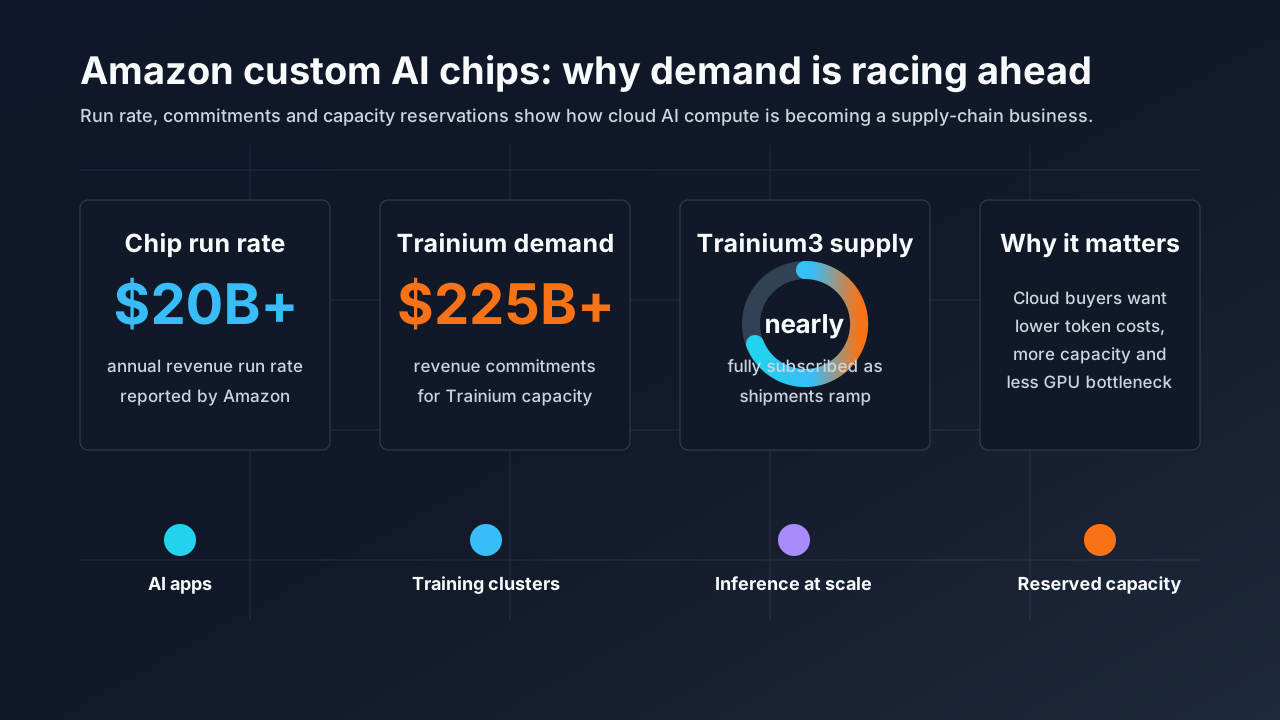
Amazon says its custom silicon business is now running above a $20 billion annual revenue rate, with Trainium commitments topping $225 billion and Trainium3 nearly fully subscribed.
Last checked: May 31, 2026. This article uses Amazon and AWS primary sources first. Amazon describes the chip figure as an annual revenue run rate, not audited full-year chip revenue, and says Trainium3 started shipping at the start of 2026.
Quick answer
Amazon says its custom chips business is now running above a $20 billion annual revenue rate after nearly 40% quarter-over-quarter growth in the first quarter of 2026. CEO Andy Jassy also said the business is growing at triple-digit percentages year over year and would be closer to a $50 billion annual run rate if it operated like a standalone chip company selling current-year production to AWS and outside customers.
The key driver is enterprise demand for AI compute. Amazon says it has more than $225 billion in revenue commitments for Trainium, its custom AI accelerator family. Trainium2 has largely sold out, and Trainium3, which Amazon says started shipping at the beginning of 2026, is nearly fully subscribed.
This is a major signal that the AI infrastructure market is moving beyond a simple "who can buy the most GPUs" story. Large customers still need GPUs, but cloud providers are now racing to control more of the AI stack with custom silicon, networking, software and reserved capacity.

What Amazon confirmed
Amazon's own summary of its Q1 2026 earnings comments says the chips business is larger than many expected. The company reported:
| Metric | Amazon's statement |
|---|---|
| Custom chips annual revenue run rate | More than $20 billion |
| Q1 2026 sequential growth | Nearly 40% quarter over quarter |
| Year-over-year growth | Triple-digit percentages |
| Standalone-style annual run rate estimate | About $50 billion |
| Trainium revenue commitments | More than $225 billion |
| Trainium2 supply | Largely sold out |
| Trainium3 status | Started shipping at the start of 2026 and is nearly fully subscribed |
| Trainium4 status | Much of capacity already reserved, about 18 months from broad availability |
The most important caveat is the phrase "run rate." It annualizes current business momentum. It is not the same as saying Amazon recognized $20 billion in chip revenue during the last fiscal year.
Still, the scale is large. Amazon says its custom silicon business is now one of the top three data center chip businesses in the world.
Why Trainium demand is so strong
AI companies and enterprises need massive compute capacity for training, fine-tuning, inference, agentic workflows, multimodal models and long-context reasoning. For the past several years, that demand has collided with GPU shortages, long reservation queues, high prices and data-center power constraints.
Trainium is Amazon's answer to that bottleneck. Instead of only renting third-party accelerators through AWS, Amazon can offer its own AI chips tightly integrated with EC2, Amazon Bedrock, SageMaker, EKS, ECS, AWS Batch, ParallelCluster and the AWS Neuron software stack.
Amazon says Trainium2 provides about 30% better price-performance than comparable GPUs. AWS says Trainium3 UltraServers deliver up to 4.4x higher performance, 3.9x higher memory bandwidth and over 4x better energy efficiency compared with Trn2 UltraServers.
That combination matters because AI customers increasingly care about cost per token, cost per training run, power efficiency and whether they can reserve enough capacity to meet product timelines.
Trainium3: what users need to know
Trainium3 is AWS's first 3nm AI chip. AWS says each chip provides 2.52 PFLOPs of FP8 compute, 144 GB of HBM3e memory and 4.9 TB/s of memory bandwidth.
Trn3 UltraServers can scale to 144 Trainium3 chips and up to 362 FP8 PFLOPs. AWS says these systems are available in EC2 UltraClusters 3.0 and are designed for frontier-scale models, reinforcement learning, mixture-of-experts models, reasoning workloads, video generation and long-context architectures.
For developers, AWS emphasizes the Neuron SDK and native integrations with PyTorch, JAX, Hugging Face Optimum Neuron and other tools. The goal is to reduce the amount of code customers need to change when moving workloads to Trainium.
The practical catch is availability. Amazon says Trainium3 is nearly fully subscribed. For customers, that means the decision is not only "Should we use Trainium?" but "Can we reserve enough of it when we need it?"
Why this matters for the GPU market
Amazon is not saying GPUs are going away. In fact, AWS still sells major GPU instances and many AI teams depend on the Nvidia software ecosystem.
What is changing is bargaining power. If cloud providers can offer competitive custom chips for a meaningful share of AI workloads, customers get more options and hyperscalers become less exposed to third-party accelerator supply shortages.
For Amazon, custom silicon also improves economics. AWS can tune chips, servers, networking, software and cloud services together. That can reduce cost per token, improve data-center efficiency and make it harder for customers to compare cloud providers on accelerator price alone.
For Nvidia and other chip suppliers, this means the market remains huge but more segmented. GPUs may keep dominating broad developer demand and cutting-edge workloads, while Trainium-style chips take more cloud-native training and inference capacity where AWS can optimize the full stack.
The role of Anthropic, OpenAI and Bedrock
Amazon says Trainium demand is being driven by large, multi-year, multi-gigawatt commitments from Anthropic and OpenAI, plus customers such as Uber.
Anthropic is especially important to the Trainium story. AWS's Project Rainier, one of the world's largest AI compute clusters, uses nearly half a million Trainium2 chips and is already supporting Anthropic workloads. Amazon says Anthropic is using Trainium2 infrastructure to build and deploy Claude.
Amazon Bedrock is another demand engine. Jassy said Bedrock has more than 125,000 customers, runs most of its inference on Trainium, and is used by almost 80% of Fortune 100 companies.
The strategic picture is clear: Amazon wants its AI services, model partners and chip roadmap to reinforce each other.
What this means for enterprises
Enterprises should treat the Trainium news as a capacity and architecture signal.
If your company is building serious AI systems, the relevant questions are:
- Which workloads must run on GPUs, and which can run on Trainium?
- Can your models and frameworks use AWS Neuron without heavy rewrites?
- How much reserved capacity do you need for training and inference?
- What is the expected cost per token or cost per experiment?
- How portable do you need your AI stack to be across clouds?
- What happens if Trainium capacity is unavailable when demand spikes?
The companies that win will not simply choose one chip forever. They will benchmark workloads across GPUs, Trainium and other accelerators, then place each workload where performance, cost, availability and engineering effort make sense.
What developers should watch
Trainium adoption depends heavily on the developer experience. A custom chip can look attractive on paper but fail if model teams spend too much time changing code, debugging kernels or waiting for library support.
Developers should watch:
- PyTorch and JAX compatibility through Neuron.
- Support for Hugging Face models and common inference stacks.
- Kernel customization options for performance engineers.
- Observability and profiling tools.
- Availability of examples for reasoning, video, multimodal and long-context models.
- Real customer benchmarks, not only vendor maximums.
AWS says it is investing in Neuron, open-source tools and developer access to Trainium3. That software layer will decide whether Trainium becomes a broad AI platform or mainly a hyperscale capacity tool for a smaller set of large customers.
Investor and market takeaway
The $20 billion run rate matters because it suggests Amazon's AI infrastructure business is becoming more vertically integrated. AWS is not just renting compute. It is designing chips, building clusters, offering managed AI services and locking in large commitments from model developers.
That has three implications:
- Amazon can improve margins if custom silicon reduces dependency on expensive third-party accelerators.
- Customers may get more reliable AI capacity if Amazon controls more of the supply chain.
- Competitors will need their own silicon strategies, deeper Nvidia access or clearer differentiation.
The risk is execution. Designing chips is hard. Scaling supply is hard. Making developers happy is hard. Amazon must keep improving silicon performance while also making the software stack easier and broader.
What normal users should know
Most users will never choose a Trainium instance directly. But they may feel the effects through faster AI features, lower AI service costs, more available cloud capacity and more AI products embedded into apps they already use.
If Amazon succeeds, AI assistants, coding tools, search features, recommendation systems, media generation and business automation could become cheaper to run at scale. If capacity remains tight, companies may ration advanced AI features, raise prices or prioritize enterprise customers.
FAQ
Did Amazon really say its chip business is at $20 billion?
Yes. Amazon said its chips business has an annual revenue run rate above $20 billion. That is a run-rate figure, not the same thing as audited full-year recognized revenue.
Is Trainium3 upcoming or already launched?
Amazon said Trainium3 started shipping at the start of 2026 and is nearly fully subscribed. AWS also describes Trn3 UltraServers as available. The better framing is that availability is ramping and demand is already absorbing much of the capacity.
Is Trainium replacing Nvidia GPUs?
No. AWS still offers GPU instances, and many AI workloads depend on the Nvidia ecosystem. Trainium gives AWS and customers another option, especially for cloud-native workloads where price-performance and capacity matter.
Why are companies reserving Trainium capacity so early?
Large AI models require huge, predictable compute allocations. Reserving capacity helps model developers plan training runs, product launches and inference scale without depending only on spot availability or scarce GPUs.
What is Trainium4?
Trainium4 is Amazon's next generation after Trainium3. Jassy said much of Trainium4 has already been reserved even though it is still about 18 months from broad availability.
Bottom line
Amazon's chip business has moved from side project to strategic pillar. A $20 billion-plus run rate, $225 billion-plus in Trainium commitments and nearly fully subscribed Trainium3 capacity show that cloud AI compute is now a supply-constrained infrastructure race.
For enterprises, the right response is benchmarking and capacity planning. For developers, it is watching whether Neuron and Trainium3 support mature quickly enough. For the AI market, the message is unmistakable: hyperscaler-owned silicon is now part of the center of gravity.
Sources
- Amazon CEO Andy Jassy on the chips business and Q1 2026 earnings: aboutamazon.com
- AWS Trainium3 UltraServers announcement: aboutamazon.com
- AWS Trainium product page: aws.amazon.com
- Amazon EC2 Trn3 UltraServers page: aws.amazon.com
- AWS Project Rainier and Anthropic Trainium2 cluster: aboutamazon.com
Before you move on
Global AI workflow guidance. Use this short checklist to turn the article into action.
- Check whether the tool can access private files or account data.
- Verify factual claims against primary sources before publishing.
- Keep a human review step for work that affects money, school, or customers.
This guide is written for practical user safety. For account, platform, or legal decisions, confirm critical steps with the official help center or your service provider.