

The EU AI Act's Article 50 transparency rules start applying on 2 August 2026, bringing new disclosure duties for AI chatbots, deepfakes, synthetic media and public-interest AI-generated text.
Last checked: May 31, 2026. The transparency obligations discussed here are based on Article 50 of Regulation (EU) 2024/1689, the European Commission's AI Act implementation timeline, and the Commission's work on a code of practice for marking and labelling AI-generated content.
Quick answer
The EU AI Act's major transparency rules start applying on 2 August 2026. From that date, many providers and deployers of AI systems in the EU will need to make it clear when people are interacting with AI, mark AI-generated or manipulated content in machine-readable ways where technically feasible, and disclose deepfakes or certain AI-generated public-interest text.
The rules are aimed at reducing deception, impersonation, fraud and misinformation as synthetic media becomes harder to distinguish from human-made content.
The key point for users is simple: if an image, audio clip, video or public-interest text was generated or manipulated by AI in a way that could mislead people, the AI Act increasingly expects that fact to be disclosed clearly. For businesses, this is no longer only a trust-and-safety best practice. It is becoming an enforceable compliance requirement.

What changes on 2 August 2026
The European Commission's AI Act implementation timeline says that the majority of AI Act rules start applying on 2 August 2026, including transparency rules under Article 50. Enforcement also starts at national and EU level from that date.
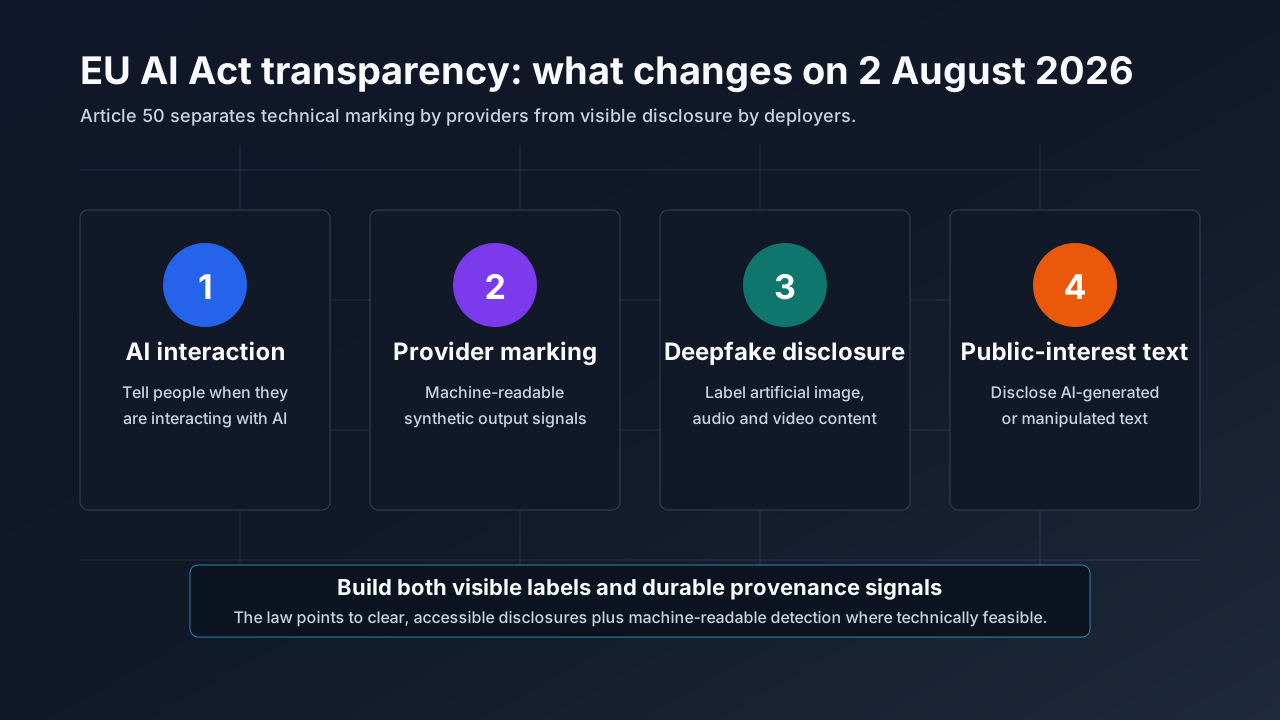
Article 50 covers several different transparency duties:
| Area | Who is mainly responsible | What must happen |
|---|---|---|
| AI interaction | Providers of AI systems that interact directly with people | Inform people they are interacting with AI unless this is obvious |
| Synthetic output marking | Providers of systems that generate synthetic audio, image, video or text | Mark outputs in a machine-readable format and make them detectable as artificially generated or manipulated |
| Emotion recognition and biometric categorisation | Deployers | Inform people exposed to those systems |
| Deepfakes | Deployers using AI to generate or manipulate realistic image, audio or video | Clearly disclose that the content was artificially generated or manipulated |
| Public-interest AI text | Deployers publishing AI-generated or manipulated text to inform the public on public-interest matters | Disclose the artificial origin unless human review/editorial control and editorial responsibility apply |
This means the law does not put one identical labelling duty on everyone. Providers and deployers have different obligations depending on what they build, publish and control.
Providers vs deployers: the distinction matters
The AI Act uses "provider" and "deployer" as separate roles.
A provider is typically the organization that develops an AI system or places it on the market under its name. A deployer is the organization or person using the AI system in a professional context.
For example:
- A model platform that generates synthetic video may need to support machine-readable marking.
- A media company publishing a realistic AI-generated video may need to disclose that the content is artificial.
- A public body using an AI chatbot may need to tell people they are interacting with AI.
- A company using AI to draft an internal memo may not have the same public-interest disclosure duty unless that content is published to inform the public.
The compliance work therefore has to follow the content chain: model provider, application provider, publisher, platform, advertiser, agency, brand or public authority.
What counts as a deepfake
The AI Act describes deepfakes as AI-generated or manipulated image, audio or video content that appreciably resembles existing persons, objects, places, entities or events and would falsely appear to a person to be authentic or truthful.
That can include:
- A synthetic video of a politician appearing to say something they never said.
- A cloned voice used in a fake executive message.
- A manipulated image of a real event.
- A realistic AI-generated interview clip.
- A synthetic celebrity endorsement.
The rule is not only about election misinformation. It also matters for scams, impersonation, consumer deception, reputational attacks and public safety.
What about AI-generated text?
Text gets a narrower rule than images, audio and video.
Article 50 targets AI-generated or manipulated text when it is published with the purpose of informing the public on matters of public interest. The disclosure duty does not apply in the same way if the content has undergone human review or editorial control and a natural or legal person holds editorial responsibility for the publication.
Practical examples:
| Scenario | Likely compliance issue |
|---|---|
| AI-generated election explainer published without human review | Disclosure likely needed |
| AI-generated emergency bulletin published by a public authority | Disclosure and review controls should be assessed carefully |
| AI-assisted newsroom draft reviewed and published under editorial responsibility | The AI Act includes an editorial-control exception |
| Internal AI-generated sales memo | Usually not public-interest publication |
| AI-written public health guidance posted as official information | High transparency risk if not reviewed and disclosed appropriately |
Media companies, public agencies and brands should document when AI is used, who reviewed the output, and who is responsible for the final publication.
Is "indelible label" the right wording?
The public discussion often uses phrases like "indelibly labelled." The Article 50 wording is more specific.
For providers of generative systems, the law requires outputs to be marked in a machine-readable format and detectable as artificially generated or manipulated. The technical solutions must be effective, interoperable, robust and reliable as far as technically feasible.
For deployers of deepfakes and certain AI-generated public-interest text, the rule is about clear disclosure of artificial creation or manipulation.
In practice, companies should think in two layers:
- A visible disclosure that ordinary people can understand.
- A durable technical signal such as metadata, watermarking, content credentials, cryptographic provenance or other machine-readable detection method.
The code of practice
The Commission is also developing a code of practice on marking and labelling AI-generated content. The AI Office says the code is intended to help providers and deployers comply with Article 50(2) and Article 50(4).
The code is expected to address:
- Machine-readable marking of AI-generated audio, images, video and text.
- Detection mechanisms for synthetic content.
- Deepfake disclosure.
- AI-generated or manipulated public-interest text.
- Cross-chain cooperation between model providers, deployers, platforms and publishers.
The code is voluntary, but if the Commission approves it, it can become a practical way for companies to demonstrate compliance.
Who should prepare now
The August 2026 date is close enough that teams should already be operationalizing the rules.
Organizations that should pay attention include:
- AI model providers and generative AI app developers.
- Social media and content platforms.
- Newsrooms, broadcasters and publishers.
- Political campaigns and advocacy groups.
- Advertising, PR and influencer agencies.
- Public authorities and emergency communication teams.
- Education, health and finance organizations publishing public-facing AI content.
- Any business using realistic synthetic avatars, voices or video.
Even companies outside the EU should assess exposure if their AI systems or AI-generated content are placed on the EU market or used in the EU.
Compliance checklist for businesses
Start with an inventory. You cannot label what you cannot find.
Recommended steps:
- List every product and workflow that generates text, image, audio or video with AI.
- Identify where outputs are public, public-interest, customer-facing or internal only.
- Add visible AI disclosures for deepfakes and synthetic public-facing content.
- Preserve metadata and provenance where possible instead of stripping it during publishing.
- Decide what label text, iconography and placement will be used consistently.
- Add human review and editorial sign-off for public-interest content.
- Log which AI tool generated or modified each public asset.
- Update vendor contracts to require machine-readable marking support.
- Train marketing, newsroom, public affairs and support teams.
- Test whether labels survive resizing, reposting, translation and platform upload.
The goal is not just a disclaimer in a privacy policy. The user should be able to understand when content is AI-generated or manipulated at the point where they encounter it.
What penalties could apply
The AI Act gives Member States authority to set penalties and enforcement measures. For many operator obligations outside the prohibited-practices category, including transparency obligations under Article 50, the regulation refers to administrative fines of up to EUR 15 million or, for undertakings, up to 3% of total worldwide annual turnover for the preceding financial year, whichever is higher.
For startups and smaller businesses, the law says penalties should take account of SMEs' interests and economic viability. That does not make the rules optional. It means enforcement should be proportionate.
What users should expect to see
Users should expect more obvious labels on synthetic media and AI-assisted public information. Examples could include:
- "AI-generated image"
- "Synthetic audio"
- "This video was generated or manipulated by AI"
- "This public-interest text includes AI-generated content"
- "You are interacting with an AI system"
The exact wording and technical standards may vary while the code of practice and guidance settle. The direction is clear: hidden AI generation will become harder to justify when content could deceive the public.
What this means for creators
Creators can still use AI. The AI Act does not ban synthetic media. It focuses on transparency, especially where realistic content could mislead viewers.
Creative, satirical, fictional and artistic works receive some flexibility. The law says disclosure duties for deepfakes in such contexts should not hamper the display or enjoyment of the work, while still preserving an appropriate disclosure of artificial generation or manipulation.
The practical advice for creators is to label early, keep provenance records, and avoid implying that synthetic scenes, voices or people are real unless the context clearly makes the artificial nature obvious.
FAQ
When do the EU AI Act transparency rules start applying?
The European Commission timeline says Article 50 transparency rules start applying on 2 August 2026.
Does every AI-generated post need a label?
Not every private or internal AI-generated draft is covered the same way. The highest-risk public duties apply to AI interactions, synthetic content marking, deepfakes and AI-generated or manipulated text published to inform the public on public-interest matters.
Are deepfakes banned?
No. The AI Act mainly requires clear disclosure for deepfakes, with special treatment for creative, satirical, artistic, fictional or analogous works.
What if a human editor reviews AI-generated text?
Article 50 includes an exception for public-interest AI-generated or manipulated text where the publication has undergone human review or editorial control and a person or organization holds editorial responsibility.
What should companies do first?
Create an inventory of AI-generated content workflows, decide which outputs are public or public-interest, implement visible labels and machine-readable provenance, and update editorial or approval processes before 2 August 2026.
Bottom line
The August 2026 AI Act transparency rollout is about public trust. The EU is not saying generative AI cannot be used. It is saying people should not be tricked into believing synthetic media or AI-written public information is human-made or authentic when that matters.
For providers, the work is technical: machine-readable marking and detection. For deployers, the work is editorial and operational: clear disclosures, review processes and accountability.
Sources
- European Commission AI Act implementation timeline: ai-act-service-desk.ec.europa.eu
- Regulation (EU) 2024/1689, Article 50 and Article 99: eur-lex.europa.eu
- Commission code of practice on marking and labelling AI-generated content: digital-strategy.ec.europa.eu
- Commission press release launching the code of practice work: digital-strategy.ec.europa.eu
- Commission FAQ on transparent AI systems: digital-strategy.ec.europa.eu
Before you move on
Global AI workflow guidance. Use this short checklist to turn the article into action.
- Check whether the tool can access private files or account data.
- Verify factual claims against primary sources before publishing.
- Keep a human review step for work that affects money, school, or customers.
This guide is written for practical user safety. For account, platform, or legal decisions, confirm critical steps with the official help center or your service provider.