


A practical guide to Faculty AI, the UK applied AI company acquired by Accenture, including Frontier, decision intelligence, AI safety, public-sector work, scrutiny and user questions.
Last checked: May 28, 2026. This article is based on Accenture and Faculty official statements, UK government procurement and AI safety records, OpenAI safety documentation, Faculty NHS material and independent reporting. It is an independent explainer, not a sponsored post or investment advice.
Quick answer
Faculty AI, usually branded simply as Faculty, is a London-based applied artificial intelligence company founded in 2014. It builds AI systems for organizations, sells a decision intelligence platform called Faculty Frontier, and works in areas where AI is used to forecast, optimize, recommend or support operational decisions.
The company became bigger news in 2026 because Accenture announced a plan to acquire Faculty on January 6, 2026 and then said the acquisition was completed on March 16, 2026. Accenture said Faculty CEO and co-founder Dr Marc Warner also became Accenture's chief technology officer and joined Accenture's Global Management Committee. Accenture also said more than 400 Faculty AI professionals joined Accenture through the deal.
For ordinary users, the most important point is this: Faculty is not a consumer chatbot like ChatGPT, Gemini or Claude. It is an enterprise and public-sector AI company. You may never log in to Faculty yourself, but you could still be affected by an organization that uses AI systems to forecast demand, manage services, prioritize resources, detect risk or support decisions.
Users should know five things:
- Faculty is now part of Accenture, but its brand and Frontier product remain important in Accenture's AI strategy.
- Faculty Frontier is positioned as a decision intelligence platform, not a general chatbot.
- Faculty has worked across public and private sectors, including health care, government, defence, life sciences, energy, finance and consumer industries.
- Faculty promotes AI safety, explainability, privacy, monitoring and model validation as core parts of its work.
- Because some of its work has involved government, NHS and politically sensitive projects, Faculty has also attracted scrutiny around procurement, data governance and transparency.
Why Faculty AI is in the news now
Accenture's acquisition changed Faculty from a UK AI specialist into part of one of the world's largest consulting and technology services companies. That matters because Accenture can sell, implement and scale AI systems across large global clients, while Faculty brings applied AI talent, a decision intelligence product and experience in safety-sensitive deployments.
Accenture's January 2026 announcement described Faculty as an AI-native services and products business with highly technical applied AI skills and a decision intelligence product with simulation and optimization capabilities. In March 2026, after completion, Accenture said the deal would expand its ability to help clients reinvent critical business processes with safe, secure and outcome-driven AI.
The acquisition also gives Accenture a more senior AI leadership signal. Marc Warner, Faculty's CEO and co-founder, became Accenture's CTO in addition to remaining CEO of Faculty. That is unusual enough to pay attention to: Accenture did not just buy a tool. It also elevated Faculty's leadership into its central technology strategy.
What Faculty AI actually does
Faculty describes itself as an applied AI company focused on making AI useful in the real world. Its own company page says it was set up in 2014 because its founders believed AI would be one of the most important technologies of the time. Faculty says it has worked with hundreds of organizations across the economy and globally.
The practical work can include:
- AI strategy and operating model design.
- Building predictive or optimization systems.
- Deploying AI into existing business workflows.
- AI safety, explainability and model monitoring.
- Training teams and helping organizations build internal AI capability.
- Applying AI to decision-heavy problems in sectors such as health, life sciences, public services, defence, national security, energy, infrastructure, finance, insurance, legal, retail, education and telecoms.
This is different from selling a single app to consumers. Faculty's work is usually about helping an organization decide or act better, faster or more consistently by combining data, models, expert judgment and workflow integration.
What is Faculty Frontier?
Faculty Frontier is Faculty's decision intelligence platform. Faculty says Frontier integrates with existing technologies and data sources to harmonize enterprise decision-making, provide connected insights and recommendations, and help users move through an Observe, Understand, Decide, Act framework.
In plain English, Frontier is meant to help organizations answer questions like:
- What is happening across this operation right now?
- What is likely to happen next?
- Which constraints or risks matter most?
- What options are available?
- What tradeoffs come with each option?
- Which decision should be made, and how should it be executed?
- Did the decision improve the outcome after it was deployed?
That is why "decision intelligence" is the key phrase. The product is not just analyzing data for a dashboard. It is meant to connect analysis to decisions, action and feedback.
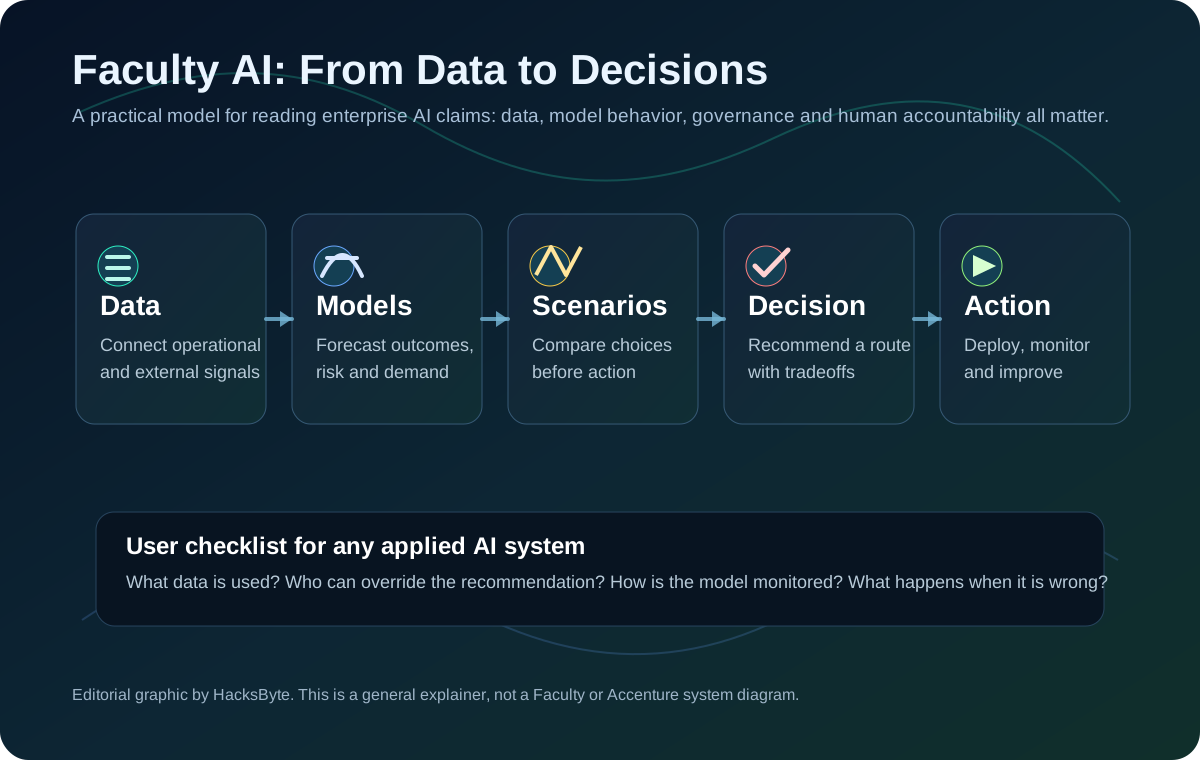
What "decision intelligence" means for users
Decision intelligence is the discipline of making decisions more measurable, explainable and repeatable with data and AI. A forecasting model might predict demand. A dashboard might show a trend. A decision intelligence system tries to connect those signals to an actual choice and then track whether that choice worked.
That can be useful, but it also raises governance questions. A system that recommends where resources go, which cases get attention first, how stock is allocated, how clinical trials are planned or which operational risk should be escalated is closer to real-world power than a simple analytics chart.
For users and affected individuals, the right question is not "is AI involved?" The better questions are:
- What decision is AI supporting?
- Is the AI making a recommendation or taking action automatically?
- What data was used?
- Who is responsible for the final decision?
- Can a human override it?
- Can the decision be explained afterward?
- Is there a way to challenge or correct a bad outcome?
Faculty AI and AI safety
Faculty's AI ethics and safety page frames safety around four pillars: fair, robust, explainable and private. The company says AI systems deployed without sufficient safety and ethics can create bias, privacy problems and unexplainable outcomes. It also says safety should be embedded across development, validation, prediction and monitoring.
That language matters because Faculty's work is often not low-stakes experimentation. It can involve public services, health care, law enforcement-adjacent work, national security and commercial decisions with financial or operational consequences.
Faculty has also appeared in wider AI safety work. The UK government's Frontier AI Taskforce said in October 2023 that it had partnered with Advai, Gryphon Scientific and Faculty AI to tackle questions about AI systems, specialized human capabilities and safeguard risks. A UK Contracts Finder notice listed an AI Safety Research Services contract for Faculty with a total value of GBP 487,325. OpenAI's o1 system-card acknowledgements also list Faculty among red-teaming organizations.
None of that means every Faculty system is automatically safe. It means buyers and users should ask for evidence: model cards, evaluations, red-team results, audit logs, monitoring plans, incident procedures and clear human accountability.
Faculty AI in health care and the NHS
Faculty's public profile grew partly because of health care work during the COVID-19 pandemic. Faculty says it worked with the NHS to develop an Early Warning System using Bayesian hierarchical modelling and aggregate data such as positive case numbers, NHS 111 calls and mobility data. Faculty said the tool was used to warn hospitals about potential case spikes so they could plan staff, beds and equipment.
In an April 2021 Faculty article, the company said there were around 1,000 users of the forecasts across the NHS at that time. The same article said a later partnership with NHS England and NHS Improvement was designed to build on COVID-19 data-response learnings and improve forecasting for operational decision-making, including areas such as accident and emergency demand and winter pressures.
This is the kind of use case that shows both the promise and the risk. Better forecasting can help a health system plan capacity. But health care AI must also be explainable, monitored, privacy-aware and accountable, because bad forecasts can affect real people.
Where Faculty says it works
Faculty's site lists a broad set of industries. The exact customer, contract and product mix can change, but the company's public positioning covers:
| Area | Why AI might be used |
|---|---|
| Health and care | Forecasting, service planning, operational decision support and model validation |
| Life sciences | Clinical trial planning, portfolio decisions and resource optimization |
| Public services | Forecasting demand, improving services and supporting operational planning |
| Defence and national security | Analysis, intelligence workflows and mission-critical decision support |
| Energy and infrastructure | Stability, forecasting, asset planning and environmental operations |
| Financial services and insurance | Risk, decision support, operational efficiency and compliance |
| Retail and consumer | Demand planning, supply chains, pricing, personalization and operations |
| Legal, education and telecoms | Process analysis, knowledge workflows, forecasting and service delivery |
The buyer takeaway is simple: if an AI vendor says it can help with mission-critical decisions, do not evaluate it like a normal dashboard. Evaluate it like an operational system.
Why Faculty AI has attracted scrutiny
Faculty's work has not been viewed only through a technology lens. It has also been scrutinized because of public-sector contracts, NHS data work and political links reported during the COVID-19 period.
In May 2020, The Guardian reported that Faculty had won at least seven UK government contracts worth almost GBP 1 million over 18 months and discussed links between Faculty, Vote Leave and senior UK government figures. The same article reported concerns about a minister's shareholding and government procurement perception. Faculty told The Guardian that it had governance procedures to manage conflicts and that its government contracts were won through proper processes and in line with procurement rules.
In 2021, Byline Times also reported on the public-sector involvement of Palantir and Faculty, including contracts connected to NHS data. Those reports are older than the Accenture acquisition, but they remain relevant because they explain why some readers ask sharper questions about transparency, data access and accountability when Faculty appears in government or public-service contexts.
Scrutiny is not the same thing as proof that a system is harmful. It is a reason to ask better questions before public bodies or large enterprises deploy AI systems that can influence services, resources or rights.
What businesses should ask before buying Faculty or Frontier
For a business or public body, the central question is not whether Faculty can build AI. It is whether the organization can govern the AI after it is deployed.
Before buying or expanding a Faculty AI system, ask:
- What exact decisions will the system support?
- Which data sources are required, and who owns them?
- Are sensitive fields minimized, pseudonymized or deleted when no longer needed?
- What happens if source data is missing, stale, biased or wrong?
- What model evaluations were performed before deployment?
- Is there a written safety case for high-impact use?
- Can end users understand why a recommendation was made?
- Are recommendations logged with the inputs and model version used?
- Who can override the system, and when?
- How will the system be monitored after launch?
- What incident-response process applies if the model behaves unexpectedly?
- Can the customer export data, logic, logs and reports if it changes vendor?
- What parts are Faculty intellectual property, Accenture service work, customer-owned data or third-party infrastructure?
- What legal, procurement, privacy and sector-specific obligations apply?
The best AI procurement processes do not treat safety, privacy and explainability as optional add-ons. They define them before launch.
What ordinary users should ask if an organization uses Faculty AI
Most individuals will not choose whether a hospital, employer, insurer, charity, local authority or company uses Faculty. But affected users can still ask practical questions.
If you are told an AI system is used in a decision about you, ask:
- What decision did the AI influence?
- Was the AI output only a recommendation?
- Which personal data categories were used?
- Was sensitive data used directly or indirectly?
- Was the data shared with Faculty, Accenture or another processor?
- Is there a privacy notice that names the vendor and purpose?
- Can I request correction of inaccurate data?
- Is there a human review or appeal route?
- How long are data, outputs and logs retained?
- Has the organization assessed bias, privacy and error risk?
For public-sector use, also ask whether there is a data protection impact assessment, procurement notice, equality impact assessment or algorithmic transparency record. Availability will vary by country and sector, but those documents are often where the real accountability details live.
Strengths and risks
Faculty's strengths are clear. It has a long applied AI track record by current industry standards, a technical team, a decision intelligence platform, public and private sector experience, health care examples, AI safety positioning and now Accenture's global delivery reach.
The risks are also clear. Enterprise AI can become opaque if it is embedded into workflows without strong governance. Public-sector AI can create trust problems if procurement, data sharing or human accountability are unclear. Decision intelligence systems can concentrate influence in a platform layer that not every affected person sees. Large consulting-led AI projects can also create cost, lock-in and maintenance risk if the customer does not retain enough internal capability.
The balanced view is this: Faculty AI is a serious applied AI company, not a hype-only startup. But serious AI used in serious contexts deserves serious scrutiny.
Media and related learning
Accenture's completion announcement includes an official video conversation between Accenture Chair and CEO Julie Sweet and Dr Marc Warner about the acquisition and its AI strategy: Accenture acquisition video.
Faculty's Frontier page also references a video from co-founder Andrew Brookes on why decision intelligence matters and links to Faculty's official YouTube channel: Faculty YouTube channel.
For wider context on the discipline behind decision intelligence, this external video is useful background. It is not a Faculty-specific video.
Practical checklist
Use this checklist whenever you see Faculty AI, Frontier or any similar enterprise AI platform mentioned in a project:
- Identify the real decision the system affects.
- Separate prediction, recommendation and automatic action.
- Confirm the data sources and retention period.
- Ask who owns the model outputs, logs and audit trail.
- Require explainability suitable for the end user, not just the data science team.
- Define human override, complaint and correction routes.
- Test for bias, privacy leakage, drift and unexpected failure.
- Monitor after launch, because AI systems can degrade when real-world data changes.
- Publish public-sector transparency records where required or expected.
- Review lock-in risk before the system becomes operationally critical.
FAQ
Is Faculty AI the same as ChatGPT?
No. Faculty is an applied AI company that builds and deploys AI systems for organizations. ChatGPT is a consumer and enterprise AI assistant from OpenAI. Faculty may work on AI safety and red-team projects related to frontier models, but it is not a general chatbot product for consumers.
Who owns Faculty AI now?
Accenture completed its acquisition of Faculty on March 16, 2026. Accenture said Dr Marc Warner became Accenture's chief technology officer and remained CEO of Faculty.
What is Faculty Frontier?
Faculty Frontier is Faculty's decision intelligence platform. It is designed to connect data, AI models and business processes so organizations can observe what is happening, understand options, decide on a route and act while tracking outcomes.
Is Faculty AI safe?
No outside reader can declare every deployment safe. Faculty publishes an AI ethics and safety approach focused on fairness, robustness, explainability and privacy, and it has participated in AI safety-related work. But safety depends on the specific use case, data, deployment, monitoring, human accountability and customer governance.
Does Faculty work with government?
Yes. Faculty has worked with public-sector organizations, and UK government records show AI safety-related contracts involving Faculty. Faculty has also done NHS-related work, including COVID-19 forecasting and operational decision support.
Why is Faculty controversial?
Faculty has drawn scrutiny because of public-sector contracts, NHS data work and political links reported during the COVID-19 period. The key user concern is not a single controversy. It is whether AI systems used in public or high-impact settings have transparent procurement, clear data governance, explainability and human accountability.
What should I do if a decision about me used Faculty AI?
Ask the organization using the system what decision was affected, what data was used, whether the AI output was reviewed by a human, how you can correct inaccurate data and how you can appeal or request review. Faculty or Accenture may be the technology provider, but the organization making the decision is usually responsible for explaining the process.
Is Faculty AI only for the UK?
No. Faculty is UK-based, but Accenture described Faculty's work as supporting organizations in the UK and globally. The acquisition is likely to make Faculty-related AI capabilities available to more Accenture clients outside the UK.
Sources
- Accenture: Accenture Completes Acquisition of Faculty
- Accenture: Accenture to Acquire Faculty to Scale AI Capabilities
- Faculty: Company page
- Faculty: Faculty Frontier
- Faculty: AI Ethics & Safety
- Faculty: Accenture to Acquire Faculty to Scale AI Capabilities
- Faculty: Faculty partners with the NHS to transform operational decision-making with AI
- GOV.UK: Frontier AI Taskforce brings in leading technical organisations to research risks
- Contracts Finder: AI Safety Research Services - Taskforce Faculty
- OpenAI: OpenAI o1 System Card External Testers Acknowledgements
- The Guardian: Vote Leave AI firm wins seven government contracts in 18 months
- Byline Times: The involvement of Palantir and Faculty in the UK public sector
Before you move on
Global AI workflow guidance. Use this short checklist to turn the article into action.
- Check whether the tool can access private files or account data.
- Verify factual claims against primary sources before publishing.
- Keep a human review step for work that affects money, school, or customers.
This guide is written for practical user safety. For account, platform, or legal decisions, confirm critical steps with the official help center or your service provider.