
BBC News reports that Martin Scorsese's endorsement of AI-assisted storyboarding through Black Forest Labs has triggered criticism from artists. Here is what is confirmed, what remains unclear, and why the Hollywood AI debate is shifting from theory to production workflows.
Last checked: June 4, 2026. This article uses BBC News' June 3 report as the primary news source, cross-checks the announcement with Black Forest Labs' official Scorsese page and video, and uses The Guardian, TechCrunch, WGA and SAG-AFTRA materials for wider industry context. HacksByte is not claiming that any storyboard artist was fired or that AI-generated images will appear in a finished Scorsese film unless that is confirmed by the sources below.
Quick answer
Martin Scorsese has become one of the most prominent filmmakers to publicly back generative AI as a production-planning tool. BBC News reported on June 3, 2026 that the director faced criticism after endorsing AI storyboarding as "creatively freeing" and becoming an adviser to Black Forest Labs, the company behind the FLUX family of image-generation models.
The official Black Forest Labs page says Scorsese is helping the company shape visual intelligence as an adviser and features a working storyboarding session with FLUX. The company also published an official YouTube video showing the workflow.
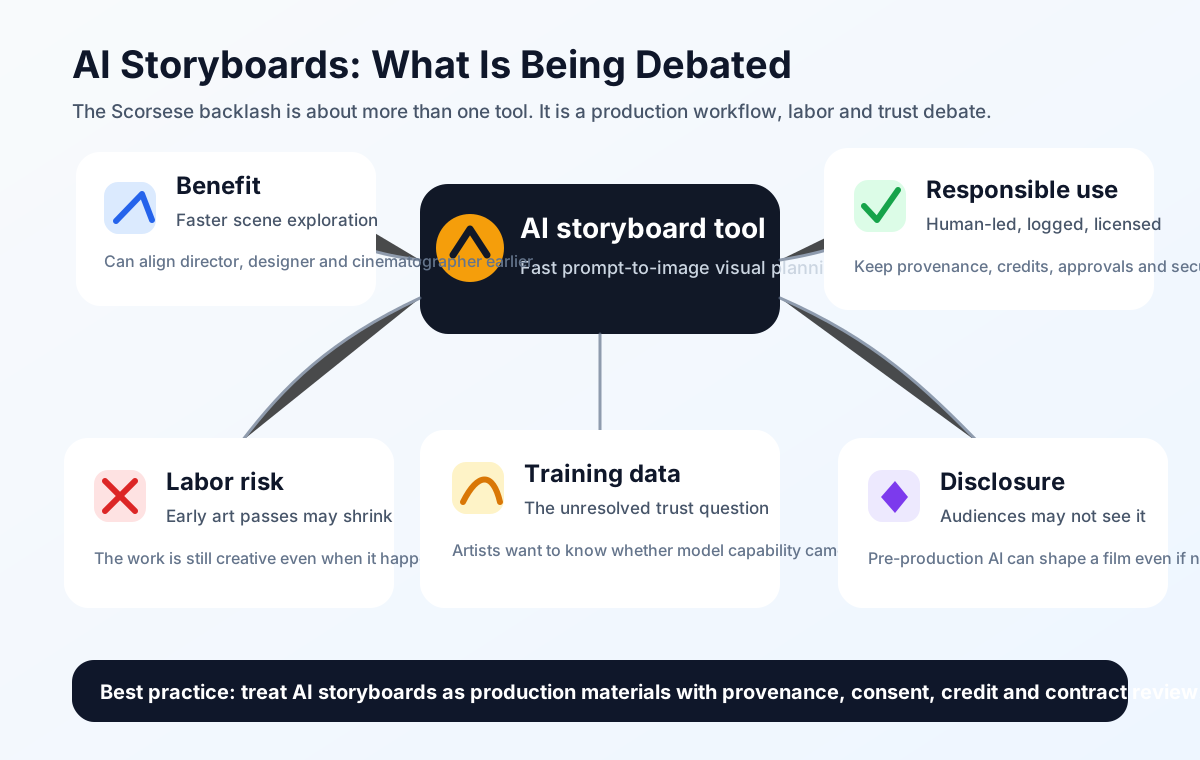
The backlash is not only about Scorsese. It is about whether AI image tools are being trained on artists' work without permission, whether studios will use them to reduce paid visual-development jobs, and whether a fast pre-production tool can weaken the role of storyboard artists, concept artists, production designers and visual development teams.
The practical takeaway: this is not a confirmed case of AI replacing artists on a finished film. It is a high-profile signal that generative AI is moving deeper into Hollywood pre-production, where the rules around training data, credit, consent, disclosure and labor protection are still unsettled.
What happened
BBC News reported that Scorsese endorsed AI in pre-production after working with Black Forest Labs. The article said the company released a video in which Scorsese used AI to create storyboard-style images of characters, places and scenes.
Black Forest Labs' official page, titled "Martin Scorsese x Black Forest Labs" in page metadata, confirms the core announcement: Scorsese is an adviser, the company sat down with him for a FLUX storyboarding session, and the work is framed as "visual intelligence" for cinema.
The Guardian also reported on June 3 that Scorsese's support for AI-generated storyboards triggered criticism from artists and animation professionals. TechCrunch reported a day earlier that Scorsese had signed on as a partner and adviser to Black Forest Labs, citing The New York Times.
What Scorsese actually endorsed
The confirmed use case is pre-production storyboarding and visual communication, not finished AI-generated film footage.
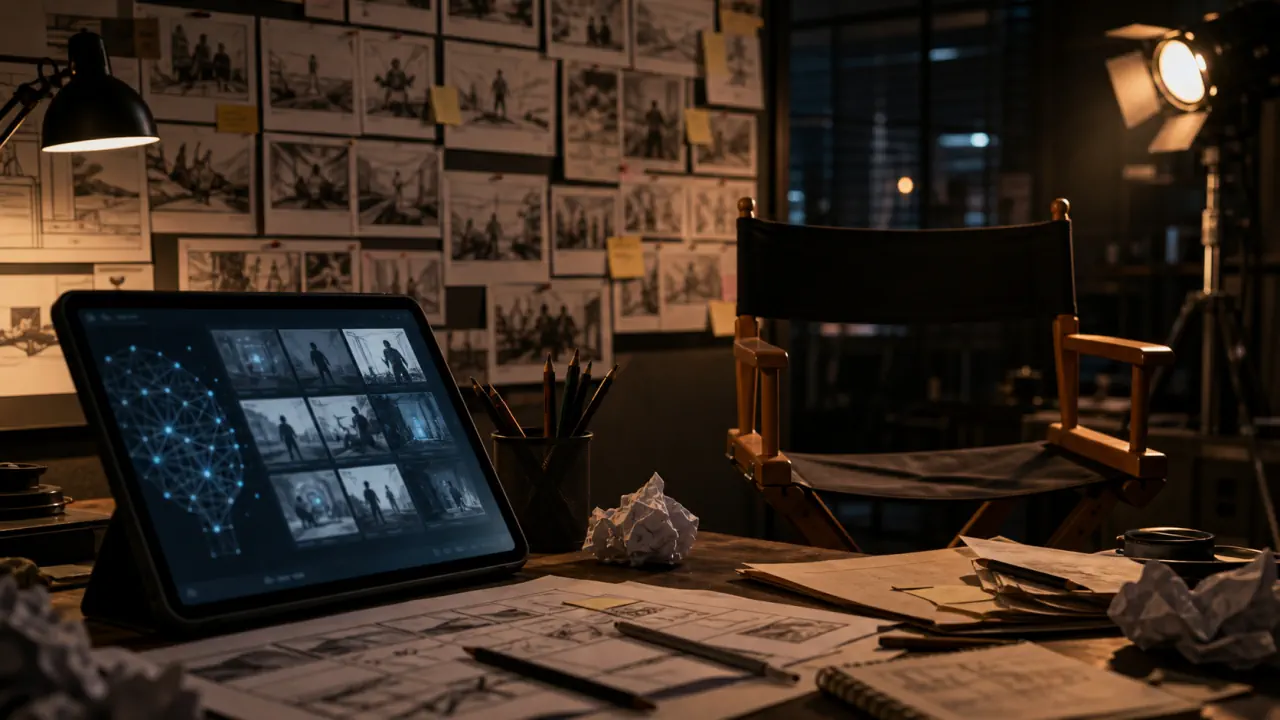
Storyboards are visual plans for scenes. They can show framing, movement, staging, light, character position, rhythm and camera logic before production begins. In a traditional workflow, a director may sketch rough frames, work with storyboard artists, use concept artists, or build previsualization with a VFX or art team.
Scorsese's public argument is that AI can help him communicate what he is imagining to the team more quickly. The official Black Forest Labs page presents the workflow as a way to share visual ideas with production designers, art designers and cinematographers. BBC and Guardian coverage both describe the core claim as speed and clarity during pre-production.
That distinction matters. An AI storyboard is not the same as an AI actor, AI script, AI final shot or AI-edited movie. But it still affects creative labor because storyboarding itself is a skilled job, not a disposable admin step.
What is confirmed and what is not
| Question | Current status |
|---|---|
| Did Scorsese advise Black Forest Labs? | Yes. Black Forest Labs' official page identifies him as an adviser. |
| Did he use FLUX for a storyboarding session? | Yes. The official page and YouTube video describe a working storyboarding session with FLUX. |
| Did BBC report backlash? | Yes. BBC News published the primary report on June 3, 2026. |
| Are artists criticizing the move? | Yes. BBC and The Guardian report criticism from artists and animation professionals, including Karla Ortiz and Samuel Deats. |
| Was a storyboard artist fired because of this? | Not confirmed in the public sources reviewed by HacksByte. |
| Will AI images appear in a finished Scorsese film? | Not confirmed. The public materials focus on pre-production storyboarding. |
| What exact training data was used for the relevant FLUX model? | Not resolved in the public sources reviewed here. |
| Does a union contract clearly govern AI storyboarding? | Not fully. WGA and SAG-AFTRA rules address parts of AI use in writing and performance, but storyboarding and visual development have their own labor and contract questions. |
Why artists pushed back
The criticism is rooted in four concerns.
1. Training data and consent
Artists argue that generative image models may learn from copyrighted or portfolio artwork without permission, credit or payment. That is why an AI storyboard tool can feel different from a camera, pencil, previs software or traditional VFX tool. The concern is not merely that it automates drawing. The concern is that the automation may be built from the visual labor of artists who never agreed to contribute.
Karla Ortiz, an artist whose credits include major studio projects, criticized the endorsement on X, according to BBC. Animation director Samuel Deats also criticized the idea of using AI for storyboards, arguing that artists do not need tools built on uncompensated creative work.
This is the core ethical dispute. If a director uses AI only as a private sketching aid, supporters may call it harmless. If the model's ability came from unlicensed art, critics see the tool as a labor and copyright problem before it ever reaches a film set.
2. Storyboarding is real work
The word "storyboard" can make the task sound rough or preliminary. In professional film and animation, it is often much more than thumbnail drawing.
Storyboard artists translate script, performance, geography, camera placement and emotional timing into a visual plan. They help directors discover whether a scene reads, whether an action sequence is coherent, whether a budget can support a shot, and where the audience's eye should go.
If AI handles early visual exploration, studios may reduce the number of human passes before a scene reaches production designers, VFX supervisors or cinematographers. That does not automatically eliminate artists, but it can change who gets hired, when they get hired and how much of the exploratory work is paid.
3. A powerful endorsement changes the market
Scorsese is not an ordinary adopter. He is one of the most influential living directors. When he endorses a tool, it sends a message to producers, investors, agencies and younger filmmakers that AI storyboarding is moving from fringe experiment to accepted professional workflow.
That is why the backlash is intense. The fear is not simply that one director will use one AI tool. The fear is that production executives will use respected artists' endorsements to normalize lower-cost AI workflows without solving permission, credit or compensation issues first.
4. "Tool" is not a complete answer
Supporters often compare generative AI with CGI, digital cameras, editing software and previsualization. That comparison has some merit: film has always adopted new technology.
But it is incomplete. A digital camera does not produce frames trained on millions of artists' portfolios. A standard editing system does not generate new visual designs from patterns learned in disputed datasets. Generative AI raises additional questions about data provenance, style imitation, authorship and market substitution.
Why others defended Scorsese
Some film fans and technologists defended Scorsese by arguing that he is using AI only to communicate ideas, not to replace creative judgment. They also point out that Scorsese has used major technical shifts before, including 3D filmmaking in Hugo and digital de-aging in The Irishman.
There is a reasonable version of that argument. Directors often need fast visual aids before a team commits money to sets, locations, costumes, lenses, VFX or stunts. A rough AI storyboard could help a director explain mood and framing in minutes rather than waiting for a full art pass.
The strongest pro-AI case looks like this:
| Claim | Why it matters |
|---|---|
| It is pre-production, not final output. | The images may guide planning without appearing on screen. |
| It speeds communication. | Directors, designers and cinematographers can align earlier. |
| It can reduce wasted production time. | Faster visual iteration may prevent expensive confusion on set. |
| It can help independent filmmakers. | Smaller teams may use AI as a rough planning assistant before hiring specialists. |
| Human judgment still decides. | A director, designer or cinematographer still chooses what is worth making. |
The weakness in that defense is that speed and usefulness do not answer the training-data question. A tool can be creatively useful and still be ethically or legally contested.
The source comparison
| Source | What it adds |
|---|---|
| BBC News | Primary report on the backlash, Scorsese's public framing and the split between critics and defenders. |
| Black Forest Labs | Official confirmation that Scorsese is an adviser and that the company filmed a FLUX storyboarding session with him. |
| The Guardian | Additional reporting on criticism from artists and wider examples of AI use in film. |
| TechCrunch | Business context around Black Forest Labs, Scorsese's advisory role and the limited storyboarding use case. |
| WGA | Official context showing that AI use in writing remains a live labor and contract issue. |
| SAG-AFTRA | Official context showing how performer unions have treated consent, digital replicas and synthetic performers. |
Why this matters beyond one director
Hollywood's AI debate has moved through several phases.
First came the abstract debate: could AI write scripts, make trailers, clone voices or create digital actors?
Then came the labor fight. AI was a major issue in the 2023 WGA and SAG-AFTRA disputes. The WGA says its 2023 agreement created protections around AI and that companies cannot require writers to use AI when performing writing services. SAG-AFTRA says its TV/theatrical agreement created consent and compensation rules for digital replicas and protections around synthetic performers.
Now the debate is shifting into day-to-day production tools. Storyboards, concept art, pitch decks, mood boards, production design references, marketing stills, temporary VFX and previs are all areas where generative AI can be introduced before audiences ever see the final work.
That makes the Scorsese story important. The fight is no longer only "Will AI make an entire movie?" It is also "Which hidden parts of the production pipeline will AI change first?"
Why storyboards are especially sensitive
Storyboards sit between imagination and production. They are early enough to feel disposable, but influential enough to shape the entire film.
That creates three risks:
- Invisible replacement: If an AI tool handles early visual exploration, the lost work may never appear in credits because it happened before formal production staffing.
- Style extraction: A model can produce boards in a visual language that resembles professional story artists, animation boards, comic panels or concept art without a clear licensing trail.
- Decision lock-in: Even rough AI images can influence costumes, environments, camera angles and mood before human artists are asked to refine the scene.
The result is a labor problem that can be easy to miss. If final frames are made by humans, a studio may say no job was replaced. But if the first 200 exploratory images were once paid human work and are now generated in a meeting, artists will still feel the economic impact.
How to understand the terms
| Term | Plain-English meaning | Why it matters |
|---|---|---|
| Storyboard | A sequence of images planning a scene before filming or animation. | This is the workflow Scorsese is publicly discussing. |
| Previsualization | A rough visual simulation of scenes, shots or movement before production. | AI storyboards may become part of broader previs pipelines. |
| Concept art | Visual exploration of characters, environments, mood and design. | Generative AI can overlap with this paid creative role. |
| Generative AI | Software that creates new text, images, audio or video from prompts and training patterns. | It raises authorship, training-data and labor questions. |
| Digital replica | A digitally created version of a real performer's voice or likeness. | This is a major SAG-AFTRA issue, but it is different from storyboards. |
| Synthetic performer | A fully generated performer or character not based on one real actor. | This is another Hollywood AI issue, but not the specific claim in the Scorsese story. |
What remains unclear
Several facts remain unresolved publicly:
- Whether Scorsese has used FLUX on a specific named upcoming film beyond the demonstrated session.
- Whether any AI-generated storyboard images will influence final production decisions.
- Whether any human storyboard artists were hired, reduced, replaced or asked to revise AI outputs.
- What exact datasets, licenses and opt-out mechanisms apply to the model used in the session.
- Whether production contracts, guild rules or studio disclosure policies require AI storyboarding to be logged.
- Whether Black Forest Labs or partners will provide clearer provenance tools for film-industry use.
- Whether future credits will disclose AI-assisted pre-production if the AI output never appears on screen.
Those gaps are why the story should be treated carefully. It is fair to say Scorsese's endorsement has triggered backlash. It is not fair to claim, without evidence, that he has replaced a named artist or outsourced a finished film to AI.
What artists should watch
Artists, storyboarders, concept designers and animation workers should pay attention to contract language around AI-assisted references, prompt-generated drafts, style imitation, work-for-hire data use and portfolio reuse.
Useful questions to ask before joining a project:
- Will AI-generated references be used before I start work?
- Am I being asked to revise or clean up AI-generated images?
- Will my finished work be used to train, fine-tune or evaluate a model?
- Will prompts include my name, my style or another living artist's style?
- Will I receive credit if my boards materially shape the scene?
- Is there a policy for data provenance and licensed references?
- Are AI-assisted materials being disclosed to the client, distributor or guild where required?
The goal is not to ban every tool. The goal is to avoid a workflow where human artists become invisible fixers for machine output built on unclear inputs.
What studios should do before using AI storyboards
Studios and production companies should treat AI storyboarding as a governance issue, not only a creative shortcut.
| Control | Why it matters |
|---|---|
| Keep a provenance log | Record model, prompts, reference inputs and who approved the generated boards. |
| Avoid living-artist style prompts without permission | Reduces reputational and legal risk. |
| Separate rough AI exploration from final credited art | Prevents AI drafts from being mistaken for human-authored production art. |
| Use licensed or cleared reference material | Helps answer training-data and input-data questions. |
| Disclose AI use to collaborators where relevant | Maintains trust with directors, designers, artists and unions. |
| Do not use AI to avoid required hires or contract coverage | Reduces labor conflict and grievance risk. |
| Protect confidential scripts and designs | AI tools can expose sensitive production materials if not deployed securely. |
For independent filmmakers, the same principles apply at smaller scale. AI can help plan a shoot, but the safest workflow is still transparent, credited, human-directed and license-aware.
What viewers should know
Viewers may not see this debate directly on screen. AI storyboards are usually internal planning materials. A finished film could be shot by human crews and still have used AI in early visual development.
That is why disclosure may become a new pressure point. Current public debate often focuses on AI-generated actors, AI scripts or AI video shots because those are visible. Pre-production AI is harder to detect, but it can still shape what gets made.
Viewers should ask:
- Did the studio disclose meaningful AI use?
- Were human artists credited clearly?
- Were AI-generated materials part of final footage or only internal planning?
- Did the production use licensed inputs?
- Did the project follow guild and contract obligations?
The answer may vary by project. AI in film is not one thing. A licensed digital double, an AI cleanup tool, an AI storyboard, an AI-generated background, a synthetic actor and an AI-written script all create different risks.
Bottom line
Scorsese's endorsement matters because it brings generative AI into the hands of a filmmaker whose taste and craft are widely respected. That gives AI storyboarding a legitimacy boost.
The backlash matters because artists are not objecting to speed alone. They are objecting to a production model that may use disputed training data, reduce paid early-stage art work and hide creative labor behind a tool demo.
The most accurate reading is this: AI storyboards are becoming a serious Hollywood workflow, but the industry has not yet settled the rules that would make that workflow trustworthy. Until studios can show clear provenance, human credit, fair contracts and honest disclosure, each high-profile endorsement will keep triggering the same question: who benefits from the tool, and whose work made it possible?
Sources
- BBC News: Martin Scorsese gets backlash after endorsing "creatively freeing" AI, June 3, 2026.
- Black Forest Labs: Martin Scorsese and Black Forest Labs, official announcement and video page.
- Black Forest Labs YouTube: Martin Scorsese storyboarding with FLUX.
- The Guardian: Martin Scorsese accused of "throwing artists under bus" with AI storyboards, June 3, 2026.
- TechCrunch: Martin Scorsese becomes the latest Hollywood voice for AI, June 2, 2026.
- Writers Guild of America: Artificial Intelligence.
- SAG-AFTRA: Artificial Intelligence Resources.
Before you move on
Global AI workflow guidance. Use this short checklist to turn the article into action.
- Check whether the tool can access private files or account data.
- Verify factual claims against primary sources before publishing.
- Keep a human review step for work that affects money, school, or customers.
This guide is written for practical user safety. For account, platform, or legal decisions, confirm critical steps with the official help center or your service provider.