


A detailed guide to the chips, memory, networking, power systems, supply chain and data-center economics behind modern AI infrastructure, based on SIA and Deloitte's June 2026 report.
Last checked: June 3, 2026. This guide uses the Semiconductor Industry Association and Deloitte's June 2026 report as the primary source, with additional context from the International Energy Agency and the U.S. Department of Energy/Lawrence Berkeley National Laboratory. This is an independent technology explainer, not investment, energy-market or procurement advice.
Quick answer
Modern AI is not powered by one magic chip. It is powered by a dense semiconductor ecosystem: AI accelerators, CPUs, custom ASICs, FPGAs, high-bandwidth memory, DRAM, NAND storage, switch chips, network interface controllers, optical and copper interconnect chips, power-management ICs, sensors, baseboard controllers, trusted-platform modules, packaging technologies and cooling-control electronics.
The Semiconductor Industry Association (SIA) and Deloitte argue in their June 2026 report that semiconductors are the hardware foundation of AI data centers. Their headline numbers show why this matters:
| SIA/Deloitte data point | What it means |
|---|---|
| More than 4,500 packaged chips in a single AI server rack | An AI rack is a system of many semiconductor parts, not only accelerators. |
| Around 20,000 individual semiconductor dies in that rack | Advanced packages can contain multiple dies, chiplets and memory stacks. |
| More than 95% of a leading AI rack's content value is semiconductor content | Chip choice drives most of the hardware value inside the rack. |
| More than 50% of total AI data-center capex can be tied to semiconductors | Chips influence facility cost, power design, cooling, networking and procurement. |
| Over $4 trillion in global data-center infrastructure investment through 2028 | AI infrastructure is becoming a major capital cycle. |
| Up to $2.8 trillion of that spend may go to semiconductors | The AI boom is reshaping demand across the chip industry. |
The practical takeaway: when people talk about "AI data centers," they are really talking about semiconductor supply chains, power delivery, memory bandwidth, networking fabric, thermal design and software-hardware co-design. GPUs are important, but they are only one part of the machine.
Why this report matters
The public AI conversation often focuses on models: ChatGPT, Gemini, Claude, Llama, image generators, coding agents and enterprise copilots. The SIA report flips the view from the model layer to the hardware layer.
That matters because every AI feature users see depends on physical infrastructure:
- Training a frontier model requires huge clusters of accelerators linked by high-speed networks.
- Serving AI answers to millions of users requires inference capacity close enough, fast enough and cheap enough to use repeatedly.
- Enterprise AI requires storage, networking, security controls, reliability and regional data-center availability.
- More AI usage increases demand for power, cooling, memory, advanced packaging and mature-node chips.
SIA is an industry association, so its report should be read as an industry-side view of AI infrastructure demand. Still, the technical point is sound: AI capacity depends on a complete semiconductor stack, and bottlenecks outside the headline accelerator can slow the entire buildout.
What an AI data center actually is
A normal data center runs websites, databases, storage, enterprise applications and cloud services. An AI data center is specialized around workloads that involve enormous matrix math, memory movement and high-speed communication between thousands of chips.
Two AI workloads shape the hardware:
| Workload | What it does | Hardware pressure |
|---|---|---|
| Training | Teaches a model from large datasets | Maximum accelerator scale, HBM capacity, cluster networking, power and cooling |
| Inference | Runs the trained model for real users | Latency, cost per query, regional capacity, throughput and reliability |
Training gets attention because it is spectacularly expensive. Inference may become the bigger long-term capacity problem because every search answer, chatbot reply, coding suggestion, image generation, voice interaction or enterprise workflow can trigger repeated compute demand.
That is why the semiconductor mix matters. A data center optimized only for training may not be the same as one optimized for low-latency inference. A cloud provider needs both.
The full chip stack behind AI
SIA and Deloitte divide the AI data-center semiconductor ecosystem into a broad set of technologies. The most important lesson is that every layer is connected.
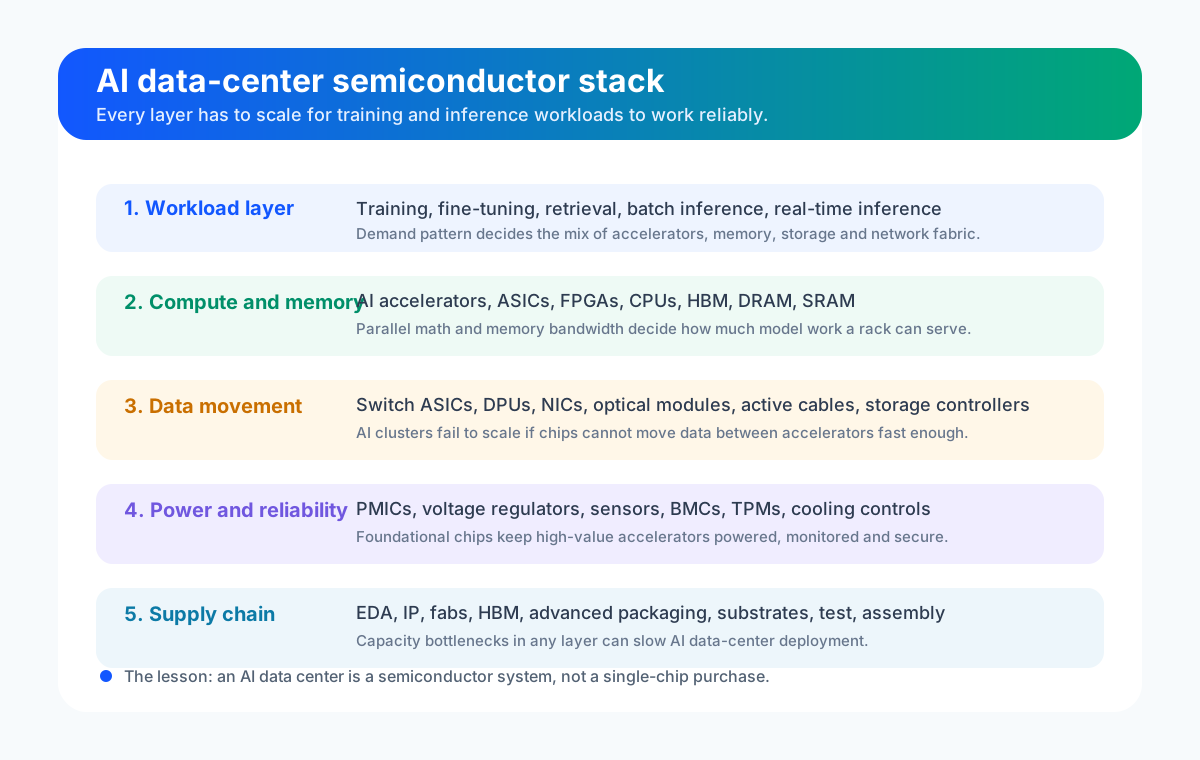
1. Advanced logic chips
These are the chips most people think of first.
Advanced logic includes:
- AI accelerators and GPUs.
- Custom ASICs built for specific AI workloads.
- FPGAs that can be reconfigured for specialized tasks.
- CPUs that coordinate work and run general-purpose processing.
- DPUs and smart NICs that help move data and offload networking or security tasks.
- Switch ASICs that move traffic inside and between racks.
The accelerator does the heavy parallel math, but it cannot work alone. It needs host processors, networking, memory, storage and management chips around it.
2. Memory
Memory is one of the most important constraints in AI.
Large models need to move data quickly between accelerator cores and memory. If the accelerator waits for data, expensive compute sits idle. That is why high-bandwidth memory (HBM) is central to modern AI systems.
Important memory technologies include:
- HBM for very high bandwidth near the accelerator.
- DRAM for system memory.
- SRAM for fast on-chip memory and caches.
- NAND flash for persistent storage.
The AI race is therefore also an HBM race, an advanced packaging race and a memory-bandwidth race.
3. Storage
AI systems need storage for datasets, model checkpoints, embeddings, logs, training artifacts and inference workloads. Storage is not only about capacity; it is about moving data at the right speed without starving the compute layer.
Storage-related chips include:
- NAND flash.
- NVMe controllers.
- Storage interface chips.
- Data-path controllers.
For retrieval-augmented generation and enterprise AI, storage and data access patterns can affect latency and cost as much as the model itself.
4. Networking and interconnect
AI clusters scale only if accelerators can communicate quickly. Training large models often means splitting work across many chips. That requires fast, predictable movement of data between accelerators, servers and racks.
Networking-related semiconductors include:
- Switch ASICs.
- Network interface cards and controllers.
- DPUs.
- Retimers, transceivers and PHY chips.
- Active copper cable chips.
- Optical modules and optoelectronics.
This is why AI infrastructure vendors talk so much about fabric, bandwidth and latency. The model may be software, but its speed depends on physical signal movement.
5. Power chips and analog semiconductors
Power delivery is a hidden foundation of AI infrastructure. AI racks draw large amounts of power and require precise voltage regulation across many components.
Analog and foundational chips include:
- Power-management integrated circuits.
- Voltage regulators.
- Power transistors.
- Sensors and transducers.
- Clocks, buffers and oscillators.
- Analog-to-digital and digital-to-analog converters.
- Controllers and monitoring chips.
These parts may cost far less than flagship accelerators, but they are essential. A failed power-management component can interrupt a system built around chips worth far more.
6. Management, security and reliability chips
AI data centers also need chips that manage platform health, remote control and hardware trust.
Examples include:
- Baseboard management controllers.
- Trusted platform modules.
- Intelligent platform management components.
- Field-replaceable unit controllers.
- Sensors for temperature, humidity, current and system health.
These chips support uptime, fleet management, secure boot, monitoring and recovery. For enterprise AI, that reliability layer is not optional.
7. Packaging and chiplets
Some of the most important AI hardware innovation now happens after individual dies are manufactured.
Advanced packaging helps combine accelerators, HBM and chiplets in high-density packages. This reduces the distance data must travel and improves bandwidth and efficiency.
Key packaging ideas include:
- Multi-die packages.
- Chiplets.
- 2.5D and 3D integration.
- Interposers and advanced substrates.
- Co-packaged or tightly integrated memory.
This is why the supply chain for AI chips includes not only foundry capacity, but also packaging, substrate, assembly and test capacity.
Why "just buy more GPUs" is not enough
GPUs and AI accelerators are the visible part of the story because they handle the most expensive compute. But an AI data center can still fail to scale if other constraints are weak.
| Bottleneck | What happens |
|---|---|
| Not enough HBM | Accelerators wait for data or cannot fit larger workloads efficiently. |
| Weak networking | Multi-rack clusters spend too much time moving data instead of computing. |
| Power delivery limits | Racks cannot be deployed at planned density. |
| Cooling limits | Chips throttle, fail faster or require expensive facility redesign. |
| Storage bottlenecks | Training pipelines and retrieval workloads slow down. |
| Packaging shortages | Finished accelerator supply is constrained even when chip designs exist. |
| Mature-node chip shortages | Low-cost controllers, sensors or power parts can block finished systems. |
The SIA report is useful because it emphasizes the long tail. Foundational chips may account for a smaller share of value, but they make up much of the volume inside an AI server. In a physical system, a missing cheap part can delay an expensive rack.
How the AI server rack fits together
SIA and Deloitte describe an AI server rack as a collection of trays and subsystems. A simplified view looks like this:
| Rack subsystem | What it contains | Why it matters |
|---|---|---|
| Compute tray | AI accelerators, HBM, CPUs, DRAM, storage, DPUs and NICs | Runs the model workload. |
| Accelerator interconnect tray | Switch ASICs, cables, connectors and signal chips | Links accelerators together. |
| Power tray | Power supply units and power supply management modules | Delivers stable power to dense compute. |
| Network and management tray | BMCs, switches, TPMs and management chips | Enables monitoring, remote management and security. |
| Coolant distribution tray | Sensors, controls and cooling-related electronics | Keeps high-density hardware within operating limits. |
That rack-level view explains why AI infrastructure procurement is complicated. Buyers are not only buying "chips." They are buying integrated servers, racks, networking, power equipment, cooling systems and cloud capacity that all depend on semiconductor availability.
The supply chain behind AI infrastructure
The semiconductor supply chain is global and highly specialized. AI data centers depend on many stages:
- Chip architecture and system design.
- Electronic design automation software.
- Semiconductor IP blocks.
- Wafer fabrication.
- Process equipment and specialty materials.
- HBM and memory manufacturing.
- Advanced packaging and substrates.
- Assembly and test.
- Server integration.
- Rack integration.
- Data-center construction, power and cooling.
- Cloud deployment and operations.
Different countries and companies dominate different parts of this chain. That is why governments treat semiconductors as strategic infrastructure, not just consumer electronics.
It also explains why AI expansion can be slowed by export controls, packaging shortages, grid interconnection delays, advanced-node capacity, HBM supply, power-equipment lead times or local permitting.
The data-center power reality
AI hardware is not only a chip story. It is also a power story.
The International Energy Agency says data-center electricity demand surged in 2025, and AI-focused data centers grew even faster than the broader sector. IEA also notes that traditional data centers often use tens of megawatts, while hyperscale AI centers can exceed 100 megawatts.
In the United States, the Department of Energy has highlighted Lawrence Berkeley National Laboratory's finding that data centers consumed about 4.4% of U.S. electricity in 2023 and could reach about 6.7% to 12% by 2028.
Those figures do not mean every data center is an AI facility, and they do not mean AI demand is impossible to manage. They do mean that AI infrastructure planning now has to include grid capacity, siting, transmission, cooling, water use, power purchase agreements, backup systems and local community impact.
For users, this matters because power and capacity constraints can influence:
- AI feature availability.
- Cloud region availability.
- Model latency.
- Subscription pricing.
- Enterprise AI contract limits.
- Sustainability claims.
- Where data centers get built.
What this means for everyday users
Most people will never buy an AI rack. But the semiconductor ecosystem still affects them.
- AI features may become more tiered. The most compute-heavy features may be limited, metered or reserved for paid plans.
- Latency will depend on regional capacity. If inference capacity is not close to users, AI tools may feel slower.
- Reliability will depend on hardware availability. Cloud providers need enough chips, power and networking to handle peak demand.
- Costs may show up indirectly. AI infrastructure spending can affect software pricing, cloud bills and enterprise subscriptions.
- Sustainability claims need scrutiny. Energy efficiency can improve, but total demand may still rise as AI use expands.
The simple user takeaway: AI is not "free compute in the cloud." It is a capital-intensive utility-like service built on physical hardware.
What businesses should ask AI and cloud vendors
If your company depends on AI tools, treat infrastructure as part of vendor risk.
Ask vendors:
- Which regions support the AI features we need?
- Are usage limits fixed, dynamic or subject to capacity constraints?
- What happens during peak demand?
- How are enterprise workloads isolated from consumer demand?
- Which data residency and compliance controls apply?
- What are the latency expectations for our users?
- How does pricing change as inference volume grows?
- Are logs, prompts and outputs retained, and for how long?
- What recovery plan exists if a region or accelerator pool is unavailable?
- Does the vendor disclose energy, carbon or water metrics for relevant services?
For procurement teams, the important shift is that AI is not only software-as-a-service. It is software plus hardware capacity plus power plus networking plus data governance.
What builders should know
Developers and AI teams should understand the hardware enough to design realistic systems.
Practical rules:
- Use smaller models when they meet the task.
- Cache repeatable outputs where appropriate.
- Use retrieval carefully so storage and vector search do not become hidden bottlenecks.
- Batch workloads that do not need real-time responses.
- Choose model size based on quality need, not prestige.
- Measure latency, tokens, memory use and cost per successful task.
- Keep a fallback path when a premium model or region is unavailable.
- Avoid building products whose economics break at real inference volume.
The best AI architecture is not always the biggest model on the most expensive accelerator. It is the system that delivers the needed quality at a sustainable cost and latency.
What policymakers should understand
The SIA report argues for policies that support semiconductor research, design, manufacturing, supply-chain resilience and investment. The broader policy issue is that AI capacity depends on both advanced chips and foundational components.
Policy debates often focus on leading-edge accelerators. That is understandable, but incomplete. AI infrastructure also depends on:
- Mature-node analog and power chips.
- Memory supply.
- Advanced packaging capacity.
- Equipment and materials.
- Skilled semiconductor workers.
- Grid interconnection and power infrastructure.
- Trade rules and trusted supply chains.
Resilience means more than having access to one flagship chip. It means reducing single points of failure across the whole stack.
Key risks and uncertainties
Several parts of the AI infrastructure story are still uncertain:
- Forecast risk: SIA's market estimates are industry projections and could change if model efficiency, demand or regulation shifts.
- Demand risk: Enterprises may adopt AI more slowly if ROI is unclear.
- Efficiency gains: Better models, sparsity, quantization and specialized inference chips could reduce compute required per task.
- Rebound effects: Cheaper inference could increase total usage enough to offset efficiency gains.
- Supply-chain bottlenecks: HBM, advanced packaging, substrates and power equipment can constrain deployments.
- Grid delays: Power access and interconnection can move slower than data-center demand.
- Export controls: National-security restrictions can reshape where AI chips can be sold and deployed.
- Local opposition: Communities may push back on data centers because of power, water, land and noise concerns.
The right conclusion is not that AI infrastructure will definitely grow in one straight line. The right conclusion is that AI has become a physical infrastructure race with many constraints beyond model quality.
Glossary
| Term | Meaning |
|---|---|
| Die | A single integrated circuit cut from a semiconductor wafer. |
| Packaged chip | One or more dies assembled into a protected package that can be mounted on a board. |
| HBM | High-bandwidth memory, stacked near accelerators to feed data quickly. |
| ASIC | A custom chip designed for a specific workload or product. |
| FPGA | A reconfigurable chip that can be programmed after manufacturing. |
| DPU | A data processing unit that offloads networking, storage or security tasks. |
| PMIC | Power-management integrated circuit, used to regulate and monitor power. |
| Interconnect | Hardware and signaling technology that links chips, servers and racks. |
| Inference | Running a trained model for real-world outputs. |
| Training | Teaching a model from data by adjusting its parameters. |
Bottom line
The SIA and Deloitte report makes one point clearly: AI data centers are semiconductor ecosystems.
Accelerators matter, but they are surrounded by memory, networking, storage, power, control, security, packaging and cooling technologies that determine whether AI systems can actually run at scale. A shortage or design weakness in any layer can slow the whole system.
For users, this explains why AI features may become more expensive, more regional and more capacity-dependent. For businesses, it means AI vendor selection is also infrastructure selection. For policymakers, it means semiconductor resilience has to cover the full stack, not just the most famous chips.
The AI era is often described as a software revolution. Underneath it is a semiconductor buildout.
Sources
- Semiconductor Industry Association: Powering AI: The Semiconductor Ecosystem at the Foundation of Data Centers, June 2026.
- SIA and Deloitte report PDF: Powering AI: The Semiconductor Ecosystem at the Foundation of Data Centers, June 2026.
- SIA summary PDF: Takeaways from AI Report, June 2026.
- International Energy Agency: Energy demand from AI.
- International Energy Agency: Artificial Intelligence topic page.
- International Energy Agency: Data centre electricity use surged in 2025.
- U.S. Department of Energy: DOE releases report evaluating increase in electricity demand from data centers.
- Lawrence Berkeley National Laboratory: 2024 United States Data Center Energy Usage Report.
Before you move on
Global AI workflow guidance. Use this short checklist to turn the article into action.
- Check whether the tool can access private files or account data.
- Verify factual claims against primary sources before publishing.
- Keep a human review step for work that affects money, school, or customers.
This guide is written for practical user safety. For account, platform, or legal decisions, confirm critical steps with the official help center or your service provider.