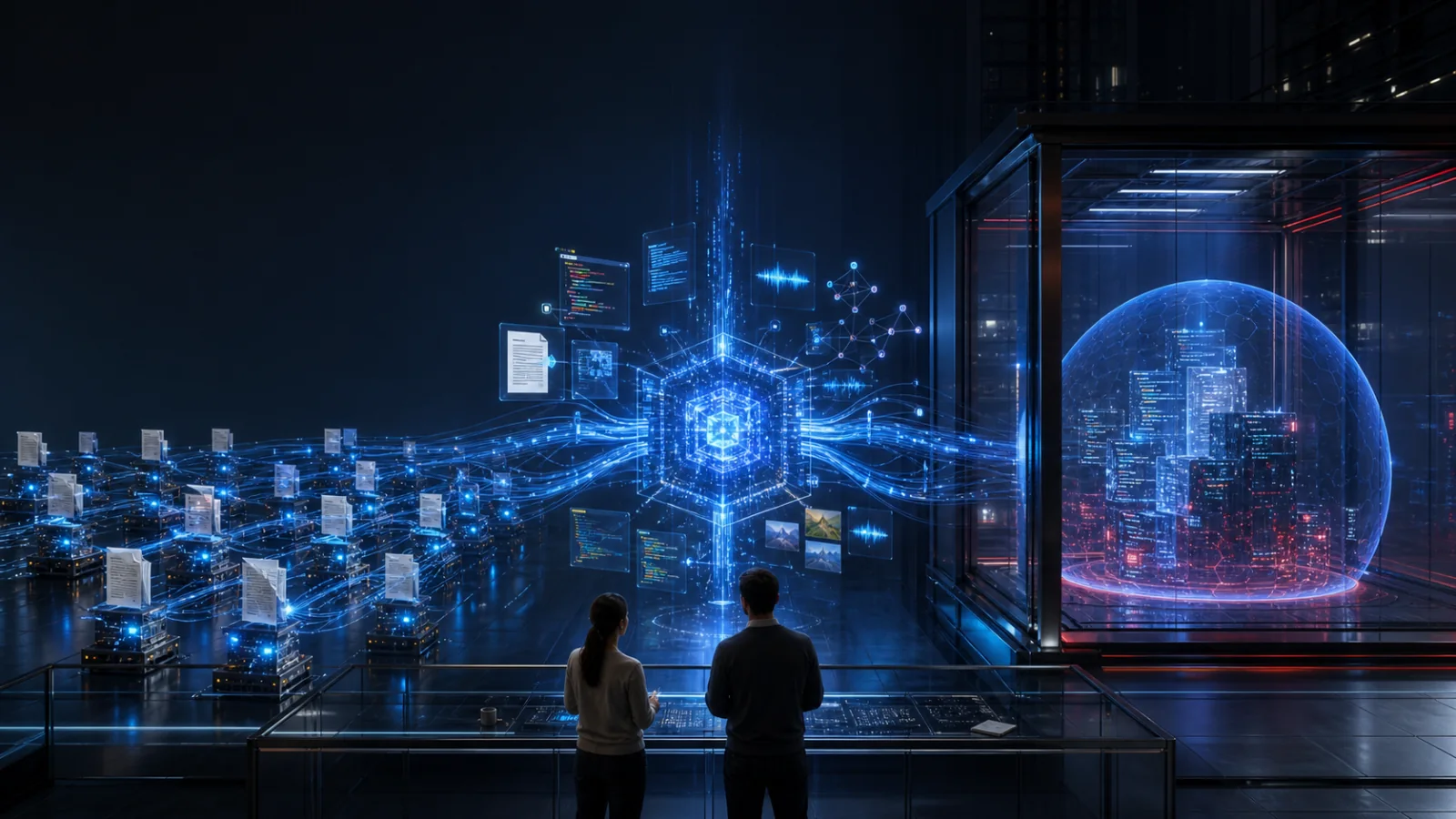

SoftBank says it will invest up to 75 billion euros to build 5 GW of AI data center capacity in France. Here is what is confirmed, why France matters, and what users and businesses should watch.
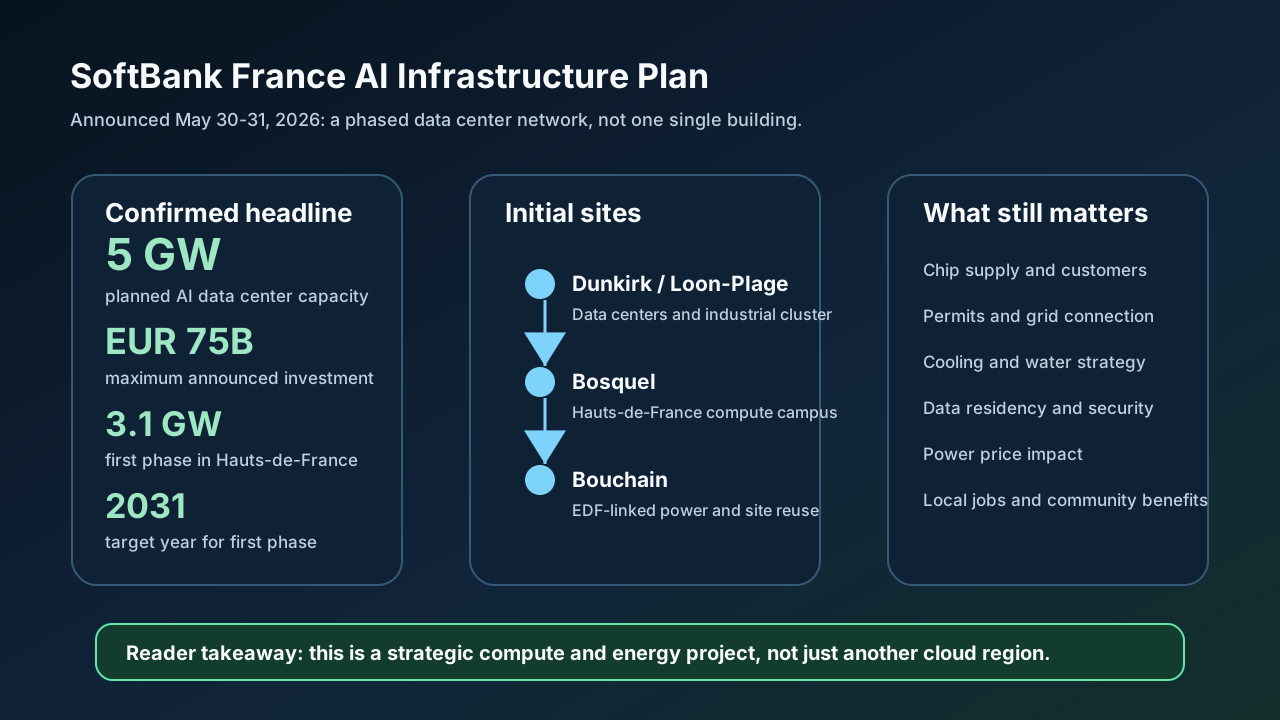
Last checked: June 1, 2026. SoftBank's official announcement says the company plans to develop and operate up to 5 GW of AI data center capacity in France, representing an investment of up to 75 billion euros. The first phase is 45 billion euros for 3.1 GW in Hauts-de-France by 2031. This is a phased data center network, not one single finished facility.
Quick answer
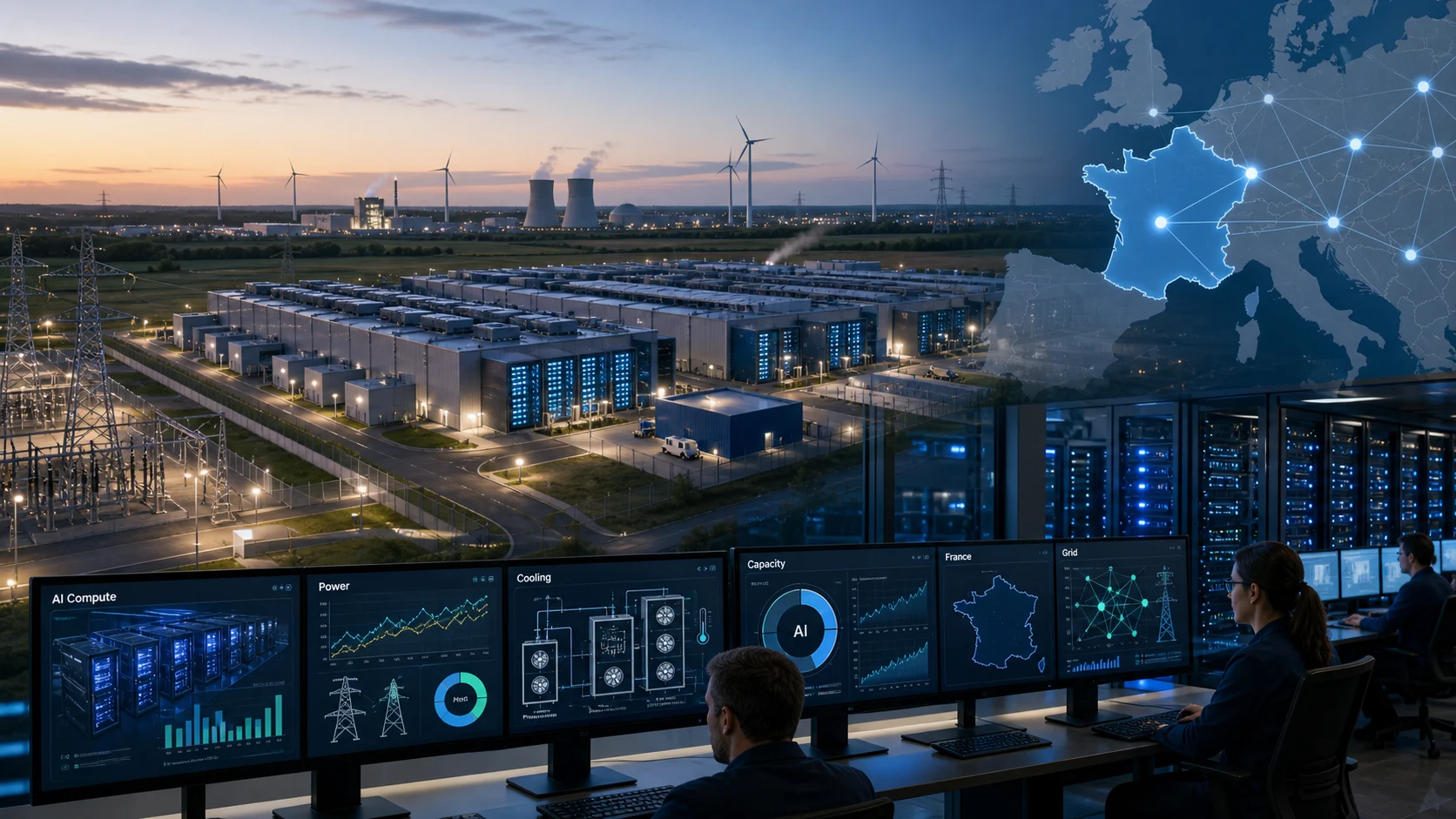
SoftBank has announced one of Europe's biggest AI infrastructure bets: up to 75 billion euros for 5 GW of AI data center capacity in France. The first phase targets 3.1 GW in the Hauts-de-France region by 2031, with initial sites named in Dunkirk/Loon-Plage, Bosquel and Bouchain.
The project matters because AI is becoming an energy-and-compute race. Whoever can provide large amounts of reliable power, advanced chips, cooling, networking and data center operations can shape where companies train and run AI systems.
For users, this could eventually mean more AI services running inside Europe, better options for data residency, lower latency for some workloads and a stronger European AI ecosystem. But it does not automatically mean cheaper AI, guaranteed sovereign control, or immediate new capacity. The plan still depends on permits, power connections, chip supply, construction, customers and environmental scrutiny.
What SoftBank actually announced
The headline is large, but the details matter.
| Item | Confirmed detail |
|---|---|
| Total plan | Up to 5 GW of AI data center capacity in France |
| Maximum investment | Up to 75 billion euros |
| First phase | 45 billion euros |
| First-phase capacity | 3.1 GW |
| First-phase region | Hauts-de-France |
| Initial sites | Dunkirk/Loon-Plage, Bosquel and Bouchain |
| First-phase target | By 2031 |
| Partners named | SB Energy, EDF for Bouchain, Schneider Electric for Dunkirk industrial production |
| Policy context | Announced around the 2026 Choose France summit |
The phrase "Europe's biggest AI facility" is useful shorthand, but the official announcement is broader: it is a network of AI data center capacity and related manufacturing, not one single building.
Why France
France is attractive for AI infrastructure for several reasons:
- A large and relatively low-carbon electricity system compared with many markets.
- Existing nuclear and grid expertise.
- Industrial land in regions such as Hauts-de-France.
- Proximity to major European business hubs.
- A government push to make France a leading AI and data center destination.
- A growing French AI ecosystem, including model developers, research labs and cloud providers.
The announcement also fits the European Union's wider AI Continent strategy, which aims to increase compute capacity and support AI factories and future AI gigafactories.
Why 5 GW is a big number
GW means gigawatts of electrical capacity. For context, 5 GW is 5,000 MW. Traditional data centers may use tens of megawatts; large AI campuses can require hundreds of megawatts or more.
If 5 GW ran continuously for a full year, the theoretical electricity draw would be 5 GW x 8,760 hours, or about 43.8 TWh per year.
That is not an official forecast because real usage depends on buildout timing, utilization, cooling efficiency, power usage effectiveness and operating patterns. But it shows why this is not just a real estate project. It is also a grid, energy, cooling and permitting project.
The first 3.1 GW phase would be about 27.2 TWh per year at continuous full load, again as a simple scale illustration rather than a prediction.
What this could mean for AI users
For everyday users, the impact will be indirect at first.
Possible benefits:
- More AI workloads hosted in Europe.
- Better latency for European users and companies.
- More options for data residency and regional compliance.
- Stronger competition among AI infrastructure providers.
- More local support for enterprise AI deployments.
Possible limits:
- New data centers take years to build.
- Capacity may be sold mainly to large AI labs and enterprise customers.
- Cheaper consumer AI subscriptions are not guaranteed.
- "In France" does not automatically mean a service is GDPR-compliant.
- Data sovereignty depends on ownership, contracts, encryption, access controls and legal jurisdiction, not only server location.
What businesses should ask vendors
If your company buys AI tools or cloud AI services, ask sharper questions:
- Which region will our data be processed in?
- Can we pin workloads to France or the EU?
- Who operates the model, cloud layer and data center?
- What logs are retained, and where?
- Are customer prompts used for training?
- What encryption and key-management options exist?
- What happens during outages or cross-region failover?
- Are there sustainability reports for the facility?
- Can we get contractual data residency commitments?
Data center location is one part of the compliance picture. Contracts and controls still matter.
What local communities should watch
Large AI campuses bring construction, jobs, tax revenue and industrial activity. They also bring concerns.
Communities should watch:
- Grid upgrades and who pays for them.
- Power price effects for households and industry.
- Water use and cooling design.
- Land use and environmental permits.
- Noise and construction traffic.
- Long-term jobs versus temporary construction jobs.
- Transparency around carbon and energy claims.
- Local supplier participation.
The best outcome is not just a giant compute campus. It is a project that improves regional infrastructure without shifting hidden costs to residents.
Why Schneider Electric and EDF matter
SoftBank's announcement names Schneider Electric for an advanced data center manufacturing cluster in Dunkirk. That points to a strategy beyond leasing buildings: build parts of the AI data center supply chain near the deployment region.
EDF matters because power availability is now one of the main constraints on AI infrastructure. The Bouchain site signals how former or existing industrial energy locations can be repurposed for compute-heavy uses.
What is still unknown
Several important details are not fully settled publicly:
- Which GPUs or accelerators will be used.
- Which AI companies will be anchor tenants.
- Exact construction schedules by site.
- Final grid connection terms.
- Water and cooling design by campus.
- Ownership and financing structure for each phase.
- Customer pricing and access for European startups.
- Final environmental and local permitting outcomes.
The announcement is significant, but execution will determine whether it becomes Europe's most important private AI infrastructure buildout or a slower phased development.
Bottom line
SoftBank's France plan is a major signal that AI infrastructure is moving from software hype to national-scale industrial planning. The most important number is not only 75 billion euros. It is 5 GW of planned power-backed compute capacity.
If built as announced, the project could strengthen Europe's AI position and France's role as a data center and industrial AI hub. But users, businesses and communities should judge it by execution: real capacity, transparent energy impact, strong data governance, useful access for European companies and measurable local benefits.
Sources
- SoftBank Group official announcement: group.softbank
- TechCrunch coverage of the France data center plan: techcrunch.com
- Data Center Dynamics coverage: datacenterdynamics.com
- European Commission AI Continent overview: commission.europa.eu
- IEA Energy and AI demand analysis: iea.org
Before you move on
Global AI workflow guidance. Use this short checklist to turn the article into action.
- Check whether the tool can access private files or account data.
- Verify factual claims against primary sources before publishing.
- Keep a human review step for work that affects money, school, or customers.
This guide is written for practical user safety. For account, platform, or legal decisions, confirm critical steps with the official help center or your service provider.