

SpaceX's reported Nasdaq IPO plan has triggered debate over valuation, governance, index inclusion and whether passive funds could become forced buyers.
Last checked: May 31, 2026. IPO terms can change before pricing. This article summarizes public reporting and S-1 details available as of today and is not investment advice.
Quick answer
SpaceX's reported public listing plan is one of the most closely watched IPO stories of 2026. The company is targeting a massive valuation, a large capital raise, and a Nasdaq listing under the proposed ticker SPCX, while investors debate whether the growth story justifies the price.
The bull case is clear: Starlink revenue, launch dominance, reusable rockets, defense contracts and Starship's long-term potential. The bear case is also clear: heavy losses, capital intensity, regulatory risk, governance concerns and the possibility that index-rule changes could push passive funds into buying shares at or near IPO prices.
For ordinary readers, the key is not the headline valuation. It is whether the S-1 shows durable cash generation, transparent governance, realistic risk disclosure and a price that leaves room for future returns.

What is being reported
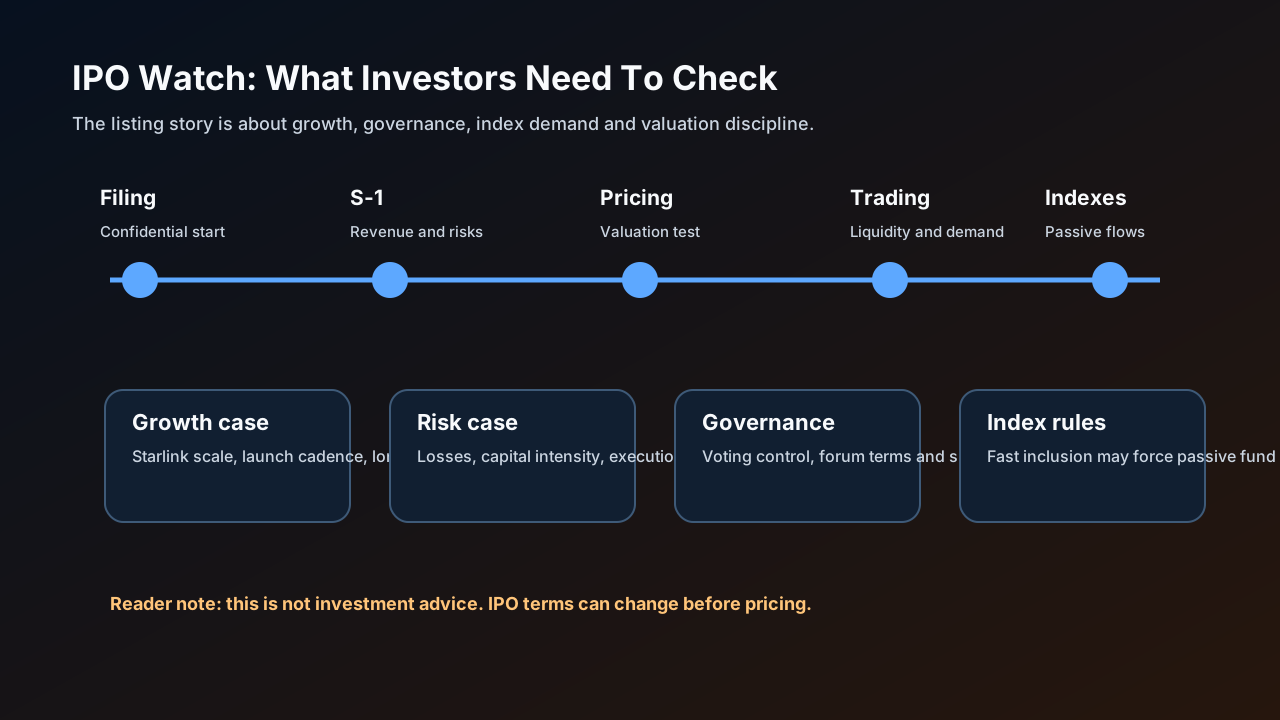
Reports describe a proposed listing timetable that began with a confidential filing in April, followed by a public S-1 in May and a possible June listing window. The offering could sell a small percentage of the company while raising tens of billions of dollars.
The numbers being discussed are enormous:
| Item | Reported figure or issue |
|---|---|
| Target valuation | Around $1.8 trillion |
| Proposed ticker | SPCX |
| Potential capital raise | Roughly $40 billion to $80 billion |
| Share sale | About 5% of shares |
| 2025 revenue | Reported at about $18.7 billion |
| 2025 net loss | Reported at about $4.9 billion |
| Key revenue engine | Starlink and launch services |
| Major debate | Valuation, voting control, arbitration bylaws and index inclusion |
Until the deal prices, these are not final investor terms.
Why the IPO is controversial
SpaceX is not a normal listing. It combines a satellite internet business, a launch monopoly-style advantage, defense and government contracts, experimental Starship economics and the public profile of Elon Musk.
Supporters argue that SpaceX could become a category-defining infrastructure company. If Starship works at scale, the cost curve for orbit could change dramatically. Starlink also gives SpaceX a subscription revenue base that traditional launch companies did not have.
Critics focus on the price and control structure. A trillion-dollar-plus valuation requires investors to believe that SpaceX can turn technical leadership into long-term cash flow. If the IPO leaves public shareholders with limited voting influence or arbitration constraints, the governance discount could matter.
The index-rule debate
One reason the SpaceX IPO is drawing extra attention is index inclusion. If index providers make it easier for newly listed mega-cap companies to enter major benchmarks quickly, passive funds may have to buy regardless of valuation.
That matters because passive funds do not evaluate every IPO the same way an active manager does. If a stock becomes a major index constituent, index funds tracking that benchmark need exposure. Critics worry this could create automatic demand that supports high IPO prices.
Supporters argue that index rules should reflect market reality. If a newly public company is large, liquid and important enough, excluding it for too long can also distort benchmarks.
What investors should read in the S-1
The S-1 is more important than headlines. Readers should focus on:
- Revenue split between Starlink, launch services, government contracts and other businesses.
- Gross margin by segment where disclosed.
- Free cash flow, not only revenue growth.
- Capital expenditure required for Starship, satellites and ground infrastructure.
- Customer concentration and government contract exposure.
- Launch failure, regulatory and insurance risks.
- Debt, lease obligations and future funding needs.
- Voting rights and insider control.
- Arbitration, forum-selection and shareholder-rights provisions.
- Related-party transactions involving Musk-led companies.
The best IPO analysis separates "amazing company" from "good stock at this price." Both can be true or false independently.
What could go right
The optimistic case is built around scale:
- Starlink keeps growing global broadband and enterprise revenue.
- Reusable launch economics stay ahead of rivals.
- Starship reaches operational reliability and opens new markets.
- Government and defense demand remains strong.
- Internal manufacturing keeps cost advantages high.
- Public-market capital accelerates satellite and launch infrastructure.
If those things happen, the company could justify a premium valuation over time.
What could go wrong
The risks are equally large:
- Starship development takes longer or costs more than expected.
- Satellite broadband competition pressures pricing.
- Regulators restrict spectrum, launches or international service.
- Launch accidents create operational delays.
- Losses remain high despite revenue growth.
- Governance structure limits public shareholder influence.
- Passive demand creates a high initial price that future earnings cannot support.
Mega-cap IPOs can still underperform if the starting price already assumes years of perfect execution.
What ordinary investors should do
Do not treat the IPO date as a deadline. Public companies trade after listing, and early volatility can be extreme.
Before buying any IPO:
- Read the S-1 risk factors.
- Compare valuation with revenue, margins and cash flow.
- Understand share-class voting rights.
- Decide whether you are buying a business or a Musk narrative.
- Avoid using money you cannot afford to keep invested through volatility.
- Be cautious if your only reason for buying is expected index inclusion.
Bottom line
SpaceX may be one of the most important private technology companies in the world. That does not automatically make every IPO price attractive.
The listing debate comes down to four questions: how much cash Starlink can generate, whether Starship changes launch economics, how much control public shareholders receive and whether passive index demand distorts price discovery.
Sources
- SEC EDGAR company filings search: sec.gov
- Kiplinger IPO coverage: kiplinger.com
- Reuters coverage syndicated by Investing.com on index-rule debates: investing.com
- Nasdaq IPO information: nasdaq.com
Before you move on
Global AI workflow guidance. Use this short checklist to turn the article into action.
- Check whether the tool can access private files or account data.
- Verify factual claims against primary sources before publishing.
- Keep a human review step for work that affects money, school, or customers.
This guide is written for practical user safety. For account, platform, or legal decisions, confirm critical steps with the official help center or your service provider.