


Suno has raised over $400 million at a $5.4 billion valuation while copyright lawsuits from major music companies remain active. Here is what is confirmed, what is still unresolved, and what creators, users and investors should watch.
Last checked: June 4, 2026. This article uses Suno's June 3 Series D announcement as the funding source, TechCrunch as the primary reporting source, Reuters for confirmation, RIAA and court-linked materials for lawsuit context, Music Business Worldwide for the latest UMG/Sony motion, Warner Music Group for the 2025 settlement and partnership, and the U.S. Copyright Office's AI copyright materials for legal background. HacksByte is not a party to the litigation and has not reviewed confidential discovery materials.
Quick answer
Suno, the AI music-generation startup, announced on June 3, 2026 that it raised over $400 million in Series D funding at a $5.4 billion post-money valuation. The round was led by Bond Capital, with IVP, Forerunner, Union Square Ventures, Alkeon, Quiet and several existing investors participating.
The new money arrives while Suno remains under legal pressure over how AI music systems are trained. Major record companies sued Suno and rival Udio in June 2024, alleging that the services copied copyrighted sound recordings without permission to train music-generation models. Suno has argued that training on copyrighted material can be protected by fair use, but that question remains unresolved for this case.
The important nuance: Warner Music Group settled its lawsuit with Suno and announced a licensing partnership in November 2025, but Universal Music Group and Sony Music Entertainment remain active plaintiffs. In May 2026, UMG and Sony asked a federal court for permission to add more than 61,000 recordings to the Suno case. That motion still needs court approval before those works are formally added.
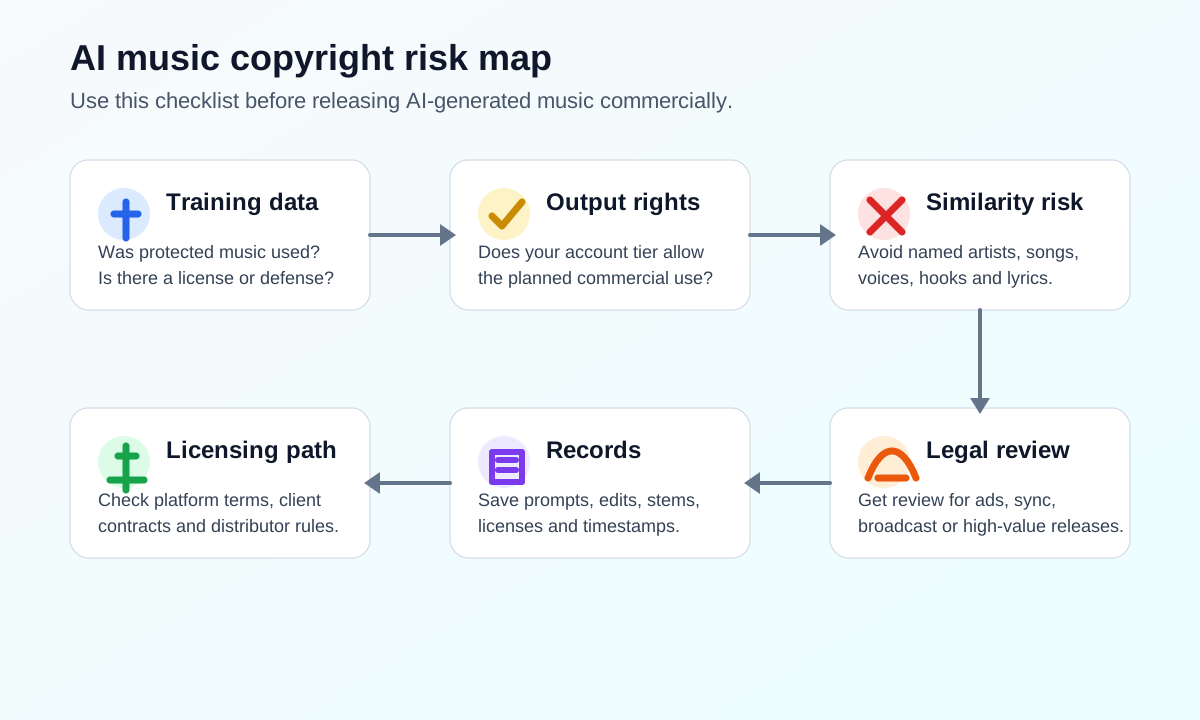
For creators, brands and app developers, the practical takeaway is simple: Suno's fundraising shows investor confidence in AI music, but it does not remove copyright risk. Before using AI-generated music commercially, check platform terms, avoid artist soundalike prompts, document your workflow and make sure distributors, clients and rights holders will accept the output.
What happened
Suno said it raised more than $400 million in Series D funding at a $5.4 billion post-money valuation. The company said the money will help it build new creative tools and prepare a music model developed with the music industry.
TechCrunch reported the announcement on June 3, noting that the round comes roughly seven months after Suno raised a $250 million Series C at a $2.45 billion valuation. Reuters also reported the Series D and described the company as a Massachusetts-based startup that lets users generate songs from AI prompts.
The Series D round was led by Bond Capital. Suno named IVP, Forerunner, Union Square Ventures, Alkeon and Quiet as additional investors, with Matrix, Lightspeed, Menlo Ventures and Schroders Capital returning.
The size of the round matters because AI music is no longer a niche experiment. Investors are funding Suno as if consumer music generation, licensed creator tools, fan interaction and professional production workflows can become a major platform category. The unresolved question is whether that platform can scale without an adverse copyright ruling, expensive licensing shift or restrictions that weaken the product.
Why Suno is controversial
Suno can generate complete songs from text prompts. That includes vocals, lyrics and instrumental arrangements. For users, the attraction is obvious: a person with no studio, band or production budget can make a polished track quickly.
For many artists, labels and publishers, the concern is also obvious. AI music tools need training data. If a model learns from commercial recordings without permission, the rightsholders argue that the model was built from protected works while competing against the people who created those works.
Suno's position is that model training can be lawful fair use. The labels' position is that large-scale commercial copying of sound recordings for a competing AI service is not fair use.
That is why the Suno case is closely watched. It is not only about one startup or one set of songs. It could influence how courts treat AI training, licensing markets and artist control in generative music.
The lawsuit context
The RIAA announced on June 24, 2024 that record companies had filed copyright infringement lawsuits against Suno in federal court in Massachusetts and Udio in federal court in New York. The plaintiffs included major music companies that hold rights in sound recordings, including Sony Music Entertainment, UMG Recordings and Warner Records.
The original Suno complaint alleged that Suno copied protected recordings to train its service and sought declarations of infringement, injunctions and damages. Suno has denied liability and has argued fair use.
TechCrunch reported in August 2024 that Suno acknowledged in a court filing that its training data included copyrighted songs, while arguing that this did not make the training unlawful. That is a key distinction: acknowledging that copyrighted material appears in training data is not the same as conceding infringement.
The case has changed since the original complaint. Warner Music Group announced on November 25, 2025 that it settled prior litigation with Suno and formed a partnership to develop licensed AI music models. Warner also said Suno would launch more advanced licensed models in 2026, deprecate current models when the new ones launch, and limit downloads in some cases.
UMG and Sony did not exit in the same way. Music Business Worldwide reported on May 26, 2026 that UMG and Sony asked the District of Massachusetts for permission to add more than 61,000 copyrighted sound recordings to the Suno lawsuit after discovery. The original complaint asserted 560 works. The court must grant the motion before the expanded list becomes part of the case.
What is confirmed and what is not
| Issue | Current status |
|---|---|
| New funding | Confirmed by Suno: over $400 million in Series D funding. |
| Valuation | Confirmed by Suno: $5.4 billion post-money valuation. |
| Lead investor | Confirmed by Suno: Bond Capital. |
| Warner litigation | Warner says its prior litigation with Suno was settled through the November 2025 partnership. |
| UMG and Sony claims | Active, according to recent reporting and court-linked filings. |
| Added 61,000-plus works | Requested by UMG and Sony; not final unless the court grants leave to amend. |
| Fair use outcome | Unresolved in this Suno litigation. |
| Future licensing deals with UMG or Sony | Not confirmed publicly as of this review. |
| Exact commercial impact on users | Unclear until model, licensing and terms changes are fully rolled out. |
Timeline
| Date | Event | Why it matters |
|---|---|---|
| May 2024 | Suno announced it had raised $125 million in earlier funding. | The company was already scaling before the major-label suits. |
| June 24, 2024 | RIAA announced copyright suits against Suno and Udio. | The cases became a major test for AI music training and fair use. |
| August 1, 2024 | TechCrunch reported Suno's fair-use defense and its acknowledgement that copyrighted songs were included in training data. | This clarified the legal fight: not whether copyrighted works appeared, but whether use was lawful. |
| November 2025 | Suno raised a $250 million Series C at a $2.45 billion post-money valuation, according to TechCrunch and Reuters. | Investor appetite grew despite ongoing litigation. |
| November 25, 2025 | Warner Music Group announced a settlement and partnership with Suno. | It showed one path toward licensed AI music models and artist controls. |
| May 21, 2026 | UMG and Sony filed a motion seeking to add more than 61,000 recordings, according to Music Business Worldwide. | The remaining plaintiffs are trying to expand the asserted works in the case. |
| June 3, 2026 | Suno announced over $400 million in Series D funding at a $5.4 billion valuation. | The company has fresh capital while the legal outcome remains open. |
Why investors are still funding Suno
Investors appear to be underwriting three things at once: consumer growth, licensing optionality and the chance that AI music becomes a new creative platform.
Suno's appeal is not only that it can create songs. The bigger investor thesis is that music generation could become a daily consumer habit, a production tool for creators, a fan-engagement layer for artists, a soundtrack engine for games and video, and a licensing business for rightsholders.
The legal risk is substantial, but investors may believe Suno has several ways forward:
- Win or narrow the fair-use fight in court.
- Settle with more rightsholders.
- Move users toward licensed models.
- Restrict risky outputs and downloads.
- Build artist opt-in tools and new revenue-sharing products.
- Use funding to absorb legal costs while growing.
None of those outcomes is guaranteed. A broad ruling against Suno could increase damages exposure, force licensing changes, affect model access or reshape how AI music products are trained. A licensing-heavy future could also raise costs and make AI music less cheap or less flexible than early users expect.
Why labels may also see opportunity
The Warner deal shows that the music industry is not uniformly rejecting AI music. Warner framed its Suno partnership as a way to build licensed models, protect artists and create new revenue opportunities.
That matters because the likely future is not simply "AI music wins" or "labels stop AI music." A more realistic outcome is a licensed AI music market where major catalogs, artist names, voices, likenesses and compositions are controlled through contracts.
For labels, the business question is whether AI music becomes a threat to recordings and artists or a new monetization layer. For startups, the question is whether they can afford the licensing structure that rightsholders demand.
What creators should know
If you are a musician, producer or songwriter, Suno's funding does not settle the rights debate. It does mean AI music tools will probably keep improving and spreading.
Creators should watch four issues:
| Issue | Why it matters |
|---|---|
| Training rights | Courts may decide whether certain AI training practices are fair use or require licensing. |
| Output similarity | Even if a tool's general training defense succeeds, a specific output can still create risk if it is too close to an existing recording or composition. |
| Voice and likeness | Artist names, vocal style, image, likeness and persona rights may be governed by separate laws and contracts. |
| Distribution rules | Streaming services, sync buyers, labels and clients may impose their own AI disclosure or rights-clearance rules. |
Creators who use AI should keep records of prompts, edits, human contributions, stems, licenses and platform terms at the time of creation. That paper trail will matter if a distributor, client or rightsholder later asks how the work was made.
What businesses and brands should do
AI music can be useful for demos, internal videos, social posts and rapid creative experiments. Commercial release is where caution matters.
Before using Suno or any AI music generator in a campaign, ask:
- Does the platform grant commercial rights for your account tier and use case?
- Are you allowed to use the output in ads, podcasts, games, apps or broadcast media?
- Does the output imitate a known artist, song, voice or label sound?
- Does your client, distributor, agency or platform require AI disclosure?
- Can you prove when the track was generated and under which terms?
- Are there indemnities, and if so, do they actually cover your risk?
- What happens if the platform's terms change after the track is made?
For high-value campaigns, the safer route is to use licensed production music, commission a composer, or get legal review before relying on AI-generated music.
What Suno users should avoid
Users can reduce risk by avoiding prompts and workflows that invite copying.
Do not ask for:
- Songs "in the style of" a living artist or specific band.
- Soundalikes of recognizable singers.
- Recreation of a named song, hook, melody or chorus.
- Lyrics copied from existing songs.
- Tracks meant to mislead listeners into thinking an artist endorsed or performed them.
Even if a platform blocks some prompts, users remain responsible for how they distribute and monetize outputs.
How the lawsuit could affect everyday users
Most casual users will not see an immediate change just because Suno raised money. The bigger changes may come from licensing deals, platform updates or court rulings.
Possible user-facing changes include:
| Possible change | Why it could happen |
|---|---|
| Paid-download limits | Warner's announcement already points toward download limits in some scenarios. |
| Licensed model tiers | Suno says it is preparing models developed with the music industry. |
| Artist opt-in catalogs | Rightsholders may require explicit permission for names, voices, likenesses and compositions. |
| More prompt restrictions | Platforms may tighten rules around artist imitation and song recreation. |
| Higher prices | Licensing and legal costs could make AI music subscriptions more expensive. |
| Stronger disclosure | Distributors and platforms may require users to identify AI-generated or AI-assisted music. |
The most likely near-term change is not the disappearance of AI music. It is a shift from open-ended generation toward controlled, paid and licensed workflows.
The legal issue in plain English
Fair use is a flexible U.S. copyright doctrine, not a blanket permission slip. Courts typically look at factors such as purpose, nature of the work, amount used and market effect.
AI companies argue that training can be transformative because models learn patterns and do not simply republish training works. Copyright owners argue that copying protected works at commercial scale, then using them to create competing outputs, harms existing and emerging licensing markets.
The U.S. Copyright Office's AI materials describe generative AI training as a fact-specific question. That means one AI case does not automatically decide every other case. Training on different data, for different purposes, with different outputs and markets, can produce different legal results.
For Suno, the sound-recording context is especially important because the product creates music, the same broad market that the plaintiffs operate in.
What remains unresolved
Several important questions are still open:
- Will the court allow UMG and Sony to add more than 61,000 recordings?
- Will the fair-use defense be decided before trial?
- Will Suno settle with additional rightsholders?
- What will the first Warner-linked licensed model allow or restrict?
- Will artist opt-in tools become the default for names, voices and likenesses?
- Will users keep broad commercial rights under future terms?
- Will distributors and streaming platforms tighten AI music policies?
- How will courts measure damages if labels prove infringement?
Those unanswered questions are why the $400 million-plus raise should be read as a high-conviction bet, not as proof that the legal cloud has cleared.
Bottom line
Suno's new funding is a major signal for AI music. A $5.4 billion valuation shows that investors believe music generation can become a large consumer and creator platform, even with lawsuits still in progress.
But the legal risk is real. Warner's settlement created one licensing path, while UMG and Sony continue to press their claims. The court has not resolved the central fair-use question for Suno.
For users, the best approach is practical caution: use AI music for experimentation, understand account-tier rights, avoid artist imitation, keep records and treat commercial releases as rights-sensitive projects. For the music industry, the fight is moving from whether AI music exists to who controls, licenses and profits from it.
Sources
- Suno: The Next Chapter for Suno, June 3, 2026.
- TechCrunch: Still facing copyright lawsuits, AI music generator Suno raises another $400M, June 3, 2026.
- Reuters via StreetInsider: AI music startup Suno raises funding at $5.4 billion valuation, June 3, 2026.
- RIAA: Record Companies Bring Landmark Cases for Responsible AI Against Suno and Udio, June 24, 2024.
- RIAA: Suno complaint, filed in the U.S. District Court for the District of Massachusetts, June 24, 2024.
- TechCrunch: AI music startup Suno claims training model on copyrighted music is fair use, August 1, 2024.
- Suno: Suno has raised $125 million, May 21, 2024.
- Warner Music Group: Warner Music Group and Suno Forge Groundbreaking Partnership, November 25, 2025.
- Music Business Worldwide: UMG and Sony seek to add over 61k recordings to Suno lawsuit, May 26, 2026.
- U.S. Copyright Office: Copyright and Artificial Intelligence.
Before you move on
Global AI workflow guidance. Use this short checklist to turn the article into action.
- Check whether the tool can access private files or account data.
- Verify factual claims against primary sources before publishing.
- Keep a human review step for work that affects money, school, or customers.
This guide is written for practical user safety. For account, platform, or legal decisions, confirm critical steps with the official help center or your service provider.