
The New York Times Magazine has revived the debate over Tilly Norwood, the synthetic actress from Xicoia and Particle6. Here is what is confirmed, why actors are angry, and what studios, creators and viewers should know.
Last checked: June 1, 2026. This article uses The New York Times Magazine's May 31, 2026 feature on Tilly Norwood as the primary news peg and cross-checks the wider record with AP, TechCrunch, ITV News, Forbes, SAG-AFTRA reporting, SAGE research and U.S. Copyright Office materials.
Quick answer
Tilly Norwood is not a human performer. She is an AI-generated entertainment persona created by Xicoia, the AI talent studio connected to Particle6 and producer Eline Van der Velden.
The latest New York Times Magazine profile asks why so many people are angry at an "AI actress." The short answer is that the backlash is not really about one fictional face. It is about consent, training data, labor rights, likeness rights, authorship, transparency, audience trust and the fear that studios may use synthetic performers to reduce human opportunity.
Actors and unions argue that a synthetic performer can be built from the aesthetics, timing, voices, body language and screen traditions of real workers without giving those workers credit, consent or compensation. Supporters of AI characters argue that Tilly should be treated as a new creative format, closer to animation, puppetry, game characters or virtual influencers than to a replacement for working actors.
The practical takeaway: Tilly Norwood has become a symbol. Whether audiences like her or not, the debate is forcing studios, agencies, brands and creators to answer a basic question: if an AI-generated "star" can perform, who owns the performance and who was used to make it believable?
What the New York Times feature adds
The New York Times Magazine feature, published May 31, 2026, reframes the Tilly Norwood controversy as a culture and labor story rather than a novelty tech story. The headline itself, "Tilly Norwood, A.I. Actress, Wants to Know Why Everyone's Mad at Her," captures the core tension: the persona is marketed with a human-style voice, career arc and emotional posture, while critics insist there is no human performer behind the character.
That is why the article matters now. Tilly is no longer only a launch stunt from 2025. She has become a recurring case study in how AI characters are packaged, defended, criticized and potentially commercialized.
The controversy has moved through three stages:
- First, curiosity: an AI talent studio introduces a screen-ready synthetic performer.
- Second, backlash: actors, unions and filmmakers object to the labor and consent implications.
- Third, normalization attempt: the creator and brand try to position Tilly as a new genre, not a human replacement.
Who is Tilly Norwood?
Tilly Norwood is an AI-generated character promoted as an "AI actress" or synthetic performer. AP reported that she is a product of Xicoia, which describes itself as an AI talent studio, and that Van der Velden promoted the character at the Zurich Summit, the industry event tied to the Zurich Film Festival.
ITV News reported that Norwood's social account had been active before the bigger media wave, and that Van der Velden's team positioned her as a potential next-generation digital star. Industry coverage also connected the character to claims that talent agents were interested in representing her.
The wording is important. Calling Tilly an "actress" makes the story more emotionally charged. Calling her a "character," "asset," "avatar," "synthetic performer" or "AI persona" changes the frame. Actors are objecting partly because the word "actress" places a software-generated persona inside a human profession.
Timeline of the backlash
| Date | What happened | Why it mattered |
|---|---|---|
| May 2025 | Tilly Norwood's social presence began drawing attention, according to ITV's timeline. | The character was built as a public-facing persona, not only a private studio experiment. |
| July 2025 | ITV reported that Van der Velden initially unveiled the synthetic star in summer 2025. | Tilly moved from concept to marketed AI performer. |
| September 2025 | Van der Velden promoted Tilly at the Zurich Summit; reports said agencies were circling. | That suggested synthetic talent could enter the same representation pipeline as human actors. |
| September 30, 2025 | SAG-AFTRA publicly rejected the idea of treating Tilly as an actor. | The union turned a viral debate into a labor and contract issue. |
| October 2025 | AP, TechCrunch, ITV and others covered the Hollywood backlash. | The controversy became mainstream entertainment news. |
| March 2026 | Tilly appeared in the "Take The Lead" music video, which Forbes and Euronews described as a response to the backlash. | The character became a multi-format entertainment brand, not only an acting demo. |
| May 31, 2026 | The New York Times Magazine published a profile about Tilly and the anger around her. | The issue moved from viral dispute to longer-term cultural reckoning. |
Why actors are angry
The anger is not hard to understand if the issue is viewed from the worker's side.
1. Consent and training data
SAG-AFTRA's position, as reported by AP and TechCrunch, is that Tilly is not an actor but a computer-generated character trained on the work of professional performers without permission or compensation. That claim goes to the center of the generative AI dispute: if a system learns from human performances, should the humans have approval, payment or credit?
Even when a company says a character is original, actors want to know what materials shaped the model, performance style, voice, gestures, face, movement and promotional imagery.
2. Job displacement
The fear is not only that an A-list star will be replaced tomorrow. The more immediate risk is at the entry level: commercials, social videos, background work, game cinematics, product demos, test scenes, dubbing, digital doubles and small speaking roles. These are the jobs where new performers build credits, income and experience.
If a synthetic performer can be reused endlessly, never ages, never bargains, never gets sick and can be localized into many markets, studios may see a cost advantage. Actors see a career-ladder problem.
3. Human experience
SAG-AFTRA and several actors have argued that performance is not only appearance. It draws on memory, emotion, lived experience, risk, timing, interpretation and the human relationship between performer and audience.
That does not mean animation or CGI cannot move audiences. It means the credit usually goes to the actors, animators, writers, directors and artists who make the performance. With AI personas, the public-facing "star" can obscure the human labor underneath.
4. Likeness and identity rights
ITV reported that British actress Briony Monroe said one promotional image resembled her and that she was concerned about her rights, while Particle6 denied using her likeness, image, voice or personal data and said Tilly was developed from scratch.
That dispute shows the challenge: when a synthetic face looks like a blend of many familiar performers, it may be difficult for any one person to prove copying, yet many performers may feel the result is built from their professional world.
5. Contract rules
SAG-AFTRA has warned that signatory producers cannot use synthetic performers without complying with contractual obligations. AP reported that AI protections were central to the 2023 SAG-AFTRA strike settlement and the later video game actor agreement.
For studios, this means synthetic performers are not a legal blank check. For workers, it means the battle is moving from social media outrage into contracts, guild rules and production paperwork.
Why Tilly's creator defends the project
Van der Velden has argued that Tilly is not a replacement for a human actor but a creative work and a new type of art. AP and TechCrunch both reported her defense that AI characters should be judged as their own genre rather than directly compared with human performers.
That defense matters because it is likely how AI studios will frame future projects:
- AI character as art, not labor replacement.
- AI persona as animation or puppetry, not stolen performance.
- AI production as a way to create new jobs for designers, prompters, editors, performers and technologists.
- Synthetic talent as a new category for stories that cannot be made affordably with traditional production.
The problem is that this framing only works if the production is transparent about who did the work, what data was used, whether likenesses were cleared, and how human collaborators are credited and paid.
What "Take The Lead" changed
In March 2026, Forbes reported that Tilly Norwood appeared in a music video called "Take The Lead," released as a response to the criticism around the character. Euronews and other outlets described the release as worsening the backlash rather than calming it.
The video was important because it made the Tilly brand more than a single acting demo. It suggested a "Tilly-verse" model: a synthetic performer who can sing, appear in videos, post on social platforms, build a fan identity and serve as reusable intellectual property.
That is why the industry reaction stayed intense. The product is not just an AI-generated clip. It is a proposal for a new entertainment business model.
The legal issues users should understand
Copyright
The U.S. Copyright Office's AI reports emphasize that copyright depends on human authorship. AI-assisted work can still include copyrightable human contributions, but material generated without sufficient human creative control raises harder questions.
For synthetic performers, the copyright question is not simple. A company may have copyright in human-created scripts, designs, edits, arrangements, compositions, software, branding and final audiovisual works. But whether the purely AI-generated aspects of a performer are independently protectable can depend on the human contribution and the jurisdiction.
That matters commercially. If an AI "star" is hard to protect, a company may struggle to stop imitators. If the surrounding brand and human-authored materials are protectable, the company may still control the commercial package.
Right of publicity and likeness
Actors also care about name, image, voice and likeness rights. These vary by jurisdiction, but the basic concern is clear: performers do not want their faces, voices, movements or signature styles reconstructed without permission.
The harder case is not a direct clone. It is a synthetic face or voice that feels familiar because it sits in the statistical middle of many real performers.
Union and contract law
For union-covered productions, the relevant question is not only "Can this be generated?" It is "Did the producer give required notice, bargain where required, obtain consent, pay properly and credit accurately?"
That is why studios and agencies should treat synthetic performers as a compliance issue, not only a creative experiment.
What studios and agencies should do before using AI talent
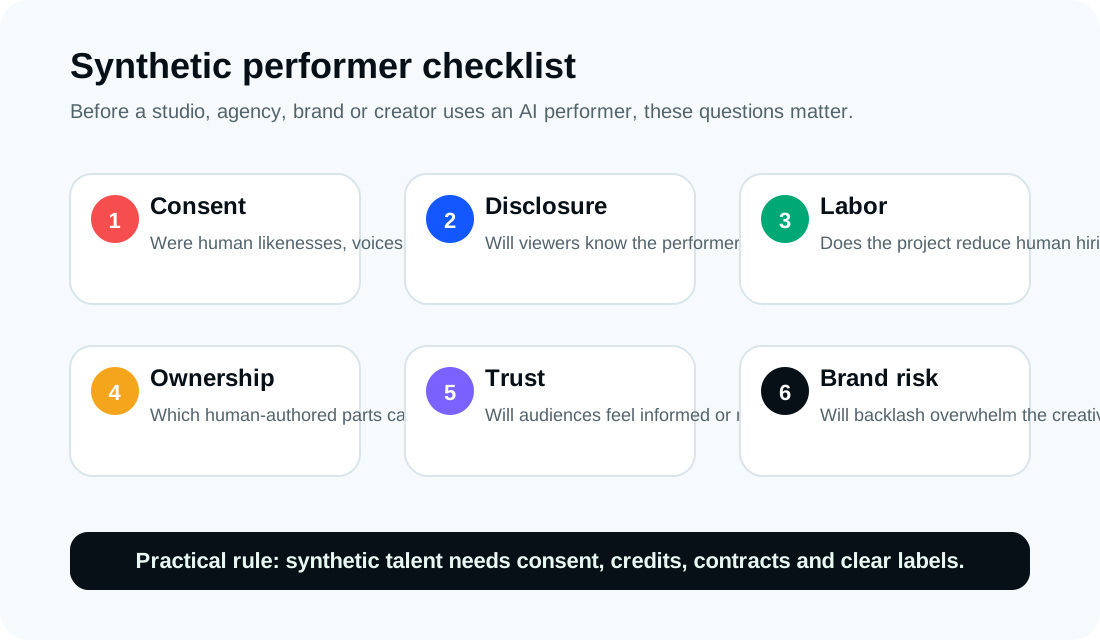
Studios, agencies and brands considering synthetic performers should answer these questions before release:
| Question | Why it matters |
|---|---|
| What training data or reference material shaped the character? | Reduces consent and likeness risk. |
| Were any actor scans, voices, motion captures or performance references used? | Determines whether permission and compensation are needed. |
| Is the performer clearly disclosed as synthetic? | Protects audience trust and reduces deceptive marketing risk. |
| Who are the human collaborators? | Keeps designers, actors, editors and technologists from disappearing behind the avatar. |
| Does the project replace a job that would normally go to a performer? | Raises labor, union and reputational questions. |
| Can the output be protected or licensed? | Affects IP strategy and investor value. |
| What happens if the character resembles a real person? | Requires takedown, review and dispute procedures. |
What actors and creators should do
Actors should review contracts for AI, digital replica, synthetic performer, voice, scan, motion capture and reuse language. If the language is broad or unclear, ask what can be created, for how long, in what media, in what territories, and whether new consent and payment are required.
Creators should keep records of their work, performance reels, voice reels, scans, contracts and takedown requests. If a synthetic character appears to use your likeness, document screenshots, dates, URLs and side-by-side examples before contacting a union, lawyer, agent or platform.
Independent filmmakers using AI should disclose what is AI-generated, license human inputs where needed, credit human collaborators, and avoid marketing a synthetic character in a way that implies a real performer exists.
What viewers should know
Viewers do not need to panic every time AI appears in entertainment. Animation, visual effects, voice processing and digital doubles have been part of filmmaking for years. The issue is transparency and control.
Ask:
- Is the performer human, synthetic, or a digital double of a consenting person?
- Were human collaborators credited?
- Does the project disclose AI use clearly?
- Is the AI character replacing human work or enabling a clearly experimental format?
- Is the company using outrage as free marketing?
The last point matters. AI controversy can become a growth strategy. If the business model depends on everyone being angry, the audience should decide whether attention is helping the project more than criticism is hurting it.
What happens next
The Tilly Norwood debate is likely to become less about one character and more about templates for synthetic talent. Expect future disputes around:
- AI performers in ads, music videos, games and low-budget film.
- Synthetic background actors and extras.
- AI-generated child performers and age-shifted performers.
- Digital replicas of living actors.
- Digital resurrection of deceased performers.
- Talent agencies representing AI personas.
- AI fan accounts, licensing and merch.
- Disclosure rules for synthetic media.
The winning model may not be "replace actors with AI." The more durable model may be hybrid: human performers, motion capture, licensed digital doubles, AI-assisted effects and transparent synthetic characters built with clear consent.
Bottom line
Tilly Norwood is not just an AI character people love to hate. She is a stress test for the entertainment industry.
If synthetic performers are built transparently, with licensed inputs, clear credits, fair compensation and honest labels, they may become one more creative tool. If they are marketed as cheaper, tireless replacements for human actors, they will keep triggering backlash.
That is why everyone is mad at Tilly Norwood. The anger is not really aimed at a fictional person. It is aimed at the system that might use fictional people to weaken real ones.
Sources
- The New York Times Magazine: Tilly Norwood, A.I. Actress, Wants to Know Why Everyone's Mad at Her, May 31, 2026.
- AP: 'AI actor' Tilly Norwood stirs outrage in Hollywood, September 30, 2025.
- TechCrunch: Hollywood is not taking kindly to the AI-generated actress Tilly Norwood, October 1, 2025.
- ITV News: Meet Tilly Norwood, the AI-generated actress facing backlash in Hollywood, October 3, 2025.
- Forbes: AI 'Actress' Tilly Norwood Responds To Backlash In Debut Song, March 10, 2026.
- Euronews: Controversial AI 'actor' Tilly Norwood releases the worst song you've ever heard, March 12, 2026.
- SAGE Emerging Media: Tilly Norwood and the Debate Over Personality Rights in the Entertainment Industry, March 25, 2026.
- U.S. Copyright Office: Copyright and Artificial Intelligence.
- U.S. Copyright Office Part 2 report: Copyrightability, January 2025.
Before you move on
Global AI workflow guidance. Use this short checklist to turn the article into action.
- Check whether the tool can access private files or account data.
- Verify factual claims against primary sources before publishing.
- Keep a human review step for work that affects money, school, or customers.
This guide is written for practical user safety. For account, platform, or legal decisions, confirm critical steps with the official help center or your service provider.