

A Traders Union report says Wei Dai warned that self-sovereign onchain privacy protocols may need multi-day deposit delays because transactions can appear legitimate before authorities or analytics providers later flag them.
Last checked: June 1, 2026. This article uses Traders Union's report on Wei Dai's warning as the primary news source. The underlying tweet embedded in that report is marked as deleted, so this article treats the Traders Union summary as the reportable claim and cross-checks the wider issue against Privacy Pools research, RAILGUN documentation, U.S. Treasury/OFAC actions, FinCEN's mixing proposal and Chainalysis crypto crime reporting.
Quick answer
Onchain privacy protocols can make crypto transactions harder to trace, but that does not mean every deposit is instantly safe for exchanges, wallets or users to accept. Traders Union reported on June 1, 2026 that Wei Dai warned fully self-sovereign privacy protocols such as Railgun or Privacy Pools may need deposit delays of several days because a transaction can look legitimate at first and be flagged later after law enforcement, analytics providers or sanctions-screening systems update their data.
The warning highlights the core design tension in crypto privacy: users want private transfers without exposing their entire transaction history, while exchanges and regulators need enough time and evidence to avoid laundering stolen funds, ransomware proceeds or sanctioned assets.
For everyday users, the lesson is simple: using a privacy protocol does not erase compliance risk. If funds later connect to theft, sanctions or exploit proceeds, a centralized exchange, bridge, wallet provider or payment platform may delay, reject or investigate the deposit even if the transaction looked normal when it first moved.
What Traders Union reported
Traders Union's Market Voices item says Dai emphasized that deposit delays of several days may be necessary for fully self-sovereign onchain privacy protocols. The report names Railgun and Privacy Pools as examples.
According to the report, Dai's point is that a deposit can initially appear legitimate, but suspicious activity may only be identified later. That matters because privacy systems can break the public link between a deposit and a later withdrawal. If the protocol allows a user to enter and exit too quickly, a bad actor may get privacy before compliance signals catch up.
The source article also notes that the tweet it referenced was deleted. That limits direct verification of Dai's exact wording. What can be verified independently is the broader technical and regulatory problem: privacy pools, proof-of-innocence systems and mixer rules all revolve around the same tradeoff between financial privacy and delayed identification of bad funds.
Why deposit delays matter
In a transparent blockchain, deposits are visible. A compliance provider may inspect the sending wallet, transaction graph, bridge history, exchange exposure, exploit links and sanctions lists. But attribution is not instant.
New flags can appear hours or days later when:
- A hacked protocol publishes exploiter addresses.
- A law-enforcement agency or analytics vendor tags a wallet cluster.
- An exchange identifies a compromised account.
- A bridge exploit investigation connects wallets across chains.
- A sanctions list or risk feed is updated.
- A stolen-funds path becomes clear after chain-hopping or splitting transactions.
If funds enter a privacy protocol and are withdrawn privately before that update, it becomes harder for counterparties to decide whether the withdrawal is safe.
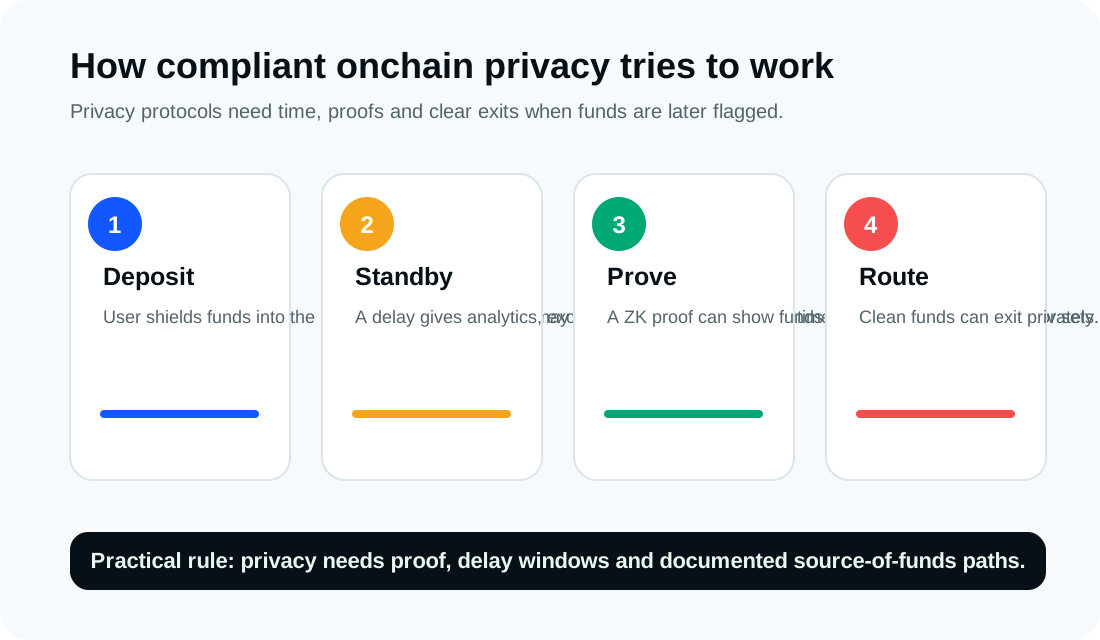
That is the operational reason for a delay. The delay creates a window for new information to arrive before the protocol gives the user a stronger privacy break.
How privacy pools try to solve the problem
Privacy Pools research, associated with Vitalik Buterin, Jacob Illum, Matthias Nadler, Fabian Schar and Ameen Soleimani, proposes a way for users to prove something useful without revealing their full transaction history.
The basic idea is that a user can publish a zero-knowledge proof showing that funds do or do not originate from certain known sources. In plain English, the proof can say: "My withdrawal belongs to an allowed set" or "My withdrawal does not belong to this known bad set," without exposing every wallet and transaction behind the user.
That is why privacy pools are different from a simple black-box mixer. The goal is not only to hide links. The goal is to let legitimate users separate themselves from bad actors without giving up all privacy.
Where RAILGUN fits
RAILGUN's documentation describes Private Proofs of Innocence as a zero-knowledge assurance tool. According to RAILGUN docs, the system checks tokens entering the smart contract against public list-provider data and lets users generate proofs without revealing balances, 0zk addresses or full activity.
The documentation says list providers can include sources such as Elliptic, ScamSniffer, PureFi, SlowMist and Chainalysis sanctions data. The important point is that the protocol is not relying on one universal blacklist. It is relying on chosen data providers and proof systems.
That design has two consequences:
| Benefit | Tradeoff |
|---|---|
| Users can keep financial history private. | The protocol must decide which lists or providers matter. |
| Counterparties can see evidence that funds are not in selected bad sets. | A proof is only as current as the underlying list data. |
| Bad deposits may be routed away or prevented from private exit. | False positives and late flags can still create disputes. |
| There is no need to reveal the full transaction graph. | Exchanges may still demand source-of-funds records. |
This is the exact place where Dai's reported warning becomes relevant: if the bad-actor list changes after deposit, the system needs enough time to react.
Why regulators care
Regulators have spent years warning that crypto mixing can support money laundering and sanctions evasion.
In August 2022, the U.S. Treasury sanctioned Tornado Cash, saying it had been used to launder more than $7 billion worth of virtual currency since 2019. Treasury specifically tied the action to North Korean Lazarus Group activity and other cybercrime concerns.
In March 2025, Treasury removed Tornado Cash from the sanctions list after legal and policy review, but it also said it remained deeply concerned about North Korean cyber actors and would continue monitoring transactions that may benefit malicious actors.
FinCEN's 2023 proposed rule on convertible virtual currency mixing also shows why regulators focus on this category. The agency described CVC mixing as a class of transactions of primary money laundering concern and proposed recordkeeping and reporting requirements for covered financial institutions that know, suspect or have reason to suspect transactions involve mixing.
The policy signal is consistent: authorities recognize that privacy tools may have legitimate uses, but they also expect financial intermediaries to screen and document risk.
Why users also need privacy
The other side of the debate is real. Public blockchains can expose more than many users realize.
A wallet address can reveal balances, payments, DeFi positions, NFT purchases, salary flows, donation history, business vendors, customer payments and travel patterns. If a user connects the address to a real identity, the entire history can become a permanent public dossier.
Privacy tools can protect:
- Salaries and business payments.
- Donations to sensitive causes.
- Personal spending patterns.
- DeFi positions that could be copied or attacked.
- Wallet balances that create physical security risk.
- Companies that do not want competitors reading supplier flows.
That is why the debate is not "privacy good" versus "privacy bad." The real question is how to make privacy usable without turning privacy infrastructure into a laundering rail.
What exchanges and wallets may do
If a user sends funds from a privacy protocol to a centralized exchange, the exchange may:
- Delay the deposit while compliance reviews it.
- Ask for source-of-funds documentation.
- Ask for transaction hashes showing where funds originated.
- Reject the deposit.
- Return funds to the sending address.
- Freeze or restrict the account while it reviews sanctions or stolen-funds exposure.
- File suspicious activity reports where required.
This can happen even when the user has no criminal intent. The risk score may come from a transaction graph, list provider, sanctions oracle, exchange policy or regulator expectation.
Users should not assume that a proof-of-innocence tool will automatically satisfy every exchange. It may help, but each platform sets its own compliance policy.
What ordinary users should do before using privacy protocols
This is not legal, tax or investment advice, but users should treat privacy protocol usage like a compliance-sensitive action.
Before depositing:
- Check whether your destination exchange accepts funds from privacy protocols.
- Keep records showing how you acquired the assets.
- Save transaction hashes, exchange withdrawal receipts, invoices or wallet notes.
- Avoid funds from unknown counterparties, high-risk OTC deals or suspicious airdrops.
- Do not mix personal funds with funds from other people unless you can document the relationship.
- Expect possible delays when exiting to a centralized service.
- Do not use privacy tools to evade taxes, sanctions, court orders or reporting obligations.
After withdrawal:
- Keep proof files or attestations generated by the protocol.
- Do not immediately send funds to a service that bans privacy-protocol flows.
- Be prepared to answer source-of-funds questions.
- If a deposit is frozen, contact the exchange through official support and provide documentation.
What protocol teams should learn
The Dai warning, as reported, is also a product-design lesson.
Privacy protocols need more than cryptography. They need operational controls:
| Control | Why it matters |
|---|---|
| Standby periods | Gives new risk intelligence time to arrive. |
| Multiple list providers | Reduces dependence on one risk source. |
| Transparent appeal paths | Legitimate users need a way to respond to false positives. |
| Proof export | Users need evidence they can show exchanges. |
| Clear documentation | Users must understand delays before depositing. |
| Emergency response rules | Exploit deposits need predictable handling. |
| Privacy-preserving design | Compliance should not become full surveillance. |
The hardest balance is avoiding two bad outcomes at once: total surveillance that defeats privacy, and total opacity that lets stolen funds move freely.
What remains unclear
Several facts remain unresolved:
- The exact wording of Dai's original post cannot be confirmed from the deleted tweet embedded by Traders Union.
- There is no single universal standard for how long a deposit delay should be.
- Different protocols use different list providers, association sets and proof models.
- Exchanges may apply stricter rules than the privacy protocol itself.
- A protocol's claim of compliance does not guarantee acceptance by banks, exchanges or regulators.
That uncertainty is why users should not treat privacy protocol design as a legal safe harbor.
Bottom line
Onchain privacy is necessary because public blockchains expose too much. Compliance checks are necessary because stolen and sanctioned funds also move on public blockchains.
Wei Dai's reported warning points to the gap between those two realities: a transaction can look clean today and become high-risk tomorrow. Deposit delays are not just inconvenience. In self-sovereign privacy systems, they may be the time buffer that lets privacy and compliance coexist.
For users, the practical rule is simple: keep records, expect delays, check destination policies and do not assume that privacy equals acceptance.
Sources
- Traders Union: Onchain privacy protocols can appear legitimate until flagged, Wei Dai warns, June 1, 2026.
- Privacy Pools whitepaper: Blockchain Privacy and Regulatory Compliance.
- RAILGUN documentation: Private Proofs of Innocence.
- RAILGUN documentation: RAILGUN Assurance Suite.
- U.S. Treasury: Tornado Cash sanctions, August 8, 2022.
- U.S. Treasury: Tornado Cash delisting, March 21, 2025.
- FinCEN: Proposal on convertible virtual currency mixing, October 2023.
- Chainalysis: 2026 Crypto Crime Report introduction.
Before you move on
Personal privacy controls. Use this short checklist to turn the article into action.
- Review location, camera, microphone, contacts, and photo access.
- Remove apps and connected services you no longer use.
- Protect your main email because it controls account recovery.
This guide is written for practical user safety. For account, platform, or legal decisions, confirm critical steps with the official help center or your service provider.