


Anthropic raised $65 billion at a $965 billion post-money valuation, putting the Claude maker at the center of the AI funding race. Here is what users, businesses and developers need to know.
Last checked: May 31, 2026. This article is based on Anthropic's May 28, 2026 Series H announcement, official Claude product material, Anthropic's Claude 4 release notes, AP reporting on OpenAI's prior private valuation and other public reporting on private AI company valuations. It is an independent explainer, not investment advice.
Quick answer
Anthropic, the company behind Claude, announced a $65 billion Series H funding round on May 28, 2026. The round valued the company at $965 billion post-money, a level that makes Anthropic the most valuable privately held AI startup based on currently reported private-market valuations.
The round was led by Altimeter Capital, Dragoneer, Greenoaks and Sequoia Capital. Anthropic said the money will help it expand compute, advance safety and interpretability research, meet demand for Claude and scale products such as Claude Code and Cowork.
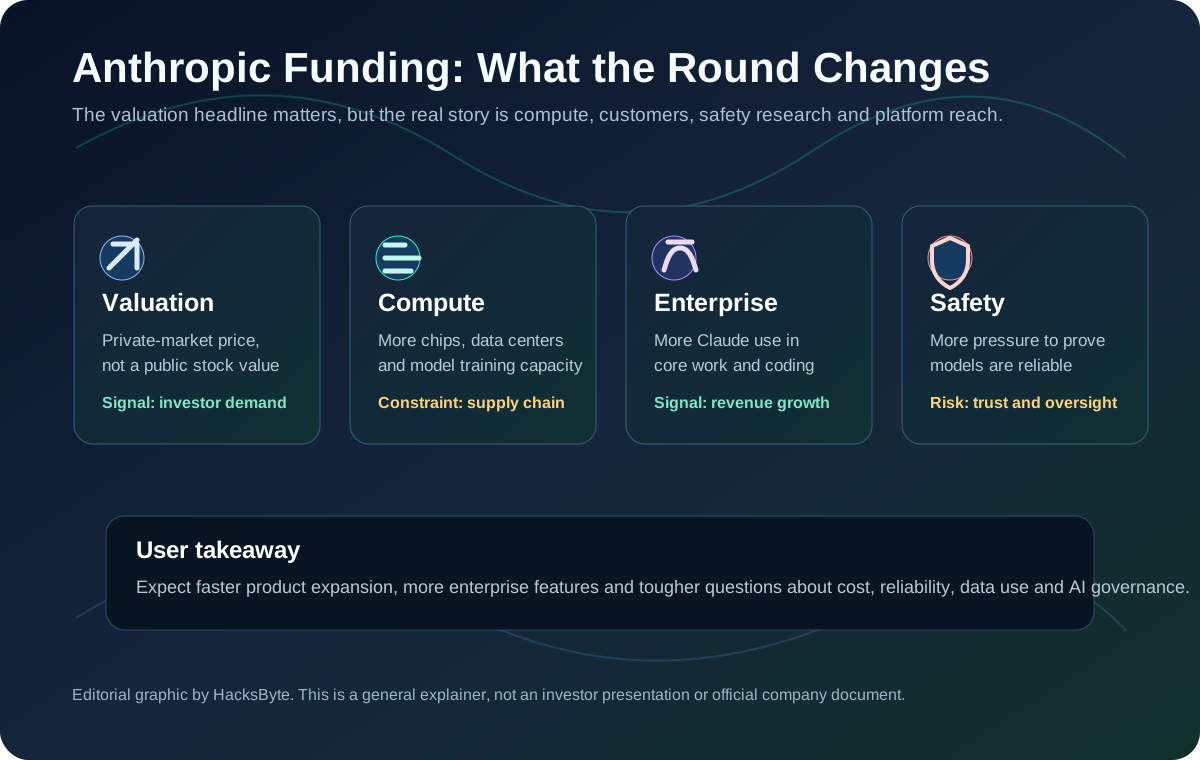
For everyday users, the headline does not mean Claude suddenly changes overnight. It means Anthropic has more capital to compete in a market where frontier AI models require huge spending on chips, data centers, talent, safety testing and enterprise support.
Users should know six things:
- This is a private funding round, not an IPO.
- The $965 billion figure is a post-money valuation, not public market capitalization.
- Anthropic says run-rate revenue crossed $47 billion earlier in May 2026.
- The funding is tied to enterprise Claude demand, Claude Code, compute expansion and safety research.
- More capital could speed up product development, but it also raises pressure to monetize AI usage.
- Businesses should still evaluate Claude on security, reliability, data controls, pricing and fit, not only on valuation.
What happened
Anthropic announced that it raised $65 billion in Series H funding at a $965 billion post-money valuation. The company said global enterprises are deploying Claude in core operations and that a growing number of people use Claude for everyday work.
The official announcement said the round was led by Altimeter Capital, Dragoneer, Greenoaks and Sequoia Capital. It also listed Capital Group, Coatue, D1 Capital Partners, GIC, ICONIQ and XN as co-leads. Other named investors included AMP PBC, Baillie Gifford, Blackstone, Brookfield, Fidelity Management & Research Company, General Catalyst, Insight Partners, Lightspeed Venture Partners, MGX, NTTVC, Qatar Investment Authority, T. Rowe Price, TPG, Wellington Management and others.
Anthropic's CFO Krishna Rao said the funding would help the company serve demand, stay at the research frontier and bring Claude to more places where work happens.
That matters because the AI race is no longer only about who has the best chatbot. It is about who can pay for enough compute, distribution, safety testing, enterprise support and model development to keep improving products at scale.
Why the valuation matters
A $965 billion private valuation puts Anthropic into territory normally associated with the world's largest public technology companies. Private valuations are not the same as public stock prices, but they influence hiring, partnerships, investor expectations, customer confidence and competitive pressure.
The valuation also changes the AI startup leaderboard. AP reported in October 2025 that OpenAI reached a $500 billion valuation after a secondary stock sale, while xAI, Perplexity, Mistral and other AI startups have been reported far below Anthropic's new level. Based on public reports available on May 31, 2026, Anthropic is now the most valuable AI startup.
The more important question is whether the business can grow into that valuation. Anthropic says run-rate revenue crossed $47 billion earlier this month. Run-rate revenue annualizes current revenue pace; it is not the same as audited annual revenue, profit or free cash flow. Still, the figure signals how quickly enterprise and developer demand for Claude has scaled.
What Anthropic will likely use the money for
Anthropic says the latest funding is expected to support four broad areas:
| Area | Why it matters |
|---|---|
| Safety and interpretability research | Anthropic has long positioned AI safety as central to its identity. Larger models and wider deployment increase the need for testing, monitoring and explanation. |
| Compute expansion | Training and serving frontier models requires large amounts of GPUs, custom chips, cloud capacity, electricity and data-center access. |
| Claude product scaling | Claude is now used by individuals, teams, developers and enterprises. More users require reliability, support, integrations and capacity. |
| Partnerships | Anthropic distributes through its own products and through cloud platforms such as Amazon Bedrock and Google Cloud Vertex AI. |
The funding does not guarantee lower prices or unlimited access. In AI, more capital often goes first toward infrastructure and model development rather than immediate consumer discounts.
Why Claude is central to the story
Anthropic's product is Claude, a family of AI models and tools used for writing, research, coding, analysis, customer support, legal review, security work and enterprise knowledge tasks.
The official Claude site highlights products such as:
- Claude for general AI assistance.
- Claude Code for software development.
- Claude for Slack and Microsoft 365.
- Claude for Chrome.
- Claude Security.
- Team and Enterprise plans.
- API access for developers.
Anthropic's Claude 4 announcement described Claude Code as generally available and said it supports background tasks through GitHub Actions plus integrations with VS Code and JetBrains. The same Claude 4 release said Opus 4 and Sonnet 4 were available through Claude, Anthropic's API, Amazon Bedrock and Google Cloud Vertex AI.
That distribution matters. If Claude is available through major cloud platforms and everyday workplace tools, enterprises can adopt it without rebuilding their entire stack.
What this means for users
For regular Claude users, the funding could lead to:
- Faster model improvements.
- More capacity during peak usage.
- Better coding, document and research features.
- More integrations with workplace tools.
- New paid tiers or enterprise features.
- More AI safety and reliability work.
But users should not assume every improvement will be free. Serving advanced AI models is expensive. A company valued near $1 trillion will face pressure to convert usage into revenue, especially from enterprise customers and heavy individual users.
Users should watch for:
- Changes to Claude plan limits.
- New premium features.
- Differences between free, Pro, Max, Team and Enterprise plans.
- Data-use settings and retention policies.
- Availability of the strongest models in their country or plan.
- Whether connectors or workplace integrations require admin approval.
What this means for businesses
For businesses, the funding makes Anthropic harder to ignore. Claude is no longer just a consumer AI assistant; it is a major enterprise AI platform with enough capital to compete for large customers.
Businesses should still do normal diligence:
- Security review: encryption, access controls, audit logs and admin controls.
- Data controls: retention, training use, data residency and deletion.
- Reliability: uptime, rate limits, incident response and support.
- Model evaluation: accuracy, hallucination risk, bias, refusal behavior and domain fit.
- Workflow fit: how Claude integrates into Slack, Microsoft 365, browsers, IDEs, ticketing, knowledge systems and cloud platforms.
- Cost control: per-seat pricing, API spend, token usage, overage risk and budget alerts.
- Governance: human review for high-impact decisions and clear ownership for AI-assisted work.
The right procurement question is not "is Anthropic valuable?" It is "does Claude improve this workflow safely, measurably and at an acceptable cost?"
What this means for developers
Developers are a major part of Anthropic's growth story. Claude Code has become one of Anthropic's most important products because coding workflows are high-value, measurable and easy to connect to enterprise budgets.
The funding could mean:
- More Claude Code integrations.
- More background task and agentic coding features.
- Better API tooling.
- More model capacity for long coding tasks.
- Deeper cloud deployment paths through Amazon and Google.
- Stronger enterprise controls for software teams.
Developers should still keep guardrails:
- Review generated code before merging.
- Run tests and security scans.
- Avoid exposing secrets, tokens or customer data.
- Use least-privilege permissions for AI coding agents.
- Track which model generated or modified critical code.
- Keep humans responsible for architecture, security and production changes.
How Anthropic compares with OpenAI and others
The AI funding race has several layers:
- OpenAI has ChatGPT, enterprise products, developer APIs and a major Microsoft partnership.
- Anthropic has Claude, Claude Code, enterprise adoption and large cloud partnerships.
- Google has Gemini and its own cloud and data-center infrastructure.
- xAI, Mistral, Perplexity and other startups compete in models, search, enterprise tools and developer platforms.
Anthropic's $965 billion post-money valuation gives it a huge headline advantage among private AI startups. But valuation does not settle the product race. Customers will still compare model quality, price, speed, coding performance, safety behavior, enterprise controls, ecosystem fit and contract terms.
The competition is likely to intensify, not slow down. Frontier AI companies need constant capital because model training and inference are expensive. The most important bottlenecks are compute, energy, talent, distribution and trust.
Risks behind the headline
The funding round is a vote of confidence, but it does not remove risk.
Key risks include:
- Valuation risk: a private valuation can fall if revenue, margins or investor appetite change.
- Compute risk: demand for chips and data-center power can outpace supply.
- Cost risk: serving AI models can be expensive even when revenue grows quickly.
- Safety risk: more powerful systems increase pressure for testing, monitoring and incident response.
- Enterprise risk: companies may pilot AI widely but scale only where ROI is proven.
- Regulatory risk: AI rules are evolving in the U.S., Europe and other markets.
- Competition risk: OpenAI, Google and others can improve models or cut prices.
- Trust risk: enterprise customers need confidence about data handling, reliability and vendor lock-in.
For users, the practical risk is simpler: do not treat a valuation as proof that an AI answer is correct. Claude outputs still need verification when they affect money, health, legal decisions, code, safety or business operations.
What to watch next
The next signals will show whether the funding is translating into durable business value:
- Claude usage limits and pricing changes.
- Expansion of Claude Code and enterprise coding tools.
- New Claude models or reasoning features.
- Cloud availability through Amazon Bedrock and Google Cloud Vertex AI.
- Enterprise customer announcements.
- Safety and interpretability research updates.
- Data-center and compute partnerships.
- Any signs of IPO preparation or secondary share sales.
- Regulatory attention around frontier AI deployment.
- Whether revenue growth is matched by better margins.
Media and related learning
Anthropic's official video below shows how the company presents Claude in everyday work contexts. It is not a funding video, but it helps explain why investors are focusing on Claude adoption.
For developer context, Anthropic also published an official video on Claude Code and GitHub Actions:
FAQ
Did Anthropic raise $65 billion?
Yes. Anthropic announced a $65 billion Series H funding round on May 28, 2026.
What is Anthropic's valuation now?
Anthropic said the round valued the company at $965 billion post-money. Post-money means the valuation after including the new investment.
Is Anthropic public?
No. Anthropic is still privately held. Users cannot buy ordinary public shares the way they can buy shares of a listed company.
Does this make Anthropic more valuable than OpenAI?
Based on publicly reported private valuations available on May 31, 2026, Anthropic's $965 billion post-money valuation is higher than OpenAI's latest widely reported private valuation. Private valuations can change and are not the same as public market prices.
Will Claude become cheaper?
Not necessarily. The funding gives Anthropic more resources, but advanced AI systems are expensive to train and operate. Users should watch plan limits, API pricing and enterprise contract terms.
Why do AI companies need so much money?
Frontier AI requires expensive compute, data centers, cloud contracts, research teams, safety testing, product engineering and enterprise support. Serving millions of users also creates ongoing infrastructure costs.
What is Claude Code?
Claude Code is Anthropic's coding product for developers. Anthropic says it supports workflows such as pair programming, background tasks through GitHub Actions and integrations with VS Code and JetBrains.
What should businesses do now?
Businesses should evaluate Claude like any high-impact software platform: define the workflow, test quality, review data controls, calculate cost, train users and add human review for consequential decisions.
Sources
- Anthropic: Anthropic raises $65B in Series H funding at $965B post-money valuation
- Anthropic: Claude product page
- Anthropic: Introducing Claude 4
- Anthropic YouTube: A day with Claude
- Anthropic YouTube: Claude Code + GitHub Actions
- AP: OpenAI now worth $500 billion, possibly making it the world's most valuable startup
Before you move on
Global AI workflow guidance. Use this short checklist to turn the article into action.
- Check whether the tool can access private files or account data.
- Verify factual claims against primary sources before publishing.
- Keep a human review step for work that affects money, school, or customers.
This guide is written for practical user safety. For account, platform, or legal decisions, confirm critical steps with the official help center or your service provider.