

A detailed SEO guide to Internet of Things examples, covering smart homes, wearables, healthcare, agriculture, manufacturing, transportation, smart cities, retail, energy, IoT security, official media, videos, and FAQs.
Last checked: May 21, 2026. This article uses official and primary sources from NIST, CISA, DHS, FCC documentation, Cisco, Microsoft, and related standards/security references where relevant. Feature image credit: official NIST image "Cyber-physical systems vs. internet of things" from nist.gov. Credit: National Institute of Standards and Technology, U.S. Department of Commerce.
Internet of Things examples are all around us: smart thermostats that learn when to heat a home, watches that track heart rate, security cameras that send alerts to phones, cars that report maintenance needs, factory sensors that predict machine failure, farm systems that measure soil moisture, smart meters that help utilities balance energy demand, and hospital devices that monitor patients. The phrase "Internet of Things," usually shortened to IoT, describes physical objects that connect to networks, collect or exchange data, and often trigger actions in the physical world.
The simplest way to understand IoT is this: the internet used to connect mostly people and computers. IoT connects everyday things. A "thing" might be a light bulb, pump, refrigerator, shipping pallet, vehicle, watch, traffic signal, medical device, industrial robot, parking meter, door lock, farm sensor, or building controller. When that object has sensors, software, connectivity, and a way to send or receive data, it becomes part of the Internet of Things.
This detailed guide explains practical Internet of Things examples across homes, workplaces, cities, healthcare, agriculture, transportation, energy, retail, manufacturing, public safety, and environmental monitoring. It also covers how IoT works, why examples matter, benefits, risks, privacy concerns, security tips, official media, videos, FAQs, and source links.
Quick Answer: Internet of Things Examples
Internet of Things examples include smart speakers, smart thermostats, connected doorbells, fitness trackers, smart watches, smart TVs, connected cars, smart meters, industrial sensors, smart irrigation systems, hospital infusion pumps, asset trackers, warehouse robots, connected traffic lights, air quality sensors, smart parking systems, building automation systems, and predictive maintenance sensors in factories.
The common pattern is simple. An IoT device senses something, connects to a network, sends data to another system, receives instructions, or triggers an action. A smart thermostat senses temperature and occupancy, then adjusts heating or cooling. A wearable senses movement and heart rate, then shows health trends. A factory vibration sensor detects unusual machine behavior, then alerts maintenance teams before a breakdown.
CISA describes the Internet of Things as objects or devices that automatically send and receive data through the internet. NIST emphasizes that IoT affects everyday life and can enable a fully connected world, while also creating privacy, security, reliability, and trust challenges.
Official Media and Videos
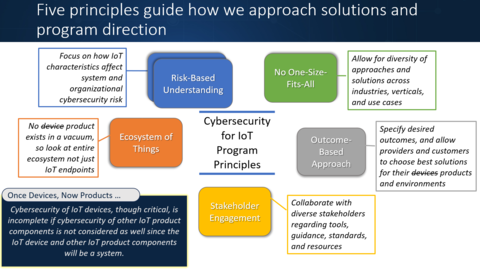
The image below is an official NIST cybersecurity for IoT program image showing five principles behind NIST's IoT cybersecurity approach. It is included as supporting media with credit.
The following official NIST video explains what the Internet of Things is and why securing it matters.
For additional video context, Cisco maintains an official IoT video portal with industry examples, including industrial IoT and autonomous systems:
- Cisco IoT video portal: https://video.cisco.com/category/videos/iot---internet-of-things_
How the Internet of Things Works
Most IoT systems include five basic parts: a physical thing, sensors or actuators, connectivity, software, and a user or business process.
The physical thing is the object being monitored or controlled. It might be a thermostat, machine, truck, water pump, glucose monitor, crop field, elevator, or streetlight.
Sensors collect information. They may measure temperature, pressure, vibration, motion, sound, location, humidity, light, current, voltage, air quality, water flow, heart rate, or machine state. Actuators do something physically, such as unlocking a door, opening a valve, dimming a light, sounding an alarm, or stopping a machine.
Connectivity moves data. Devices may use Wi-Fi, Bluetooth, cellular, Ethernet, Zigbee, Z-Wave, LoRaWAN, satellite, or industrial networks. The right connection depends on distance, power, bandwidth, cost, reliability, and environment.
Software processes the data. That software may run on the device, an edge gateway, a cloud platform, a local server, or a mobile app. It may store data, analyze trends, trigger alerts, run machine learning models, or integrate with business systems.
The value comes from action. A smart sensor that only collects data is less useful than a system that helps a person or machine make a better decision.
1. Smart Thermostats
Smart thermostats are one of the most familiar Internet of Things examples. They connect to heating and cooling systems, monitor temperature, learn schedules, and can be controlled from a mobile app. Some use occupancy sensing, weather data, and energy pricing signals to reduce energy waste.
The IoT value is convenience and efficiency. Instead of manually adjusting the thermostat, users can automate comfort and save energy. Utilities can also use connected thermostat programs to reduce peak demand when customers opt in.
The risk is that thermostat data can reveal when people are home, asleep, or away. Strong account security and device updates matter.
2. Smart Speakers and Voice Assistants
Smart speakers connect microphones, cloud services, music apps, home automation, and voice control. They can set timers, control lights, answer questions, play music, manage reminders, and interact with other smart devices.
They are useful because voice is a natural interface. The risk is privacy. A device with microphones inside a home or office needs clear controls for recordings, account access, device sharing, and connected services.
3. Smart Doorbells and Security Cameras
Video doorbells and smart cameras detect motion, record video, send alerts, and let users view live footage remotely. They are common IoT examples because they combine sensors, video, cloud storage, mobile apps, and home security workflows.
These devices can improve awareness, but they also raise privacy and security questions. Poorly secured cameras can expose video feeds, and neighborhood sharing features can affect people who never bought the device.
4. Smart Locks
Smart locks let users lock and unlock doors with phones, PINs, biometrics, keypads, or remote access. They can create temporary codes for guests, cleaners, deliveries, or maintenance workers.
The benefit is access control. The risk is that a weak account, reused PIN, outdated firmware, or insecure integration can become a physical security issue. A smart lock should have strong authentication, logs, mechanical backup, and secure update support.
5. Smart Lighting
Smart bulbs and lighting systems can be controlled from apps, schedules, sensors, or voice assistants. They can adjust brightness, color, and timing based on occupancy, daylight, or scenes.
Homes use them for comfort and automation. Buildings use them for energy savings. Cities use connected streetlights for adaptive lighting and maintenance monitoring.
6. Smart Plugs and Outlets
Smart plugs turn ordinary lamps, fans, appliances, or tools into controllable devices. Users can schedule power, monitor energy usage, and turn devices on or off remotely.
They are simple IoT examples because they show how connectivity can be added to older objects. However, users should avoid overloading smart plugs and should buy from reputable manufacturers with safety certification.
7. Smart Appliances
Connected refrigerators, washing machines, ovens, dishwashers, and air conditioners can send maintenance alerts, optimize cycles, download settings, or integrate with energy systems.
The best smart appliance examples solve real problems: detecting leaks, reminding users to replace filters, reducing energy use, or diagnosing failures. A weak example is an appliance that adds an app but no practical value.
8. Wearable Fitness Trackers
Fitness trackers and smart watches measure steps, heart rate, sleep, activity, workouts, and sometimes blood oxygen or ECG-style signals depending on device capabilities. They connect to mobile apps and health platforms.
Wearables are powerful IoT examples because they turn personal behavior into measurable data. They can motivate exercise and help people notice trends. They also collect sensitive health and location information, so privacy controls matter.
9. Connected Medical Devices
Healthcare IoT includes wireless infusion pumps, remote patient monitoring devices, connected blood pressure cuffs, glucose monitors, smart inhalers, implantable devices, and hospital asset trackers. NIST and CISA both discuss medical and healthcare-related IoT risks because these devices can affect patient safety.
The benefit is better monitoring and faster care. The risk is higher than consumer convenience devices because failure, data exposure, or unauthorized access can affect health outcomes.
10. Remote Patient Monitoring
Remote patient monitoring lets clinicians track patients outside hospitals. Devices can collect blood pressure, pulse, glucose, oxygen saturation, weight, or activity data and send it to care teams.
This can reduce hospital visits and support chronic disease management. The challenge is reliability, privacy, data accuracy, and making sure alerts do not overwhelm clinicians.
11. Connected Cars
Modern vehicles contain sensors, software, cellular connections, navigation systems, diagnostics, driver assistance systems, and app-based controls. Connected cars can report maintenance issues, update software, provide traffic data, support emergency calls, and integrate with insurance or fleet systems.
Vehicle IoT is powerful because cars are physical systems moving at speed. Security, safety, update quality, and data governance are essential.
12. Fleet Tracking
Delivery companies, trucking fleets, rental services, public transit operators, and emergency services use IoT trackers to monitor vehicle location, fuel use, driver behavior, maintenance needs, temperature, cargo status, and route efficiency.
Fleet IoT can reduce cost and improve safety. It can also create worker privacy concerns if monitoring is excessive or unclear.
13. Smart Parking
Smart parking systems use sensors, cameras, meters, and apps to show available spaces, guide drivers, manage pricing, and enforce parking rules. CISA gives parking guidance as an IoT-style example: devices can direct a car to an open spot.
The benefit is reduced congestion and wasted fuel. The tradeoff is the need for accurate sensors, fair pricing, and protection of location data.
14. Traffic Lights and Smart Intersections
Smart traffic systems use cameras, road sensors, connected signals, and analytics to adjust light timing, prioritize emergency vehicles, improve pedestrian safety, and reduce congestion.
These systems are city-scale IoT examples. They can improve transportation flow but need resilience because failures can affect public safety.
15. Public Transit Sensors
Buses, trains, stations, and transit infrastructure can use IoT for vehicle location, passenger counts, predictive arrival times, equipment health, air quality, fare systems, and safety monitoring.
The best use cases improve reliability and rider experience. Data should be handled carefully because transit movement data can reveal sensitive patterns.
16. Smart Streetlights
Connected streetlights can dim when streets are empty, brighten when motion is detected, report outages, monitor energy use, and support other city sensors. They reduce manual inspection and energy waste.
Smart streetlights are often part of broader smart city infrastructure. Cities should avoid turning lighting networks into uncontrolled surveillance networks without public oversight.
17. Air Quality Sensors
IoT air quality sensors measure particulate matter, gases, temperature, humidity, and pollution trends. Cities, schools, factories, and homes use them to understand indoor and outdoor environmental conditions.
These systems help identify health risks and guide decisions. Accuracy, calibration, placement, and interpretation are important because cheap sensors can produce misleading data.
18. Smart Water Meters
Smart water meters measure usage, detect leaks, and send readings automatically. Utilities can reduce manual meter reading, detect abnormal consumption, and help customers find leaks earlier.
Water IoT examples are valuable because small leaks can waste large amounts of water and cause property damage.
19. Smart Electric Meters
Smart meters collect electricity usage data and communicate with utilities. They support remote readings, outage detection, dynamic pricing, demand response, and distributed energy planning.
The benefit is grid visibility. The privacy issue is that fine-grained energy data can reveal occupancy and behavior patterns if mishandled.
20. Smart Grids
Smart grids use sensors, connected meters, automated switches, distributed energy resources, and analytics to improve reliability and efficiency. They help utilities manage solar, batteries, electric vehicle charging, and changing demand.
This is IoT at critical infrastructure scale. Security and resilience are central because grid systems affect everyday life and economic activity.
21. Industrial Predictive Maintenance
Factories use vibration sensors, temperature sensors, acoustic sensors, oil quality sensors, and current monitors to predict equipment failure. Instead of waiting for a machine to break, teams can repair it when data shows early warning signs.
This is one of the strongest industrial IoT examples because downtime is expensive. Predictive maintenance can save money, improve safety, and extend equipment life.
22. Connected Robots
Manufacturing robots, warehouse robots, inspection robots, and autonomous mobile robots use sensors and network connections to coordinate tasks, report status, and improve automation.
Robot IoT examples combine the physical and digital world directly. Strong safety controls are essential because robots act in shared spaces with people and equipment.
23. Factory Energy Monitoring
Industrial facilities use IoT meters to monitor energy usage across machines, lines, compressors, HVAC systems, and lighting. This helps identify waste, reduce costs, and support sustainability goals.
Energy monitoring is often a practical first step toward smart manufacturing because it produces measurable business value.
24. Warehouse Asset Tracking
Warehouses use RFID tags, Bluetooth beacons, barcode systems, computer vision, and connected scanners to locate inventory, pallets, tools, forklifts, and shipments.
Asset tracking reduces loss and improves operations. The system needs good data hygiene because bad location data can disrupt fulfillment.
25. Cold Chain Monitoring
Food, vaccines, medicines, and sensitive materials often need temperature-controlled shipping. IoT sensors can monitor temperature, humidity, shock, and location during transport.
Cold chain IoT prevents spoilage and improves compliance. It also creates evidence when goods were stored or shipped improperly.
26. Smart Agriculture
Farms use IoT sensors for soil moisture, weather, irrigation, livestock tracking, greenhouse controls, crop health, equipment monitoring, and water use. Smart irrigation systems can water crops only when needed.
Agricultural IoT improves yield, conserves water, and helps farmers respond to changing conditions. Rural connectivity and device durability are key challenges.
27. Livestock Monitoring
Connected tags and collars can track animal location, activity, temperature, feeding patterns, and health indicators. Farmers can detect illness, manage grazing, and locate animals more efficiently.
The benefit is earlier intervention and better herd management. Devices must be rugged, low-power, and reliable.
28. Smart Greenhouses
Greenhouses use sensors and actuators to manage temperature, humidity, irrigation, lighting, ventilation, and nutrients. Automation helps maintain stable growing conditions.
This is a clear IoT example because sensors directly trigger physical changes to support plant growth.
29. Retail Inventory Sensors
Retail IoT includes smart shelves, RFID inventory systems, digital price tags, foot traffic sensors, beacons, and checkout automation. Stores use these systems to reduce out-of-stock items, optimize layouts, and improve operations.
Retailers must balance operational data with customer privacy, especially when location tracking or cameras are involved.
30. Smart Payment Terminals
Modern payment terminals are connected devices that process transactions, receive updates, monitor tampering, and integrate with point-of-sale systems.
They are often overlooked IoT examples because they feel like normal business equipment. Security is crucial because payment data is sensitive.
31. Connected Vending Machines
Connected vending machines can report inventory, temperature, payment status, maintenance needs, and sales trends. Operators can restock efficiently and fix problems faster.
This is a simple commercial IoT example with clear business value.
32. Smart Buildings
Smart buildings connect HVAC, lighting, access control, elevators, occupancy sensors, air quality monitors, security systems, and energy management platforms. The goal is comfort, efficiency, safety, and operational visibility.
Smart building IoT can reduce energy costs and improve maintenance. It also expands the attack surface because building systems that were once isolated may become network-connected.
33. Elevator and Escalator Monitoring
Connected elevators and escalators can report faults, vibration patterns, usage counts, door issues, and maintenance needs. Building owners can reduce downtime and improve safety.
Predictive maintenance is valuable here because failures inconvenience many people and can create safety risks.
34. Smart Hotels
Hotels use IoT for keyless entry, smart thermostats, occupancy sensors, connected TVs, energy management, service alerts, and guest personalization.
The guest benefit is convenience. The hotel benefit is operational efficiency. The privacy risk is that room occupancy and behavior data can be sensitive.
35. Smart Schools
Schools can use connected locks, cameras, HVAC systems, attendance systems, air quality sensors, buses, and emergency alert devices. IoT can improve safety and comfort.
Schools must apply strict privacy and security controls because children, staff, and education records are involved.
36. Public Safety Sensors
Public safety IoT includes flood sensors, wildfire sensors, emergency alert systems, connected sirens, environmental monitors, and first responder tracking. These systems help authorities detect and respond to incidents faster.
Reliability matters because public safety systems must work during emergencies.
37. Smart Waste Management
Connected trash bins can measure fill levels and help cities schedule collection routes efficiently. This reduces unnecessary trips and prevents overflowing bins.
The concept is simple: sensors tell the city where service is actually needed.
38. Environmental Monitoring
IoT devices can monitor rivers, forests, oceans, wildlife habitats, weather stations, pollution, noise, and soil conditions. Researchers and governments use this data to understand environmental changes.
Environmental IoT often needs low-power devices, rugged hardware, remote connectivity, and careful calibration.
39. Smart Mining and Oil Fields
Industrial sites use IoT sensors to monitor equipment, worker safety, pipelines, pressure, temperature, gas levels, and remote assets. These environments are often dangerous and difficult to inspect manually.
The benefit is safety and operational visibility. The risk is that failures can affect workers and the environment.
40. Supply Chain Tracking
IoT tags and sensors track goods through manufacturing, shipping, warehouses, ports, trucks, and stores. They can report location, temperature, humidity, shock, opening events, and delays.
Supply chain IoT helps businesses know where goods are and whether they were handled correctly.
41. Smart Toys
Connected toys may use microphones, speakers, apps, cameras, or cloud services. They can respond to children, update content, and interact with mobile apps.
Smart toys are sensitive IoT examples because children are involved. Privacy, parental controls, data retention, and security updates are essential.
42. Pet Trackers
Pet collars and trackers use GPS, cellular, Bluetooth, or Wi-Fi to help owners locate pets, monitor activity, and sometimes track health trends.
They are consumer-friendly IoT examples because the value is easy to understand: know where a pet is and whether it is active.
43. Smart Irrigation at Home
Home irrigation controllers use weather data, soil sensors, schedules, and local rules to water lawns and gardens efficiently. They reduce water waste and can prevent overwatering.
This example shows how IoT can connect local physical conditions with online data.
44. Connected Printers
Networked printers can report toner levels, receive print jobs, scan to cloud services, and update firmware. They are common in homes and offices.
Printers are also common security weak points. Change default passwords, update firmware, and restrict access.
45. Home Routers and Mesh Wi-Fi
Routers are foundational connected devices. Modern routers and mesh systems include app control, parental controls, guest networks, device lists, automatic updates, and threat detection features.
The router is not just another IoT device; it is the network gateway many IoT devices depend on. Securing it should be a priority.
Benefits of Internet of Things Examples
IoT creates value in several ways. It improves visibility by measuring things that used to be invisible. It improves automation by letting systems act without manual input. It improves efficiency by reducing waste, downtime, and unnecessary travel. It improves safety by detecting problems earlier. It improves convenience by making everyday devices easier to control.
The best Internet of Things examples solve a real problem. A connected pump that prevents flooding is useful. A connected factory sensor that prevents downtime is useful. A smart medical device that improves monitoring is useful. An app-connected object that adds complexity without value is not enough.
Risks of Internet of Things Devices
IoT risks come from scale, connectivity, weak security, physical impact, and sensitive data. CISA warns that interconnectedness increases consequences and creates new risks. Attackers can exploit weak devices, steal data, build botnets, disrupt services, or affect physical systems.
Common risks include:
- Default passwords.
- Infrequent updates.
- Weak encryption.
- Insecure mobile apps.
- Poor cloud security.
- Excessive data collection.
- Long device lifetimes without support.
- Publicly exposed services.
- Weak authentication.
- Unclear privacy policies.
IoT is different from ordinary software because devices may stay in homes, factories, hospitals, and cities for years.
How to Secure IoT Devices
For consumers, start with the basics. Change default passwords. Use strong unique passwords. Turn on multifactor authentication where available. Keep device firmware and apps updated. Put smart home devices on a guest network if your router supports it. Disable features you do not use. Buy from manufacturers that provide security updates. Remove devices you no longer need.
For businesses, create an asset inventory. Know what devices exist, who owns them, what data they collect, how they update, which networks they use, and when support ends. Segment networks, monitor unusual traffic, manage identities, test updates, and include IoT in incident response plans.
For cities and critical infrastructure, procurement matters. Security requirements should be written into contracts before devices are deployed.
Future of Internet of Things
The future of IoT will be shaped by edge AI, better sensors, 5G and private networks, smart grids, autonomous vehicles, digital twins, robotics, healthcare monitoring, energy management, and stronger cybersecurity labels and standards.
The most important trend is not just more devices. It is more decision-making at the edge. Instead of every sensor sending raw data to the cloud, devices and gateways increasingly analyze data locally and send only useful events. This can reduce latency, improve privacy, save bandwidth, and make systems more resilient.
Security will also become more visible. Programs such as consumer IoT cybersecurity labeling and NIST IoT guidance are part of a broader shift toward making device trust easier for buyers to understand.
SEO Summary: Internet of Things Examples in Plain English
Internet of Things examples include smart thermostats, doorbells, cameras, wearables, connected medical devices, smart meters, industrial sensors, smart agriculture, fleet tracking, smart parking, connected cars, smart buildings, retail sensors, warehouse trackers, and environmental monitors. These devices connect the physical world to software by using sensors, networks, data, and automation.
The biggest benefits are convenience, efficiency, safety, visibility, predictive maintenance, energy savings, and better decision-making. The biggest risks are privacy loss, weak passwords, insecure updates, exposed networks, data misuse, and physical consequences when connected systems fail.
The best IoT device is not the one with the most features. It is the one that solves a real problem, protects data, receives updates, and remains reliable over its lifetime.
Frequently Asked Questions
What are the most common Internet of Things examples?
Common IoT examples include smart speakers, smart thermostats, smart TVs, fitness trackers, smart watches, smart lights, connected doorbells, security cameras, smart locks, connected cars, smart meters, and industrial sensors.
What is an IoT device in simple words?
An IoT device is a physical object that connects to a network and sends or receives data. It often uses sensors, software, and an app or cloud service.
Is a smartphone an IoT device?
A smartphone is connected and sensor-rich, but it is usually treated as a general computing device rather than a typical IoT device. However, phones often control, configure, and collect data from IoT devices.
Is a smart TV an IoT device?
Yes. A smart TV connects to the internet, runs software, collects usage data, streams content, receives updates, and often connects to other home systems.
What are examples of IoT in healthcare?
Healthcare IoT examples include remote patient monitors, connected blood pressure cuffs, glucose monitors, smart inhalers, wireless infusion pumps, hospital asset trackers, and wearable health devices.
What are examples of IoT in agriculture?
Agricultural IoT examples include soil moisture sensors, smart irrigation systems, livestock trackers, weather stations, greenhouse controls, equipment monitors, and crop health sensors.
What are examples of industrial IoT?
Industrial IoT examples include predictive maintenance sensors, connected robots, factory energy monitors, asset trackers, pressure sensors, vibration sensors, remote equipment monitors, and warehouse automation systems.
Why is IoT security important?
IoT security is important because connected devices collect data and may affect physical systems. A weak device can expose private information, join a botnet, disrupt operations, or create safety risks.
How do I make smart home devices safer?
Use strong passwords, update firmware, enable MFA where available, use a guest network, disable unused features, buy from reputable vendors, and remove devices that no longer receive support.
Final Takeaway
Internet of Things examples show how deeply connected devices have entered everyday life and industry. The same basic idea appears everywhere: a physical object senses the world, connects to software, shares data, and helps people or systems act.
Smart homes make daily life more convenient. Wearables make health trends visible. Smart meters help utilities manage resources. Industrial sensors prevent downtime. Farm sensors save water. Connected medical devices support care. Smart city systems improve traffic, lighting, and public services.
The opportunity is real, but so are the risks. Every connected thing needs security, privacy, updates, and a clear reason to exist. IoT is most valuable when it solves a real-world problem while protecting the people and systems it connects.
Sources and Official References
- NIST Internet of Things topic page: https://www.nist.gov/internet-things-iot
- NIST Cybersecurity for IoT Program: https://www.nist.gov/itl/applied-cybersecurity/nist-cybersecurity-iot-program
- NIST video, What is the Internet of Things and how can we secure it: https://www.nist.gov/video/what-internet-things-iot-and-how-can-we-secure-it-0
- NIST image, Cyber-physical systems vs. internet of things: https://www.nist.gov/image/cyber-physical-systems-vs-internet-things
- CISA, Securing the Internet of Things: https://www.cisa.gov/news-events/news/securing-internet-things-iot
- DHS, Securing the Internet of Things: https://www.dhs.gov/securingtheIoT
- FCC Cybersecurity Labeling for Internet of Things rulemaking: https://docs.fcc.gov/public/attachments/FCC-24-26A1_Rcd.pdf
- Cisco, What is IoT: https://www.cisco.com/c/en/us/solutions/internet-of-things/what-is-iot.html
- Cisco Industrial IoT overview: https://www.cisco.com/c/en/us/solutions/internet-of-things/what-is-industrial-iot.html
- Microsoft guide to the Internet of Things: https://news.microsoft.com/europe/2017/06/14/easy-guide-internet-things/
Before you move on
Global AI workflow guidance. Use this short checklist to turn the article into action.
- Check whether the tool can access private files or account data.
- Verify factual claims against primary sources before publishing.
- Keep a human review step for work that affects money, school, or customers.
This guide is written for practical user safety. For account, platform, or legal decisions, confirm critical steps with the official help center or your service provider.