
Ultrahuman says an unauthorized party accessed an internal analytics system in March 2026, exposing some customer account, order and fitness-related data. Here is what is confirmed, what remains unclear, and what users should do now.
Last checked: June 4, 2026. This article uses TechCrunch's June 3 report as the primary source and cross-checks it with Ultrahuman's official March 2026 security-incident notice, Gadgets & Wearables, 9to5Google, Mozilla Foundation privacy research, FTC phishing guidance and HHS health-app privacy guidance. HacksByte has not seen evidence that passwords, payment cards, production systems or Ultrahuman Ring devices were compromised.
Quick answer
Ultrahuman, the wearable health-tech company behind the Ring Air and Ring Pro, says an unauthorized third party accessed an internal analytics system on March 27, 2026. The company says the system was used internally, access was read-only, and the incident did not involve passwords, payment details, credit card data, production systems or Ultrahuman Ring devices.
TechCrunch reported on June 3, 2026 that attackers gained access after stealing an employee's credentials from a malware-infected laptop. Ultrahuman told TechCrunch that wellness data belonging to about 0.1% of users was accessed. Based on Ultrahuman's previously reported 700,000 monthly active users, TechCrunch estimated that this could mean at least 700 people, though Ultrahuman declined to provide an exact number.
Ultrahuman's official notice says affected data varied by account. It may have included contact and account details, order and transaction history, and for a smaller group, fitness-related data connected with product use and purchases.
For users, the main immediate risk is targeted phishing: a scammer who knows your email, order history or product usage could send messages that look more convincing than generic spam. If you received the Ultrahuman security email, do not click links in unexpected messages, do not share payment or health details by email or SMS, and contact Ultrahuman through official channels if something looks suspicious.
What happened
Ultrahuman published a public notice titled "Notice of a security incident - March 2026," last updated June 2, 2026. The company said the incident affected its systems on March 27, 2026 and involved an internal analytics system.
According to Ultrahuman, the unauthorized party could view data in that system but could not modify or delete data. The company says it identified the issue promptly, took the affected system offline, revoked access and later notified affected users by email.
TechCrunch added a key detail not fully explained in the public notice: Ultrahuman told the outlet that the attackers used credentials stolen from an employee's malware-infected laptop. That makes this an internal-tool access incident rather than a direct compromise of the smart ring itself.
The distinction matters. The ring and app may continue working normally, but the incident still shows how sensitive wearable data can be exposed through back-office systems, employee devices and analytics tooling.
Timeline
| Date | What happened | Why it matters |
|---|---|---|
| March 27, 2026 | Ultrahuman says an unauthorized third party accessed an internal analytics system. | This is the breach date listed in the company notice. |
| March 27, 2026 onward | Ultrahuman says it took the system offline, revoked access and investigated scope. | The company says access was contained, but the full scope took time to determine. |
| June 2, 2026 | Ultrahuman's public notice was last updated and affected-user notifications began on or after this date. | Users were notified more than two months after the incident date. |
| June 3, 2026 | TechCrunch reported that attackers used employee credentials stolen by malware and that about 0.1% of users had wellness data accessed. | This added attack-path and scale context. |
| June 4, 2026 | HacksByte reviewed the public notice and reporting for this article. | No public evidence reviewed here confirms misuse or publication of the data. |
What data may have been accessed
Ultrahuman says the affected information varied by account. The company's public notice lists these broad categories:
| Category | What it could mean for users |
|---|---|
| Contact and account details | Name, email, phone or account identifiers may make phishing more personalized. |
| Order and transaction history | A fake support or delivery message could reference a real product or purchase. |
| Fitness-related data for a smaller group | Product-use and wellness context could be sensitive even if it is not payment data. |
TechCrunch reported that Ultrahuman declined to define exactly what "wellness data" means in this incident. That is an important unresolved point. Wearable products can collect or infer data about sleep, activity, recovery, heart rate, skin temperature, respiratory patterns, cycle tracking and other intimate signals, but the public notice does not list precise metrics for every affected user.
Mozilla Foundation's recent Ultrahuman Ring privacy review also underscores why this matters: the device category can involve sleep stages, heart rate, HRV, blood oxygen, skin temperature, respiratory rate, activity data, cycle and ovulation information, and self-provided health details. That does not mean every one of those data types was involved in this incident. It means the broader category of wearable wellness data is sensitive and should not be treated like ordinary marketing data.
What Ultrahuman says was not affected
Ultrahuman says the incident did not involve:
- Passwords.
- Payment details.
- Full credit card numbers, CVVs or bank credentials.
- The Ultrahuman app.
- Ultrahuman Ring devices.
- Production systems powering day-to-day user experience.
The company says the incident was confined to an internal analytics tool. Ultrahuman also says it has found no evidence that the accessed information has been published or misused.
Users should read that carefully. "No evidence of misuse" is not the same as proof that no data left the environment. TechCrunch reported that Ultrahuman declined to confirm whether its investigation determined if customer data was exfiltrated. For affected users, the safest assumption is that some data visible in the internal tool may be useful for future social-engineering attempts.
What remains unclear
Several important questions remain unanswered publicly:
| Question | Current status |
|---|---|
| How many users were affected? | Ultrahuman told TechCrunch about 0.1% of users had wellness data accessed, but declined to disclose an exact count. |
| What exact wellness metrics were visible? | Ultrahuman's public notice says fitness-related data for a smaller group, but does not list every metric. |
| Was data exfiltrated? | TechCrunch reported that Ultrahuman declined to confirm whether customer data was exfiltrated. |
| Which jurisdictions were notified? | Ultrahuman says relevant authorities were notified under applicable data-protection law, but public details are limited. |
| How long did unauthorized access last? | Ultrahuman says it identified the incident promptly, but the public notice does not provide a full timestamp window. |
| Did the malware compromise any other employee systems? | Public materials reviewed here do not provide a broader malware-forensics report. |
Those gaps do not mean the incident is worse than reported. They mean users should avoid overconfidence until the company publishes more detail or regulators release filings.
Why this incident matters
Wearables turn the body into a data stream. A smart ring can generate useful insights, but those insights often depend on cloud processing, internal dashboards, support systems, analytics systems and employee access.
That creates a trust problem. Users may think of the device as personal hardware sitting on their finger, but part of the service lives in company systems. If those systems are too broadly accessible, an employee credential theft can become a customer privacy incident.
The Ultrahuman incident highlights three broader risks:
| Risk | Why it matters |
|---|---|
| Internal-tool exposure | Back-office analytics systems can contain sensitive customer data even when production systems are not breached. |
| Employee-device compromise | Malware on one laptop can become a path into cloud tools if access controls are weak. |
| Wellness-data sensitivity | Sleep, recovery, cycle, activity and health-adjacent data can reveal habits, routines and vulnerabilities. |
This is why wellness data deserves stricter handling than ordinary app telemetry. A breached shopping receipt is annoying. A breached pattern of sleep, recovery or fitness behavior can feel much more personal.
Why phishing is the biggest user risk now
Ultrahuman says it has not found evidence of publication or misuse. Still, phishing risk rises after any incident involving contact details, order history or account context.
A convincing scam may say:
- Your Ultrahuman order needs verification.
- Your ring warranty is suspended.
- Your wellness data export is ready.
- Your account must be re-linked to Apple, Google or Facebook.
- You need to confirm payment details after the breach.
- A refund, replacement or security upgrade is available.
Those messages can be dangerous because they may reference real information. A scam that mentions your actual product or order history is easier to believe than a generic phishing email.
Ultrahuman says it will not ask users to confirm passwords, payment details or personal information by email or SMS. The FTC gives the same general advice for phishing: do not trust the contact information inside a suspicious message; go directly to the company's official website or app.
What affected Ultrahuman users should do
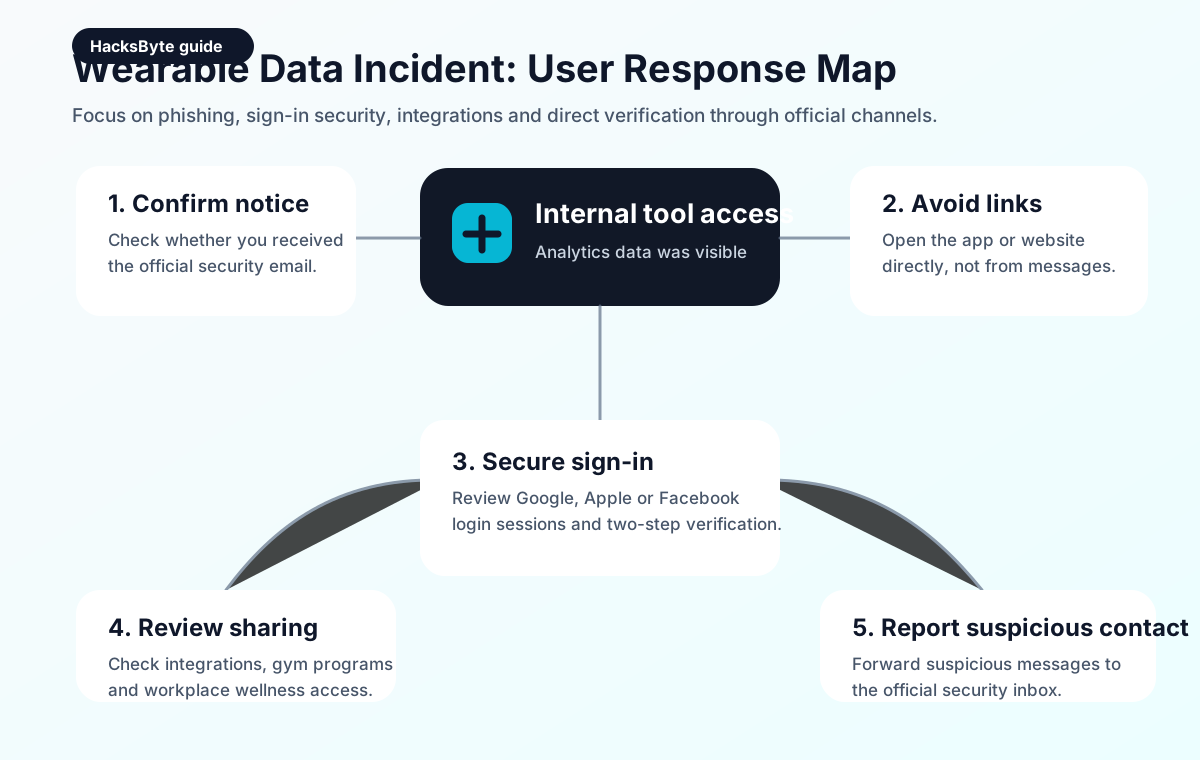
If you received an email from security-2026@ultrahuman.com about this incident, take these steps.
1. Read the notification carefully
Ultrahuman says each email lists the categories of information visible for that person's account. Do not assume every affected user had the same data exposed.
2. Do not click links in unexpected messages
Go directly to the Ultrahuman app or official website. If a message asks you to log in, verify payment, confirm health details or act urgently, treat it as suspicious.
3. Secure your sign-in provider
Ultrahuman says it uses Google, Apple or Facebook sign-in rather than storing an Ultrahuman password. Review the security settings for whichever provider you used:
- Enable two-step verification.
- Review logged-in devices.
- Remove unknown sessions.
- Check recovery email and phone details.
- Watch for suspicious sign-in alerts.
4. Watch for targeted support scams
Scammers often target users after a breach by pretending to be support, refunds, delivery teams or recovery services. Do not share health information, payment details or identity documents by email or text.
5. Check integrations and data sharing
Open the Ultrahuman app and review any third-party integrations, workplace wellness connections, gym programs or partner access. Mozilla's privacy review specifically advises users to understand what third parties can see if they use Ultrahuman through an employer, gym or other provider.
6. Ask Ultrahuman for clarification if needed
Ultrahuman says users can write to security-2026@ultrahuman.com if they are unsure whether they are affected or need more information.
What if you did not receive an email?
Ultrahuman's FAQ says affected users were notified directly on or after June 2. It also says users who did not receive the notice were not in the affected dataset, but can contact the company for confirmation.
That does not mean you should ignore basic account hygiene. If you use Ultrahuman or any wearable health app, it is still sensible to:
- Keep your Google, Apple or Facebook account protected with strong two-step verification.
- Review app integrations and connected services.
- Avoid sharing health or payment information through email or SMS.
- Keep your phone and wearable app updated.
- Be cautious with workplace wellness programs that may share data with an institution.
What businesses should learn
This incident is a useful case study for any company holding wellness, fitness, health-adjacent or behavioral data.
Internal tools need production-grade security
Companies sometimes protect the main app more carefully than analytics dashboards, support tools or admin panels. That is risky. If an internal tool can show customer data, it needs strong authentication, device posture checks, least-privilege access, export limits and audit logs.
Employee endpoints are part of the data perimeter
TechCrunch reported that the attackers used credentials from a malware-infected employee laptop. That is a reminder that endpoint security, phishing training, hardware-backed authentication and session controls are not optional when employees can access customer data.
"Read-only" access can still be damaging
Read-only access prevents tampering, but it does not prevent privacy harm. If an attacker can view or export sensitive records, the incident can still create phishing, stalking, blackmail, discrimination or reputational risks depending on the data involved.
Breach notices should define data plainly
Users should not have to guess what "wellness data" means. Strong incident notices identify categories in plain language: sleep data, heart-rate data, recovery scores, cycle data, purchase history, device identifiers, location or whatever applies.
The health-privacy angle
Not every wellness app is covered by the same health-privacy rules as a hospital or health insurer. HHS explains that, in many cases, HIPAA does not protect information users download or enter into personal mobile apps unless the app is provided by a HIPAA-covered entity or its business associate.
That matters for smart rings and wellness apps. A user may experience their data as health data, even when the legal framework treats the company differently from a doctor or clinic.
The FTC also maintains data-breach and phishing resources for consumers and businesses. For users, the practical rule is simple: treat wearable wellness data as sensitive, regardless of whether the company labels it as medical, wellness, fitness or analytics data.
Bottom line
Ultrahuman says the March 2026 incident did not compromise passwords, payment details, production systems or ring devices. That is important and reduces some immediate risk.
But the incident is still serious because an internal analytics system reportedly exposed some customer account, order and fitness-related data after an employee credential theft. Wellness data can reveal personal habits and routines, and even limited account context can make phishing more convincing.
For users, the response is practical: read your notice, avoid links in unexpected Ultrahuman messages, secure your Google/Apple/Facebook sign-in, review integrations and contact Ultrahuman directly if unsure.
For wearable companies, the lesson is broader: internal analytics tools are not low-risk back-office software. If they can see customer health-adjacent data, they need security controls worthy of that data.
Sources
- TechCrunch: Ultrahuman says hackers accessed customers' wellness data via internal tool, June 3, 2026.
- Ultrahuman: Notice of a security incident - March 2026, last updated June 2, 2026.
- Gadgets & Wearables: Ultrahuman says user data was accessed in security incident, June 3, 2026.
- 9to5Google: Ultrahuman says recent security breach did not affect passwords or credit cards, June 3, 2026.
- Mozilla Foundation: Ultrahuman Ring AIR privacy review, June 2026.
- FTC: How to recognize and avoid phishing scams.
- FTC: Data breach resources.
- HHS: Protecting health information when using personal mobile apps and devices.
Before you move on
Defensive security explainers. Use this short checklist to turn the article into action.
- Change reused passwords on important accounts.
- Enable multi-factor authentication or passkeys where available.
- Keep a separate backup for files you cannot afford to lose.
This guide is written for practical user safety. For account, platform, or legal decisions, confirm critical steps with the official help center or your service provider.