

The White House delayed a planned AI cybersecurity executive order after concerns that pre-release government review of frontier AI models could slow U.S. innovation. Here is what changed, why it matters and what comes next.
Last checked: May 31, 2026. The order discussed here had not been signed or published as a final executive order at the time of writing. Draft language and reported plans may change before any future White House action.
Quick answer
The White House delayed a planned artificial intelligence and cybersecurity executive order shortly before a scheduled signing event with technology executives, according to Associated Press reporting. The draft was expected to create or expand a federal process for reviewing the national security risks of the most advanced AI systems before they are released to the public.
The delay matters because it exposes the central AI policy dispute of 2026: should the U.S. government inspect frontier models before release because they may accelerate cyberattacks, biological misuse or other national security risks, or would that process slow American AI companies and weaken the U.S. competitive edge against rivals such as China?
For everyday users, nothing changes immediately. No new consumer rule took effect. But for AI developers, security teams, banks, cloud providers and critical-infrastructure operators, the delay leaves a major question unresolved: how much pre-release oversight should the federal government have over the most capable AI models?
What happened
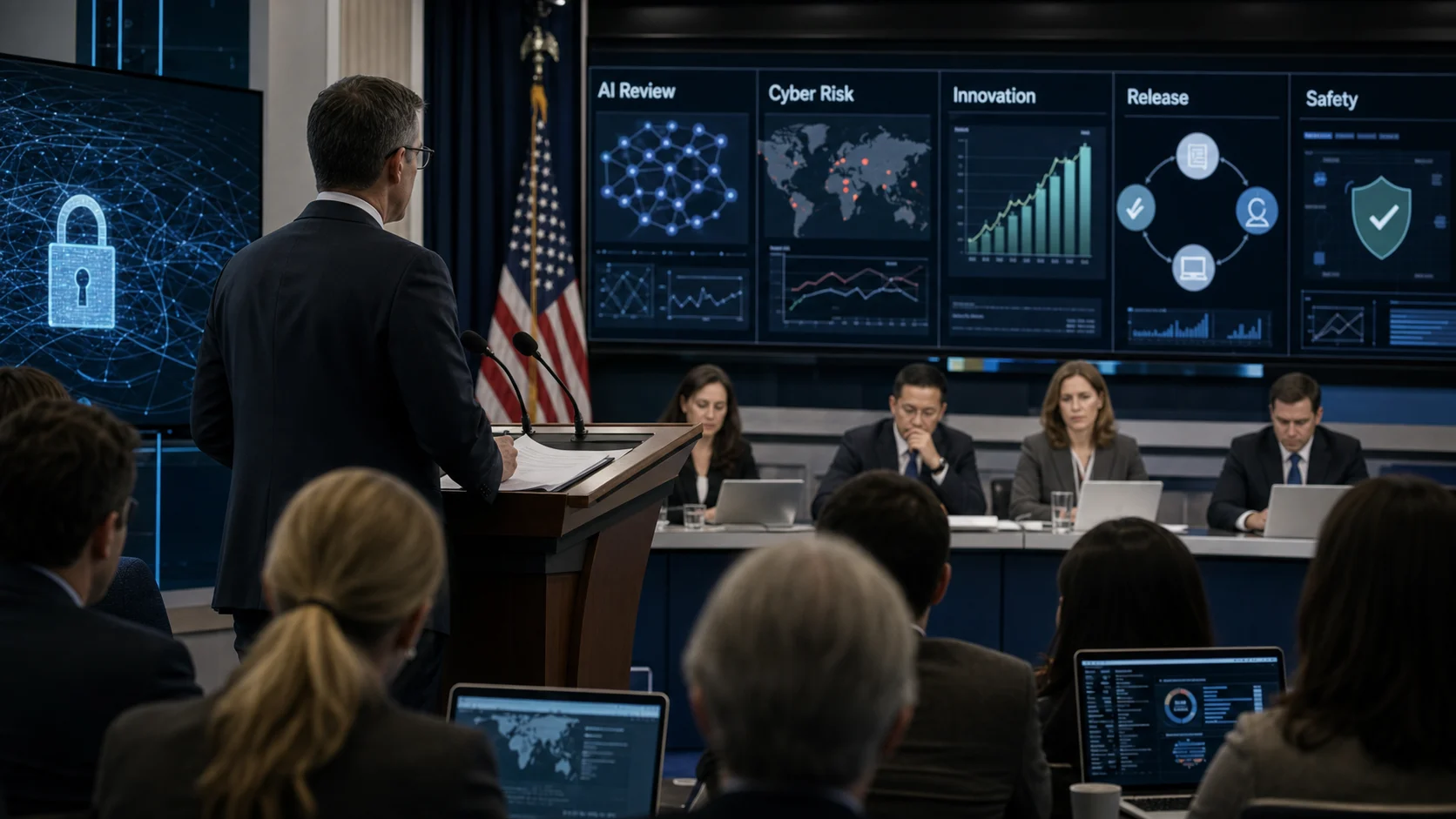
The expected executive order was pulled back before a planned White House ceremony on May 21, 2026. AP reported that President Donald Trump told reporters he did not want to do anything that would interfere with U.S. leadership in AI, while a person familiar with the deliberations said the proposed framework would have let the government vet national security risks of advanced AI systems before public release.
The order was reportedly being described as a voluntary collaboration with U.S.-based AI companies, including Anthropic, OpenAI and Google. That distinction is important. Because the final order was not signed, the precise legal obligations are not public and may still change.
The core idea, however, is clear: federal officials and parts of the financial sector have grown concerned that frontier AI models could help discover cybersecurity vulnerabilities, automate parts of exploitation and compress the time attackers need to turn weaknesses into real campaigns.
Why the order was delayed
The immediate reason was concern that government review could slow American AI development. AP reported Trump said the U.S. was leading China and others in AI and that he did not want to get in the way of that lead.
That concern fits the administration's broader AI posture. In January 2025, the White House issued an executive order titled "Removing Barriers to American Leadership in Artificial Intelligence," revoking earlier Biden-era AI directives and emphasizing U.S. AI dominance, private-sector speed and reduced regulatory friction.
The delayed order would have looked different. Even if framed as voluntary cooperation, a White House-backed review process for powerful commercial AI models would have signaled a more direct federal role in pre-release AI safety and cybersecurity review.
What the draft was reportedly trying to do
Because the final text was not published, the safest way to describe the draft is as a reported pre-release review framework, not as current law.
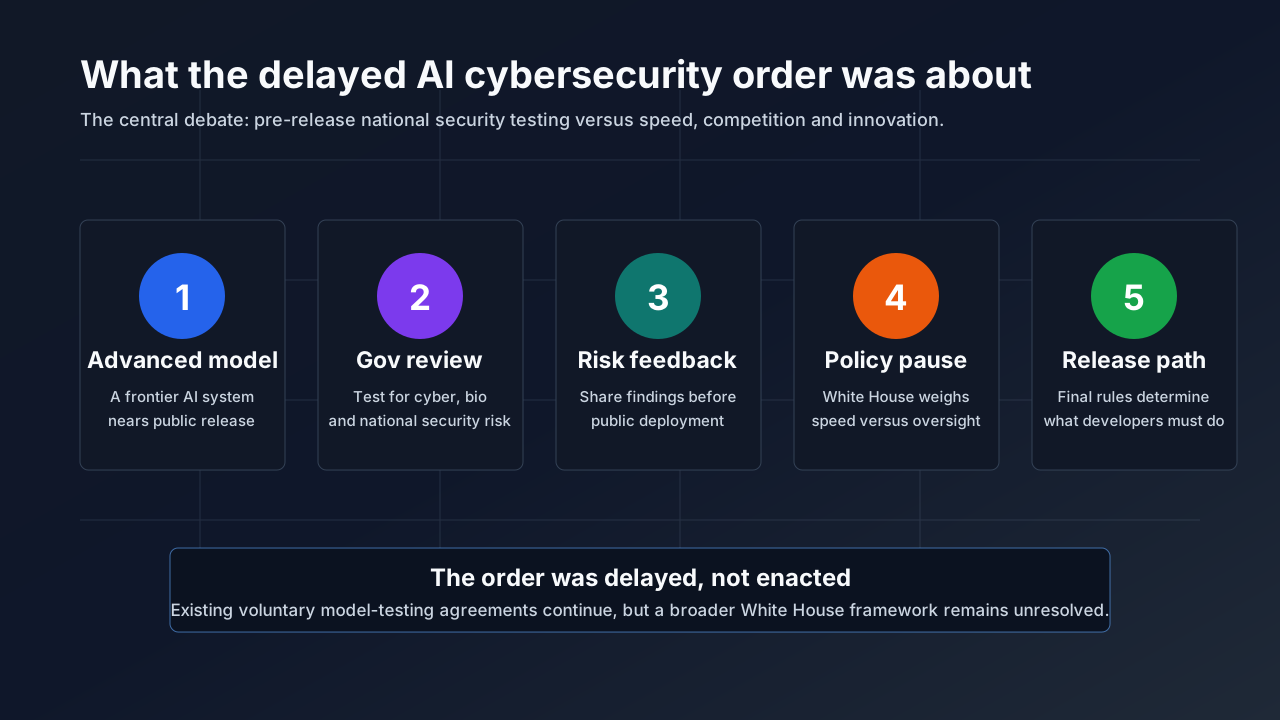
Based on public reporting and existing government programs, the draft appears to have been aimed at:
| Policy area | What it likely targeted |
|---|---|
| Frontier model access | Giving federal evaluators early access to certain high-capability models |
| Cybersecurity risk | Testing whether models can find, chain or operationalize software vulnerabilities |
| National security | Reviewing risks related to biosecurity, chemical weapons, cyber operations and foreign competition |
| Industry cooperation | Building a process with major U.S. AI developers |
| Release decisions | Feeding risk findings back before public deployment |
This is not the same as banning models or giving the government ownership of AI systems. The reported goal was review and risk assessment. The unresolved question is whether such review would be voluntary, mandatory, time-limited, confidential and technically useful.
How this connects to CAISI and NIST
The U.S. government already has a model-evaluation channel through the Center for AI Standards and Innovation, or CAISI, at the National Institute of Standards and Technology.
NIST describes CAISI as the federal government's primary point of contact for testing and collaborative research related to commercial AI systems. CAISI says it can establish voluntary agreements with private AI developers and lead unclassified evaluations of AI capabilities that may pose national security risks, including cybersecurity, biosecurity and chemical weapons concerns.
That means the delayed order was not coming out of nowhere. The government had already moved toward pre-release model evaluations through voluntary agreements. In 2024, NIST announced agreements with Anthropic and OpenAI for access to major new models before and after public release. In May 2026, reporting from The Guardian and other outlets said CAISI had struck similar pre-release review deals with Google DeepMind, Microsoft and xAI.
The delayed order would likely have formalized, expanded or politically elevated this process. Instead, for now, the voluntary framework remains the more visible path.
Why cybersecurity is central to the debate
The AI cybersecurity concern is not abstract. Recent model evaluations and security research have suggested that the most capable AI systems can assist with vulnerability discovery, exploit reasoning, malware analysis, phishing, social engineering and automated code review.
That does not mean a model can automatically hack any system. But it can lower the cost of tasks that used to require more specialized expertise. A model that helps defenders find serious vulnerabilities can also help attackers if comparable capabilities become widely available without safeguards.
The White House debate is therefore about timing:
- Before release: government evaluators get access early, test risky capabilities and give feedback before the model is widely available.
- After release: companies ship faster, but government and industry defenders may discover dangerous capabilities only after the public can use them.
Neither path is simple. Pre-release review can delay launch and create confidentiality, security and trade-secret issues. Post-release discovery can leave defenders reacting after a risky capability is already broadly distributed.
What critics worry about
Critics of pre-release government review worry that it could become slow, politicized or technically shallow. If the process takes too long, U.S. firms may delay launches while foreign rivals move faster. If the process is unclear, companies may face uncertainty about what counts as a model requiring review.
There are also security concerns. Sharing unreleased frontier models with the government requires strict controls over model weights, access logs, evaluation environments, classified findings, contractor access and incident response. A weak evaluation pipeline could itself become a target.
Another concern is regulatory creep. A voluntary review program can become a de facto permission structure if customers, insurers, investors or agencies begin treating review as required even without a formal mandate.
What supporters argue
Supporters argue that some AI capabilities are too consequential to evaluate only after public release. If a model can substantially accelerate vulnerability discovery, autonomous cyber operations or other national security risks, they say the government needs a way to understand those capabilities before broad deployment.
They also argue that pre-release review can support innovation rather than slow it if it is fast, confidential and technically rigorous. A trusted review process could help companies prove that serious risks were tested, give customers more confidence and reduce the chance of a damaging post-release crisis.
In that view, the challenge is not whether to test frontier models. It is how to test them without creating a slow approval bureaucracy.
What this means for AI companies
For major AI developers, the delay means uncertainty continues. Companies should assume that model evaluations, government partnerships and national-security testing will remain part of the operating environment, even if a formal order is postponed.
Practical steps for AI labs:
- Maintain internal evaluations for cyber, biosecurity, chemical, autonomy and misuse risks.
- Keep a clear escalation path for dangerous capabilities found during training or red teaming.
- Prepare secure access environments for trusted external evaluators.
- Document what safety mitigations changed before release.
- Plan how to share sensitive findings without exposing model details or exploit methods.
- Track how foreign AI competition affects release timing, but do not treat speed as the only risk.
The strongest companies will be able to show both speed and control.
What this means for businesses using AI
Businesses should not wait for Washington to settle every rule. If your organization is deploying AI into software development, security operations, customer support, finance, legal or infrastructure workflows, you need your own AI risk review.
Ask vendors:
- Was the model evaluated for cybersecurity misuse?
- What safeguards limit dangerous cyber assistance?
- Can enterprise admins log, restrict and monitor high-risk use?
- Is customer data used to train future models?
- What happens if the vendor changes the model after procurement?
- Are there incident notification commitments for model abuse or safety regressions?
For sensitive uses, require human review before AI output changes production code, modifies cloud infrastructure, disables security controls, sends external messages or touches regulated data.
What everyday users should know
The delay does not mean your phone, email or AI chatbot settings changed overnight. It does mean AI tools will keep improving quickly while policy catches up.
Users should expect more convincing scams, fake support messages, AI-written phishing, deepfake-style impersonation and automated vulnerability hunting against poorly maintained services. The safest habits remain basic but important:
- Update your devices, browser and apps.
- Use passkeys or multi-factor authentication on important accounts.
- Verify urgent requests through a separate trusted channel.
- Do not share one-time codes with anyone.
- Be cautious with AI-generated instructions that ask you to run commands, install software or reveal secrets.
What happens next
The White House could revise the draft, narrow the review framework, keep relying on voluntary CAISI agreements, or return with a different executive order. Congress could also step in, though federal AI legislation has moved more slowly than model capability gains.
The most likely near-term path is continued voluntary testing with major AI developers, plus political debate over whether that is enough. If frontier AI models keep demonstrating stronger cybersecurity capabilities, pressure for a more formal pre-release review process will likely increase.
For now, the important point is simple: no final order has been signed, but the policy fight is not over.
FAQ
Did the White House sign the AI cybersecurity executive order?
No. The planned order was delayed before signing, and no final executive order text had been published as of May 31, 2026.
Would the draft have forced every AI company to share models with the government?
That is not confirmed. AP reported the proposal was being characterized as voluntary collaboration with U.S.-based companies. Because the final text was not released, exact obligations are unknown.
Why is China part of the debate?
The administration has emphasized maintaining U.S. AI leadership. Critics of strict pre-release review argue that delays could help foreign competitors, including China, move faster.
Why does cybersecurity matter for AI model review?
Advanced models may help find software flaws, reason about exploits, automate security research or support social engineering. Those same capabilities can help defenders or attackers depending on access and safeguards.
Does this affect consumers right now?
Not directly. The delay affects federal AI policy and frontier model governance. Consumers should still focus on software updates, account security, scam awareness and careful use of AI tools.
Bottom line
The delayed order shows that U.S. AI policy is being pulled in two directions at once. National security officials and cybersecurity experts want earlier visibility into the most powerful models. Innovation-focused officials and companies worry that government review could slow U.S. leadership.
The final answer will likely be some version of fast, confidential, technically serious pre-release testing. The open question is whether it remains voluntary or becomes a formal federal requirement.
Sources
- Associated Press on the delayed AI order: apnews.com
- White House executive order on American AI leadership, January 23, 2025: whitehouse.gov
- White House fact sheet on AI leadership, January 23, 2025: whitehouse.gov
- NIST Center for AI Standards and Innovation: nist.gov/caisi
- NIST agreements with Anthropic and OpenAI: nist.gov
- The Guardian on CAISI agreements with Google DeepMind, Microsoft and xAI: theguardian.com
- CISA Secure by Design: cisa.gov/securebydesign
Before you move on
Defensive security explainers. Use this short checklist to turn the article into action.
- Change reused passwords on important accounts.
- Enable multi-factor authentication or passkeys where available.
- Keep a separate backup for files you cannot afford to lose.
This guide is written for practical user safety. For account, platform, or legal decisions, confirm critical steps with the official help center or your service provider.