

Last checked: November 23, 2026. This report is based on The Wall Street Journal report "Asian Regulators Step Up Efforts to Calm AI-Driven Market Turmoil", official policy statements from financial authorities in South Korea, Taiwan, and China, and financial cybersecurity advisories.
Financial regulators and exchange operators across East Asia have deployed a coordinated wave of emergency market defenses—ranging from dormant crisis stabilization funds and conditional short-selling bans to margin-financing cuts—after a sharp global pullback in artificial intelligence and semiconductor stocks rattled regional benchmarks.
As reported by The Wall Street Journal in "Asian Regulators Step Up Efforts to Calm AI-Driven Market Turmoil", authorities in South Korea, Taiwan, and China moved quickly in late November 2026 to stem cascading equity selloffs that spilled over from Wall Street into Asia's chip-heavy indexes, including South Korea's Kospi and Taiwan's Taiex.
Because East Asia houses the physical backbone of the global AI buildout—advanced wafer foundries, high-bandwidth memory (HBM) plants, chiplet packaging lines, and server rack assemblers—investor anxiety over debt-fueled AI data-center spending, circular financing structures, and chipmaker governance hit regional exchanges with outsized force. At the same time, financial security teams warn that sudden market turbulence and emergency regulatory headlines have triggered a parallel surge in AI-driven brokerage phishing, fake margin-call alerts, and deepfake "stabilization fund" investment scams targeting retail traders.
Quick Summary: How Asian Authorities Intervened
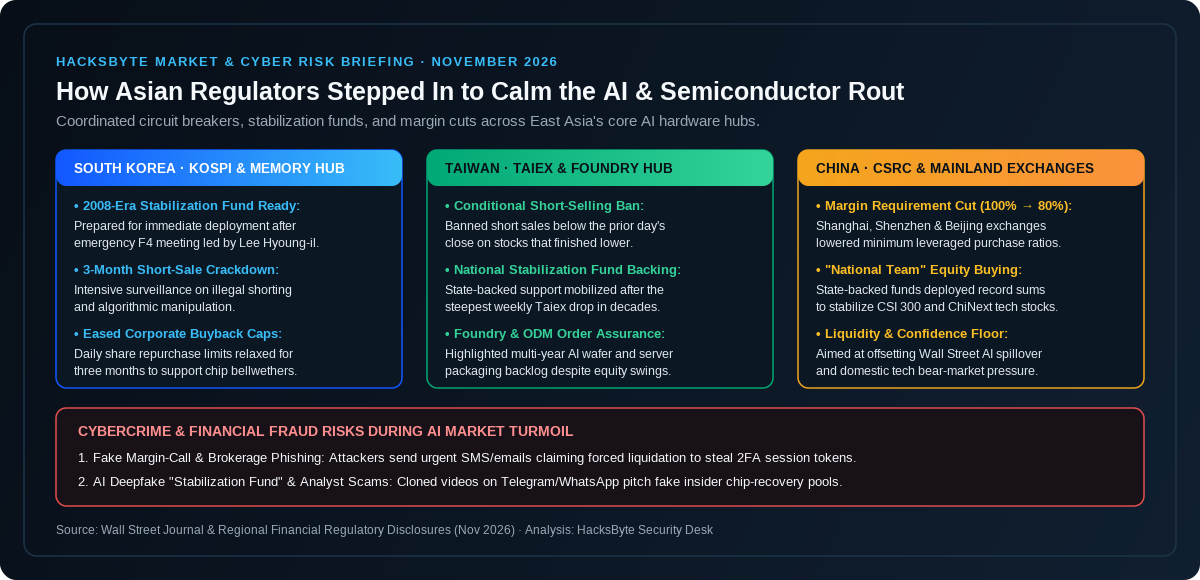
- South Korea Prepares 2008-Era Stabilization Fund: Following an emergency macroeconomic "F4 meeting" chaired by Finance Minister Lee Hyoung-il with the Bank of Korea and financial regulators, Seoul readied its Securities Market Stabilization Fund—unused since the 2008 global financial crisis—for immediate deployment, eased daily corporate share-buyback limits for three months, and launched a three-month crackdown on illegal short selling and market manipulation.
- Taiwan Enacts Conditional Short-Sale Circuit Breakers: After the Taiex suffered its steepest weekly decline in decades, Taiwan's regulators banned short selling below the previous day's closing price on stocks that finished the prior session lower, backed by the National Financial Stabilization Fund.
- China Cuts Margin Requirements from 100% to 80%: With approval from the China Securities Regulatory Commission (CSRC), the Shanghai, Shenzhen, and Beijing stock exchanges lowered minimum margin ratios for leveraged stock purchases from 100% to 80% while state-backed "national team" funds stepped in with large-scale equity buying.
- Fundamentals vs. Financial Panic: Regional finance ministries emphasized that multi-year physical supply orders for HBM memory and AI server silicon remain intact despite equity volatility—while warning market participants against panic selling and fraudulent recovery schemes.
Confirmed Regulatory Actions vs. Unresolved Market Risks
To understand what the November 2026 interventions actually change for technology companies and investors, compare the confirmed regulatory mechanisms against the broader macro uncertainties that remain unresolved:
| Jurisdiction / Benchmark | Confirmed Regulatory Action (November 2026) | Policy Mechanism | What Remains Unresolved |
|---|---|---|---|
South Korea (Kospi) | Emergency F4 meeting led by Finance Minister Lee Hyoung-il; 2008-era market-stabilization fund prepared for immediate activation. | Eased daily corporate buyback caps for 3 months; 3-month crackdown on illegal shorting and manipulation. | Whether foreign institutional outflows slow if Wall Street AI valuation debates continue. |
Taiwan (Taiex) | Conditional downtick short-selling ban on stocks that closed lower in the prior session; stabilization fund backing. | Circuit-breaker friction designed to halt algorithmic momentum shorting on foundry and ODM bellwethers. | Exposure to U.S. hyperscaler capex pacing and geopolitical semiconductor tariff uncertainty. |
China (CSI 300 / ChiNext) | CSRC and Shanghai, Shenzhen, and Beijing exchanges cut minimum margin requirements from 100% to 80%. | Expands retail and institutional buying power alongside direct state-backed "national team" equity purchases. | Whether leveraged margin buying creates secondary volatility if domestic tech earnings lag. |
Inside the Three-Pronged Asian Regulatory Playbook
Unlike Western markets, where exchanges typically rely on automatic index-wide circuit breakers during extreme intraday drops, East Asian financial authorities intervened directly in market microstructure to break the feedback loop between falling U.S. AI stock futures and forced regional liquidations.
1. South Korea: Mobilizing the 2008 Stabilization Playbook
South Korea's Kospi is heavily weighted toward memory semiconductor giants SK Hynix and Samsung Electronics—the primary global suppliers of HBM3e and HBM4 memory stacked inside frontier AI accelerators. When U.S. AI hardware stocks tumbled, foreign funds rapidly de-risked Korean chip holdings.
In response, Finance Minister Lee Hyoung-il convened the emergency "F4" macroeconomic and financial coordination forum alongside the Bank of Korea governor and top securities regulators. Seoul announced three immediate pillars:
- Readiness of the Securities Market Stabilization Fund: Jointly capitalized by major financial institutions and securities firms, the fund—last activated during the 2008 global financial crisis—was placed on standby for immediate liquidity injection if market disorder deepens.
- Three-Month Easing of Corporate Buyback Rules: Listed companies were granted expanded daily flexibility to repurchase their own shares on the open market for three months, allowing cash-rich technology exporters to put an immediate floor under their stock prices.
- Three-Month Enforcement Blitz Against Illegal Shorting: Regulators launched a targeted three-month surveillance sweep against naked short selling, spoofing, and algorithmic manipulation, while Lee Hyoung-il publicly noted that long-term HBM and enterprise server contract backlogs remain structurally sound.
2. Taiwan: Braking Downward Momentum on the Taiex
Taiwan sits at the center of the physical AI supply chain, home to foundry leader TSMC and the major original design manufacturers (ODMs) building liquid-cooled AI server racks—including the ecosystem supporting Nvidia's CUDA and Vera Rubin NVL72 data center dominance.
After the Taiex recorded its sharpest weekly drop in decades, Taiwan's Financial Supervisory Commission deployed a targeted momentum brake: any stock that closes lower on a given trading day cannot be sold short below that closing price during the following session. Combined with readiness from Taiwan's National Financial Stabilization Fund, the rule prevents high-frequency bears from hammering chip and server component stocks down through successive intraday support levels.
3. China: Lowering Margin Barriers to 80% and "National Team" Buying
While Seoul and Taipei focused on restricting downward selling pressure, Beijing moved to amplify upward buying capacity. With approval from the China Securities Regulatory Commission (CSRC), the Shanghai, Shenzhen, and Beijing stock exchanges reduced the minimum margin financing requirement from 100% to 80%, effectively permitting higher leverage on approved equity purchases. Simultaneously, state-backed institutional buyers—widely known as the "national team"—stepped into exchange-traded funds and large-cap tech weights to stabilize the CSI 300 and ChiNext indexes.
Why the AI Capex Debate Hit Asian Hardware Markets Harder
Why did a valuation and governance shakeup on Wall Street trigger emergency stabilization meetings across Asia? The answer lies in the asymmetry between AI software narratives and physical semiconductor capital expenditure:
- Debt-Fueled Infrastructure & Circular Financing Questions: Throughout 2026, hyperscalers and AI investors announced unprecedented capital raises—including Alphabet's planned $80B stock sale for AI infrastructure, Abu Dhabi's $49B MGX AI infrastructure fund, and SoftBank's €75B France AI data center blueprint. When Wall Street traders began questioning how quickly enterprise AI software revenue would pay back hundreds of billions in debt-backed data-center leases and circular vendor investments, momentum funds rotated out of hardware suppliers first.
- High Benchmark Concentration: As our guide to the AI semiconductor ecosystem and data center supply chain explains, a single AI server rack depends on dozens of specialized Asian suppliers—from silicon wafers and HBM memory stacks to CoWoS substrates, optical transceivers, and liquid-cooling manifolds. Because those manufacturers make up a far larger percentage of the Taiex and Kospi than hardware makes up of the S&P 500, any shift in U.S. AI chip sentiment—such as the implied swings tracked in our Nvidia earnings and options volatility analysis—produces magnified index moves in Taipei and Seoul.
The Cybercrime and Financial Fraud Surge Behind AI Market Turmoil
For HacksByte readers, financial market turmoil is never purely an economic event—it is also a prime window for financial cybercrime, account takeovers, and AI-enabled investment fraud.
Security operations teams and financial compliance units—including banks adopting agentic AI for AML compliance and two-tier frontier AI governance in banking—highlight three active threat patterns that spike whenever emergency market regulations make headlines:
1. Fake "Emergency Margin Call" and Brokerage Phishing (Vishing & Smishing)
When exchanges change margin requirements (such as China's 100%-to-80% margin adjustment) or stocks drop sharply, scammers blast urgent SMS messages (smishing) and automated voice calls (vishing) impersonating retail brokerages and regional banks. The message warns that the victim's trading account faces "immediate forced liquidation within 30 minutes due to new regulatory margin rules" and directs them to a lookalike login page designed to steal credentials and real-time 2FA session tokens. Review our vishing vs. smishing defense guide to recognize these pressure tactics.
2. AI Deepfake "Stabilization Fund" and Chip Recovery Scams
Cybercriminals rapidly spin up cloned voice and video advertisements on social platforms, WhatsApp, and Telegram impersonating well-known financial journalists, fund managers, or Asian ministry officials. Using the techniques detailed in our AI voice-cloning scam protection report, fraudsters invite retail investors into private "National Stabilization Fund VIP allocation groups" or discounted OTC semiconductor recovery pools—classic advance-fee and pig-butchering traps.
3. Synthetic News Injection Targeting Algorithmic Trading Bots
Modern quantitative desks and retail trading bots scrape social feeds, press releases, and financial forums using large language models to trade headlines in milliseconds. Threat actors and manipulative short-sellers increasingly attempt indirect prompt injection and synthetic rumor flooding—planting fabricated regulatory filings or fake chip-order cancellation screenshots to trigger automated sell cascades before human editors can debunk the claim.
What Investors, Financial Firms, and Tech Buyers Should Do Next
Whether you manage enterprise IT procurement or personal technology investments, follow a disciplined verification checklist during periods of AI market volatility:
- Never Act on Urgent Margin or Brokerage Links in SMS/Email: If you receive a text, email, or call claiming your brokerage account faces forced margin liquidation or regulatory restriction, close the message and open your brokerage app directly or call the official number on your statement.
- Remember That Real Stabilization Funds Never Solicit Retail Deposits: Government and institutional stabilization funds in South Korea, Taiwan, and China operate through regulated exchange clearinghouses and institutional liquidity facilities. They never recruit individual investors via WhatsApp, Telegram, or social media ads.
- Harden Financial Accounts With Phishing-Resistant MFA: Protect brokerage, banking, and primary email accounts with hardware security keys or passkeys instead of SMS one-time codes, and follow our Google Account security checklist so an attacker cannot intercept password resets during market hours.
- Separate Equity Volatility From Enterprise Hardware Procurement: For CIOs and engineering leaders, short-term swings in Asian semiconductor stock prices do not mean data-center GPU or HBM supply has suddenly become abundant. Maintain multi-quarter capacity planning and follow structured evaluation rules like OpenAI's five steps for managing AI investments.
Related HacksByte Coverage
To explore connected AI semiconductor developments, financial governance, and scam defense checklists on HacksByte, review these related reports and guides:
- Why Nvidia’s Grip on AI Infrastructure Is So Hard to Break: News report — An examination of why Nvidia's CUDA software moat, Vera Rubin NVL72 rack systems and $107.6B data center scale keep enterprises locked in—and the cyber risks.
- Nvidia Q1 FY2027 Earnings Preview: AI Demand and Risks: News report — Nvidia's Q1 FY2027 earnings preview examining hyperscaler AI capex, data-center revenue momentum, and market concentration risks.
- AI Data Centers: Chips, Memory, Networking and Power: Practical guide — Understand the AI semiconductor ecosystem: GPUs, custom ASICs, HBM memory, advanced packaging, networking and data-center power constraints.
- Alphabet Plans $80B Stock Sale to Fund Its AI Infrastructure Push: News report — Alphabet plans an $80B stock sale as AI data-center capital expenditure intensifies across hyperscale cloud providers.
- Two-Tier AI Governance: Why Banks Restrict Frontier Models: News report — How financial institutions separate broad internal AI assistants from tightly gated frontier models to manage market, compliance and security risk.
Frequently Asked Questions
What emergency steps did South Korea take to calm AI-driven market turmoil?
Following an emergency F4 financial meeting chaired by Finance Minister Lee Hyoung-il, South Korea prepared its 2008-era Securities Market Stabilization Fund for immediate activation, relaxed daily corporate share-buyback limits for three months, and launched a three-month crackdown on illegal short selling and market manipulation on the Kospi.
How did Taiwan and China respond to the November 2026 AI and tech stock rout?
Taiwan banned short selling below the previous day's closing price on stocks that finished the prior session lower and mobilized backing from its National Financial Stabilization Fund after a historic weekly drop on the Taiex. China's CSRC and mainland exchanges cut the minimum margin requirement for leveraged stock purchases from 100% to 80% while state-backed funds purchased equities.
Why are East Asian stock markets so sensitive to U.S. AI sentiment?
South Korea and Taiwan have some of the world's highest equity index concentrations in physical AI hardware suppliers—including wafer foundries (TSMC), high-bandwidth memory makers (SK Hynix and Samsung), advanced packaging providers, and server rack assemblers. When Wall Street debates AI capital expenditure or chipmaker valuations, those supply-chain stocks experience amplified swings.
How can retail investors avoid cyber scams during stock market turmoil?
Never click links in urgent "margin call" or "account restriction" texts and emails; log into your brokerage account directly through its official app, enable passkeys or authenticator-based MFA, and ignore WhatsApp, Telegram, or deepfake video ads claiming to offer retail access to government market-stabilization funds.
Sources and Official References
- The Wall Street Journal: Asian Regulators Step Up Efforts to Calm AI-Driven Market Turmoil
- Financial Services Commission (FSC) of South Korea — Market Stability & Short-Selling Announcements
- Financial Supervisory Commission (FSC) of Taiwan — Securities Market Announcements
- China Securities Regulatory Commission (CSRC) Official Portal
- IOSCO Investor Alerts Portal — Avoiding Investment and Impersonation Fraud
This reporting reflects the publication and update dates above. Check the linked sources for subsequent developments. How we source coverage · Request a correction.