

Last checked: November 23, 2026. This report analyzes senior contributor Janakiram MSV's November 22, 2026 Forbes analysis "Why Nvidia's Grip On AI Is So Hard To Break", alongside official disclosures from Nvidia, AMD, hyperscale cloud providers, and enterprise AI infrastructure security advisories.
Every major cloud provider, rival chipmaker, and frontier artificial intelligence laboratory has spent the past three years trying to reduce dependence on Nvidia. Yet as 2026 closes, breaking Nvidia's hold over enterprise and hyperscale AI infrastructure remains far harder than designing a faster or cheaper silicon die.
As technology analyst Janakiram MSV detailed in a November 22, 2026 Forbes analysis titled "Why Nvidia's Grip On AI Is So Hard To Break", Nvidia's true competitive barrier is no longer an individual graphics processing unit (GPU). Instead, it is the compounding lock-in of a nearly two-decade CUDA software ecosystem, a transition to rack-scale co-design with the Vera Rubin NVL72 platform and NVLink 6, and a $107.6 billion data center revenue engine (up roughly 110% year-over-year) that funds a relentless 12-month architecture refresh cadence.
For enterprise chief information officers (CIOs) and chief information security officers (CISOs), that dominance carries a dual reality. Standardizing on Nvidia accelerates AI deployment across Microsoft Azure, Google Cloud, and Oracle Cloud Infrastructure, but relying on a single hardware-software monoculture also concentrates supply-chain exposure, cloud GPU hijacking ("LLM-jacking"), and runtime vulnerability blast radius across the global AI stack.
Quick Summary: The Four Pillars of Nvidia's AI Lock-In
- The CUDA Software & Kernel Wall: Moving off Nvidia hardware requires far more than recompiling Python code. Engineering teams must replace low-level CUDA kernels, retune multi-node collective communications (
NCCL), revalidate numerical precision across training checkpoints, and rebuild observability pipelines. - Rack-Scale Co-Design (Blackwell to Vera Rubin NVL72): Nvidia shifted the unit of competition from a discrete accelerator card to an entire liquid-cooled data center rack—combining custom Vera CPUs, Rubin GPUs, NVLink 6 interconnects, and Spectrum-X networking to optimize tokens per watt.
- Unmatched R&D Capital Velocity: Generating $107.6 billion in data center revenue allows Nvidia to compress its hardware and software release cycle to an annual rhythm, forcing challengers like AMD's Helios rack architecture and custom hyperscaler ASICs to chase a moving target.
- Cybercrime & Monoculture Concentration Risk: When more than 80% of production AI clusters share the same driver, container toolkit, and inference microservice stack, a single container escape CVE or stolen cluster credential becomes a high-leverage target for organized cybercrime.
What Is Established vs. Where Challengers Are Gaining Ground
To evaluate whether enterprise AI buyers can realistically diversify their compute footprint over the next 12 to 24 months, it helps to separate Nvidia's entrenched advantages from the workloads where rival silicon is already winning:
| Infrastructure Layer | Where Nvidia Holds Entrenched Dominance | Where Rivals (AMD, Google, AWS) Are Gaining Traction |
|---|---|---|
| Developer & Kernel Stack | CUDA, cuDNN, NCCL, TensorRT-LLM, and NIM microservices remain the default target for open-source research and enterprise ML ops. | Compiler abstractions such as PyTorch 2 (torch.compile), OpenAI Triton, vLLM, and OpenXLA reduce direct CUDA code in standard transformer inference. |
| System & Rack Architecture | Blackwell and next-generation Vera Rubin NVL72 racks using NVLink 6 provide tightly coupled memory domains across 72 GPUs across Azure, GCP, and OCI. | AMD's Helios rack-scale architecture and Google Cloud's TPU pods offer competitive rack-level bandwidth for large-scale training and inference. |
| Economics & Scale | $107.6 billion data center revenue scale (up ~110% YoY) funds full-stack co-design across chips, switches, DPU security, and enterprise software. | AWS Trainium3 (exceeding a $20B annual run rate) and Google TPUs offer lower price-per-token for high-volume internal and partner workloads. |
| Customer Diversification | Most Fortune 500 enterprises and sovereign AI clouds standardize on Nvidia to avoid hiring scarce non-CUDA systems engineers. | Frontier labs such as Anthropic and OpenAI deliberately split workloads across Nvidia, Google TPUs, and AWS Trainium to hedge supply and pricing risk. |
1. The CUDA Software Moat and the Hidden Penalty of Switching
A persistent misconception in semiconductor coverage is that an AI chip competitor only needs to beat Nvidia on peak floating-point operations per second (FLOPs) or high-bandwidth memory (HBM) capacity. In practice, raw silicon specifications determine theoretical ceiling, while software determines delivered utilization.
Introduced nearly two decades ago, Nvidia's CUDA platform has evolved from a parallel programming API into an expansive stack of domain-specific libraries, communication primitives, and deployment runtimes. When a quantitative trading firm, healthcare researcher, or SaaS provider builds an AI pipeline on Nvidia hardware, their dependency spans four distinct software layers:
- Operator Kernels (
cuBLAS,cuDNN, FlashAttention optimizations): Hand-tuned low-level routines that squeeze maximum occupancy out of Tensor Cores. - Multi-GPU & Multi-Node Collectives (
NCCL): Distributed training and large-model tensor parallelism depend on deterministic all-reduce and all-to-all communication patterns tuned specifically for NVLink and InfiniBand topologies. - Inference Optimization (
TensorRT-LLM& NIM): Quantization formats (such as FP8 and FP4) and speculative decoding pipelines that directly govern latency and cost per million tokens. - Operational Tooling (
DCGM, Profiling & Container Toolkits): Kubernetes device plugins, telemetry exporters, and hardware health monitors wired into enterprise SRE dashboards.
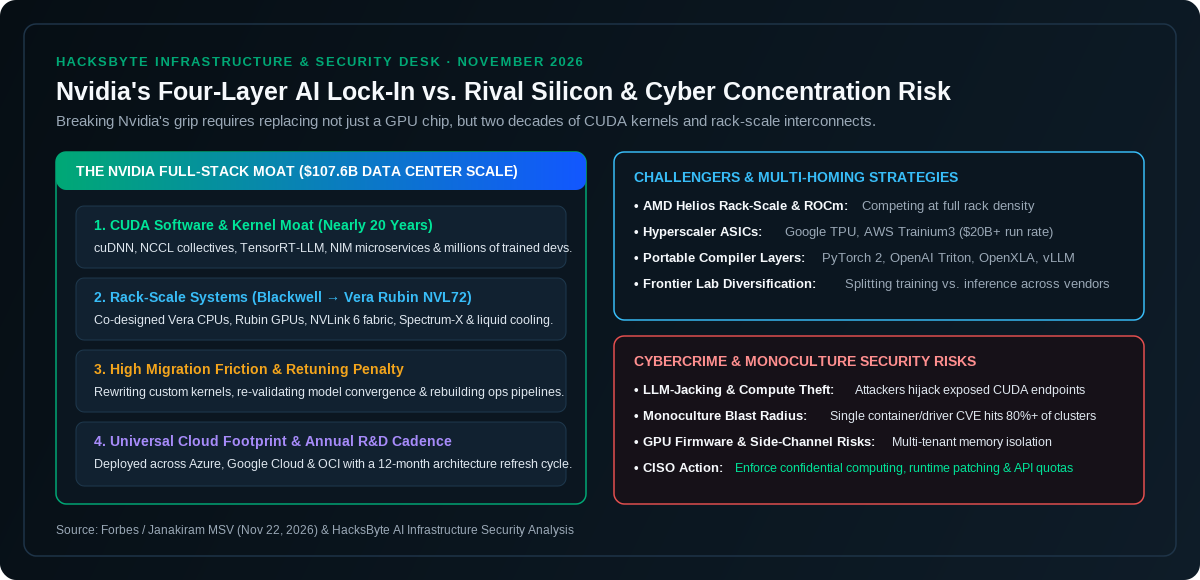
As the Forbes analysis emphasizes, migrating a production workload to an alternative accelerator is not a flip-of-a-switch recompile. Even when high-level frameworks like PyTorch abstract the model definition, switching hardware forces engineering teams to replace custom CUDA extensions, debug subtle floating-point divergence that can degrade model accuracy, retune cluster networking, and retrain staff. For time-pressed enterprises, the engineering payroll and delayed time-to-market of a hardware migration frequently outweigh a 20% to 30% discount on rival silicon.
2. From Discrete GPUs to the Vera Rubin NVL72 Rack-Scale Computer
The second pillar of Nvidia's lock-in is architectural: the data center itself has become the chip.
When models fitted inside a single 8-GPU server node, cloud buyers could swap accelerator cards with manageable friction. Modern frontier reasoning models, mixture-of-experts (MoE) architectures, and long-context agentic systems require dozens of GPUs to act as a single coherent memory and compute domain.
Nvidia capitalized on this shift by moving from component sales to rack-scale co-design:
- Vera Rubin Platform & Rubin NVL72: Building on the liquid-cooled Blackwell NVL72 blueprint, Nvidia's next-generation Vera Rubin platform integrates custom Vera ARM CPUs and Rubin GPUs inside the Rubin NVL72 rack architecture, linked via NVLink 6 high-speed interconnects and deployed across Microsoft Azure, Google Cloud, and Oracle Cloud Infrastructure.
- Networking as a Moat (NVLink 6, Quantum InfiniBand & Spectrum-X): By owning both the intra-rack fabric (
NVLink 6) and the inter-rack fabric (Quantum InfiniBandandSpectrum-XEthernet), Nvidia eliminates the communication bottlenecks that plague stitched-together multi-vendor clusters. - Tokens per Watt in Power-Constrained Data Centers: As detailed in our guide to the AI semiconductor ecosystem and data center power constraints, modern data centers are capped by megawatts rather than floor space. Co-designing CPU, GPU, switch silicon, and liquid cooling lets Nvidia deliver higher token throughput per megawatt—the metric that ultimately drives hyperscaler capital allocation in massive buildouts like Alphabet's $80B AI infrastructure push and SoftBank's €75B France AI data center plan.
With data center revenue reaching $107.6 billion (a 110% year-over-year surge that builds on the trajectory tracked in our earlier Nvidia FY2027 earnings and AI demand analysis), Nvidia can reinvest tens of billions of dollars annually to maintain a one-year cadence across silicon, networking, and systems software.
3. The Cybercrime and Security Flip Side: AI Monoculture Risk
While financial analysts view Nvidia's ecosystem grip as a durable competitive moat, cybersecurity analysts view any 80%+ infrastructure monoculture through a different lens: systemic concentration risk.

Because high-density CUDA clusters are scarce, expensive, and universally compatible with every major open-weight and proprietary AI payload, they have become prime targets for organized cybercrime and state-aligned threat actors:
1. "LLM-Jacking" and Illicit Compute Theft
Just as earlier cybercrime groups scanned the internet for exposed Docker daemons to mine cryptocurrency, automated threat groups in 2026 scan for exposed AI inference endpoints, leaked cloud IAM credentials, and vulnerable AI orchestration platforms—such as the flaws examined in our report on Flowise and Langflow AI orchestration RCE vulnerabilities. Once attackers compromise an account backed by Nvidia GPU quotas or CUDA clusters, they can burn tens of thousands of dollars in illicit LLM inference or fine-tuning compute within hours.
2. Container Runtime and GPU Driver Blast Radius
Virtually every containerized AI workload relies on the same underlying software plumbing: host GPU drivers, the nvidia-container-toolkit, Kubernetes device plugins, and pre-built CUDA base images. Historically, container escape vulnerabilities in GPU runtime hooks have allowed untrusted container workloads to break out to the host operating system. In a single-vendor monoculture, a critical CVE in the container-to-GPU bridge simultaneously exposes cloud tenants, enterprise Kubernetes clusters, and AI SaaS providers worldwide.
3. Multi-Tenant GPU Memory Isolation and Firmware Supply Chain
When multiple enterprise departments or cloud tenants share high-density NVL72-class racks via Multi-Instance GPU (MIG) partitioning or time-slicing, defending against side-channel leakage, residual VRAM data exposure, and unverified firmware modifications requires hardware-rooted Confidential Computing and strict attestation. Furthermore, export restrictions and hardware scarcity have fueled a gray market for diverted accelerator boards, forcing procurement teams to verify cryptographic hardware attestation before adding nodes to sensitive clusters.
How Rivals Are Fighting Back: AMD Helios, Google TPU, and AWS Trainium3
Nvidia's grip is formidable, but it is not unchallenged. Competitors have recognized that they cannot beat a rack-scale ecosystem with a standalone PCIe card:
- AMD's Helios Rack-Scale Architecture & ROCm Maturation: AMD has shifted from competing solely on individual Instinct accelerators to offering its Helios rack-scale architecture, pairing next-generation Instinct GPUs, EPYC CPUs, and Pensando networking with open-standard Ultra Accelerator Link (
UALink) and Ultra Ethernet Consortium (UEC) fabrics, while closing kernel coverage gaps in its ROCm software stack. - Google's Custom TPU Portfolio: Google continues to run its own frontier Gemini training and inference—including the Gemini 3.6 Flash and 3.5 Flash Cyber family—primarily on internal TPU generations, proving that a vertically integrated hyperscaler with its own compiler stack (
XLA/JAX) can operate at massive scale outside CUDA. - Amazon's Trainium3 & $20B+ Custom Silicon Business: AWS has scaled its custom Trainium and Graviton business past a $20 billion annual run rate, positioning Trainium3 and the Neuron SDK as a lower-cost alternative for large-scale partner training and inference.
- Compiler Portability Layers (
Triton&vLLM): Ironically, one of the strongest forces loosening direct CUDA lock-in is OpenAI Triton and portable serving engines like vLLM, which allow developers to write high-performance GPU kernels in Python that compile down to Nvidia CUDA, AMD ROCm, and custom ASIC backends alike.
What Enterprise CIOs, CISOs, and AI Engineers Should Do Next
Most organizations will continue running their primary AI workloads on Nvidia infrastructure in 2026 and 2027—and for many teams, that remains the most productive engineering choice. However, smart technology leaders can capture the performance of Nvidia's stack while limiting commercial lock-in and cybercrime exposure:
- Verify Hardware Provenance and Firmware Attestation: Procure AI servers exclusively through authorized OEM channels and enable cryptographic GPU firmware attestation at boot to prevent tampered or gray-market components from entering production data centers.
Related HacksByte Coverage
To explore connected AI semiconductor developments, infrastructure investments, and cybersecurity governance on HacksByte, review these related reports and guides:
- Asian Regulators Step Up Efforts to Calm AI Market Turmoil: News report — South Korea, Taiwan and China roll out stabilization funds, short-sale bans and margin cuts after an AI chip selloff—plus the cyber fraud risks for investors.
- Amazon Says Custom AI Chips Exceed a $20B Annual Run Rate: News report — Amazon says its custom silicon business exceeded a $20B annual run rate as AWS scales Trainium3 to challenge Nvidia data center GPUs.
- AI Data Centers: Chips, Memory, Networking and Power: Practical guide — Understand the AI semiconductor ecosystem: GPUs, custom ASICs, HBM memory, advanced packaging, networking and data-center power constraints.
- Nvidia Q1 FY2027 Earnings Preview: AI Demand and Risks: News report — Nvidia's Q1 FY2027 earnings preview examining hyperscaler AI capex, data-center revenue momentum, and market concentration risks.
- OpenAI Proposes Perplexity Safety Limits as AI Cyber Risks Grow: News report — OpenAI Chief Scientist Jakub Pachocki proposes industry-wide log-perplexity limits before frontier AI models cross high-risk cyber and research thresholds.
- Alphabet Plans $80B Stock Sale to Fund Its AI Infrastructure Push: News report — Alphabet plans an $80B stock sale as AI data-center capital expenditure intensifies across hyperscale cloud providers.
Frequently Asked Questions
Why is Nvidia's CUDA moat so difficult for rival AI chipmakers to overcome?
CUDA is not just a driver; it is a nearly 20-year ecosystem of optimized math libraries (cuDNN, cuBLAS), multi-node communication collectives (NCCL), inference compilers (TensorRT-LLM), and developer tooling. Moving to a competing chip requires replacing custom kernels, re-tuning cluster networking, and re-validating model accuracy, which creates high engineering switching costs.
What is Nvidia's Vera Rubin NVL72 platform?
Vera Rubin is Nvidia's next-generation rack-scale AI platform succeeding Blackwell. The Rubin NVL72 combines custom Vera CPUs and Rubin GPUs connected via NVLink 6 interconnects inside a single liquid-cooled rack system deployed across major cloud providers including Microsoft Azure, Google Cloud, and Oracle Cloud.
What are the cybersecurity risks of relying on a single AI hardware vendor?
Standardizing more than 80% of enterprise AI clusters on a single hardware and container-runtime stack creates monoculture risk: a single vulnerability in GPU container toolkits, drivers, or inference microservices affects organizations globally, while scarce CUDA clusters are prime targets for "LLM-jacking" (illicit compute and API quota theft).
How can enterprises reduce Nvidia lock-in without hurting AI performance?
Teams can write models and custom kernels using portable abstractions such as PyTorch 2 (torch.compile), OpenAI Triton, and vLLM, route application requests through hardware-agnostic model gateways, and decouple CUDA-heavy training workloads from high-volume inference workloads that can run on AMD Instinct, Google TPU, or AWS Trainium silicon.
Sources and Official References
- Forbes: Why Nvidia's Grip On AI Is So Hard To Break (Janakiram MSV, November 22, 2026)
- Nvidia Data Center and Accelerated Computing Documentation
- Nvidia CUDA Toolkit and Developer Ecosystem
- AMD ROCm Open Software Stack and Instinct Architecture
- NIST Artificial Intelligence Risk Management and Infrastructure Security
This reporting reflects the publication and update dates above. Check the linked sources for subsequent developments. How we source coverage · Request a correction.